Faithful Conversations #48
Introduction to Readers:
“The fear of the Lord is the beginning of wisdom.” (Psalm 111: 10)
How do we acquire knowledge? And further, how do we know if what we think we know is true? The readings for Epiphany 4 prompt these questions and seem especially relevant for those of us living in the information-saturated social media environment of 2024 where false information lurks around every corner. Dwell on these questions as you walk through this week’s lectionary and, as always, thanks for your ongoing desire to be challenged in your understanding and application of the scriptures!
Note: I do utilize various hyperlinks within the body here for further exploration! They are a different color and italicized. If you click out, simply click back to return to the blog. The images included, mostly, are from Wikimedia Commons, and therefore are in the public domain.
Readings for Epiphany 4 (28 January)
Deuteronomy 18: 15-20 (focus reading)
Psalm 111
1 Corinthians 8: 1-13
Mark 1: 21-28 (focus reading)
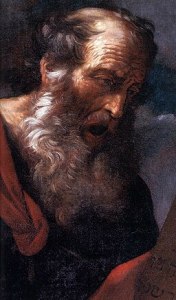
Moses by Italian Painter Guido Reni (1575-1642)
The First Reading: Deuteronomy 18: 15-20
15 “The Lord your God will raise up for you a prophet like me (Moses) from among your own people; you shall heed such a prophet. 16 This is what you requested of the Lord your God at Horeb on the day of the assembly when you said, ‘Let me not hear again the voice of the Lord my God or see this great fire anymore, lest I die.’ 17 Then the Lord replied to me, ‘They are right in what they have said. 18 I will raise up for them a prophet like you from among their own people; I will put my words in the mouth of the prophet, who shall speak to them everything that I command. 19 Anyone who does not heed the words that the prophet shall speak in my name, I myself will hold accountable. 20 But any prophet who presumes to speak in my name a word that I have not commanded the prophet to speak or who speaks in the name of other gods, that prophet shall die.’

The Face of Jesus (generated using A.I.)
The Gospel Reading: Mark 1: 21-28
21 They went to Capernaum, and when the Sabbath came, he entered the synagogue and taught. 22 They were astounded at his teaching, for he taught them as one having authority and not as the scribes. 23 Just then there was in their synagogue a man with an unclean spirit, 24 and he cried out, “What have you to do with us, Jesus of Nazareth? Have you come to destroy us? I know who you are, the Holy One of God.” 25 But Jesus rebuked him, saying, “Be quiet and come out of him!” 26 And the unclean spirit, convulsing him and crying with a loud voice, came out of him. 27 They were all amazed, and they kept on asking one another, “What is this? A new teaching—with authority! He commands even the unclean spirits, and they obey him.” 28 At once his fame began to spread throughout the surrounding region of Galilee.
This Week’s Reflection: “Beware of false prophets!”
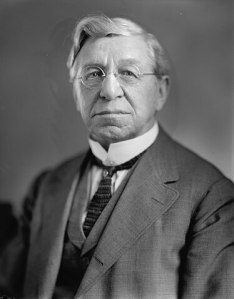
Jacob S. Coxey
(1854-1951)

Carl Browne
(1849–1914)
Carl Browne came to mind this week after reading the Deuteronomy passage. Unless you are an “in the weeds” American history buff, I suspect his name is not familiar. Here’s the backstory. The Panic of 1893 (think economic depression) scrambled our political landscape (sidebar: it was plenty rough on Black River Falls). A third-party movement known as Populism stormed across the Midwest raising the voices of desperate farmers and workers, demanding, among other things, the free and unlimited coinage of silver — something a little hard to grasp in 2024. It was in this volatile environment that cattle rancher, cartoonist, and journalist Carl Browne emerged. Part entertainer, part labor organizer, his story intersected with another quirky character, Jacob S. Coxey, best known for leading a motley crowd of desperate men, tagged “Coxey’s Army,” to march on the US Capitol in May of 1894. Beyond the silver issue, their radical demand for a mammoth public works program designed to employ thousands of hopeless workers appeared dangerous and out of bounds to the Cleveland administration. Where am I going with this, you might ask? Consider this. Browne, a sincere admirer of Coxey, was also a believer in the religion of theosophy, and, moreover, presented himself as a partial reincarnation of Jesus Christ (he also believed that Coxey was the reincarnation of Andrew Jackson!). Ultimately becoming Coxey’s right-hand man, Browne helped lead the disorganized and chaotic march. Hoping to storm the Capitol, the project fizzled in the end and both Coxey and Browne were prosecuted for trespassing.
What are we to make of this strange episode from 130 years ago? What was the attraction of Carl Browne? To be charitable, he was an eccentric, and it is impossible to fully understand his psychology or motives. Portraying himself as the reincarnation of Jesus Christ, however, was misguided and dangerous, and smacks of the false prophecy spoken of in Deuteronomy 18. Tapping into the desperation and anger of those who shared his political views while coupling it with a spiritual undercurrent was a dangerous brew, though not necessarily unique in history.

Martin Luther (1483-1546)
False prophets have been around throughout the centuries. There are dozens of references in the scriptures to false prophets. Jesus, in fact, spoke of false prophecy on more than one occasion, most notably in the Sermon on the Mount (specifically Matthew 7: 15-20). Luther, who viewed this world as one of cosmic struggle between God and the devil, interpreted Christ’s warning, emphasizing (especially) the danger of false prophets who claim to be Christian, those who “grow up among you, bear and boast of your name” and “cunningly reach after the doctrine, that they may take the treasure itself out of my heart, namely, the dear word.” In turn, he provided a road map for discerning false prophecy. Listen to Luther’s words here: “But when a Christian is attentive, and has no more than the catechism, the Ten Commandments, the Creed, the Lord’s Prayer, the Word of the Lord, Baptism and the Sacrament of the Lord’s Supper, he can well defend and maintain himself against all heresies. For the Lord Christ here commands, and gives power to all Christians, to be judges over all doctrines, and enables them to understand what is right and wrong. For thou must be as sure as thou livest, that this is the word of God; yea, even more certain, or else it is not possible to holdout. But no man can judge false teaching, but the spiritual man.” As he often does, Luther takes us back to the basics. Be attentive. Be prepared to defend. Don’t get distracted by all the noise. Stay grounded. Yes, “the fear of the Lord is the beginning of wisdom,” empowering us to navigate our lives of faith.
This week’s Gospel provides a window into the authority, wisdom, and disciplined confidence displayed by Jesus as he taught in the temple, a charismatic model for the Christian family. The reaction by those who witnessed these events is inspiring. Genuinely astounded by the young rabbi’s wisdom (verse 22), listeners were amazed when He dramatically confronted a demonic force (verses 24-25). For many, I suspect their lives were never the same.
Soli Deo Gloria
And, here’s a powerful commentary From Henri Nouwen:

Henri Nouwen (1932-1996)
God cannot be understood: he cannot be grasped by the human mind. The truth escapes our human capacities. The only way to come close to it is by a constant emphasis on the limitations of our human capacities to “have” or “hold” the truth. We can neither explain God nor his presence in history. As soon as we identify God with any specific event or situation, we play God and distort the truth. We only can be faithful in our affirmation that God has not deserted us but calls us in the middle of all the unexplainable absurdities of life. It is very important to be deeply aware of this. There is a great and subtle temptation to suggest to myself or to others where God is working or where not, when he is present and when not; but nobody, no Christian, no priest, no monk, has any “special” knowledge about God. God cannot be limited by any human concept or prediction. He is greater than our mind and heart and perfectly free to reveal himself where and when he wants.
Announcement Regarding Our Lectionary Discussions:
We WILL NOT be meeting in person after church on Sunday (1.28) due to the Annual Meeting. We will gather again on Sunday, 4 February at 10:45 in the library. Invite a friend! ALL ARE WELCOME!
And . . . .
looking over the horizon . . . “Faithful Conversations: Resilient Voices”
 We continue to “think digitally” and how we can share the Good News in our community and beyond. We have secured the various pieces of technology necessary to begin conducting interviews and developing podcasting capabilities. Thanks to Peter Bushman for his excellent guidance with technology and to Pastor Jen for her ongoing conversations regarding new and different ways to approach adult education! Starting in February, we plan to do a series of interviews with members regarding their faith journeys. Stay tuned for further announcements!

I wholeheartedly agree with Henri Nouwen in that we absolutely cannot understand God!! How can we understand His vast, unfathomable Love regarding us with such value that He bankrupted heaven!! I still scratch my head…
On another note–when the demon said with great terror in his voice “I know who you are–the Holy One of God!”, I imagine Peter or Andrew in the crowd saying the same announcement but with a totally different inflection. They’d say “I KNOW who you are–the Holy One of God!” with incredulous JOY in their voice instead of terror!
LikeLike