Faithful Conversations #53
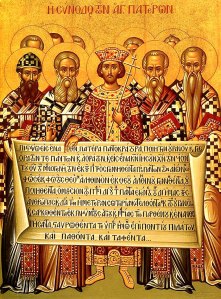
Icon depicting the First Council of Nicaea, and text of the Nicene Creed in Greek.
Introduction to Readers:
For starters, a bit of history today. Thursday (29 February) is day 13 of the 40-day Lenten journey from Ash Wednesday to Easter Sunday (not counting Sundays). The word lent comes from the Old English word lengten, which means springtime or March. Over time, lengten evolved into lent (Middle English), retaining its association with the spring season (seems entirely appropriate this year, right?). The designation of the 40 days leading to Easter as Lent, it seems, dates from the First Council of Nicaea in 325 CE. Called by the Roman Emperor Constantine I, the Council was ecumenical and sought to clear up several disputes going on within the various strands of Christianity at the time (sidenote: the Council of Nicaea also put forth the Nicene Creed, one of the three statements of faith we utilize within the ELCA).
What about this week’s readings? Try and catch the connections as you walk through them — sometimes that’s crystal clear, and other times, not so much. The four readings this week are interconnected through the theme of repentance, renewal, and God’s call for transformation. The Exodus reading recounts the receiving of the Ten Commandments, emphasizing the importance of living in accordance with God’s law. The Psalm highlights the perfection of God’s law. In the reading from 1 Corinthians, Paul discusses God’s wisdom in contrast to human folly, urging believers to pursue spiritual growth. Finally, the passage from John depicts Jesus cleansing the temple, symbolizing the need for purifying one’s heart and renewing one’s commitment to God. Together, these readings remind us of the continual call to turn away from sin, embrace God’s mercy, and strive for spiritual renewal during the Lenten season. My reflections this week will focus on the Gospel reading, with some guidance regarding the Exodus passage as well.
As always, thanks for your ongoing interest in Bible study! One note: I do provide links within the blog for further reading, if interested (italicized and a different color). If you click on the link, simply use the back arrow (upper left) to get back to the blog.
Readings for Lent 3 (Sunday 3 March)
Exodus 20: 1-17
Psalm 19
1 Corinthians 1: 18-25
John 2: 13-22

Moses Destroying the Ten Commandments by Gustave Dore, French artist, b January 6, 1832
The OT Reading: Exodus 20: 1-17:
Then God spoke all these words, 2 “I am the Lord your God, who brought you out of the land of Egypt, out of the house of slavery; 3 you shall have no other gods before me. 4 “You shall not make for yourself an idol, whether in the form of anything that is in heaven above or that is on the earth beneath or that is in the water under the earth. 5 You shall not bow down to them or serve them, for I the Lord your God am a jealous God, punishing children for the iniquity of parents to the third and the fourth generation of those who reject me 6 but showing steadfast love to the thousandth generation of those who love me and keep my commandments. 7 “You shall not make wrongful use of the name of the Lord your God, for the Lord will not acquit anyone who misuses his name. 8 “Remember the Sabbath day and keep it holy. 9 Six days you shall labor and do all your work. 10 But the seventh day is a Sabbath to the Lord your God; you shall not do any work—you, your son or your daughter, your male or female slave, your livestock, or the alien resident in your towns. 11 For in six days the Lord made heaven and earth, the sea, and all that is in them, but rested the seventh day; therefore the Lord blessed the Sabbath day and consecrated it. 12 “Honor your father and your mother, so that your days may be long in the land that the Lord your God is giving you. 13 “You shall not murder. 14 “You shall not commit adultery. 15 “You shall not steal. 16 “You shall not bear false witness against your neighbor. 17 “You shall not covet your neighbor’s house; you shall not covet your neighbor’s wife, male or female slave, ox, donkey, or anything that belongs to your neighbor.”
Commentary and Questions for Reflection
The image of Moses I included with the Exodus passage reflects chapter 32 — the moment Moses came down from the mountain and found the Israelites worshipping a golden calf! In righteous anger, Moses destroyed the tablets he received from God, and later received another set, apparently! The Commandments, by the way, are also recorded in Deuteronomy 5: 6-21. Signifying their centrality to our Judeo-Christian heritage, Martin Luther included the commandments with accompanying explanations of their meaning in his Small Catechism of 1529, something that those of us who navigated Confirmation within the Lutheran Church well remember, I suspect! Here are two questions to think about:
- What relationships are highlighted in the Commandments? Why are these relationships important for the health of our society?
- This is from our service of baptism (page 228 of the ELW): “As you bring your child to receive the gift of baptism, you are entrusted with responsibilities: to live with them among God’s faithful people, bring them to the word of God and the holy supper, teach them the Lord’s Prayer, the Creed and the Ten Commandments, place in their hands the holy Scriptures, and nurture them in faith and prayer, so that your children may learn to trust God, proclaim Christ through word and deed, care for others and the world God made, and work for justice and peace. Do you promise to help your children grow in the Christian faith and life?”
How do you react to hearing those words? The reason I ask, is that this seems to be particularly challenging in 2024. Or, has it always been challenging?
The Gospel Reading: John 2: 13-22
13 The Passover of the Jews was near, and Jesus went up to Jerusalem. 14 In the temple he found people selling cattle, sheep, and doves and the money changers seated at their tables. 15 Making a whip of cords, he drove all of them out of the temple, with the sheep and the cattle. He also poured out the coins of the money changers and overturned their tables. 16 He told those who were selling the doves, “Take these things out of here! Stop making my Father’s house a marketplace!” 17 His disciples remembered that it was written, “Zeal for your house will consume me.” 18 The Jews then said to him, “What sign can you show us for doing this?” 19 Jesus answered them, “Destroy this temple, and in three days I will raise it up.” 20 The Jews then said, “This temple has been under construction for forty-six years, and will you raise it up in three days?” 21 But he was speaking of the temple of his body. 22 After he was raised from the dead, his disciples remembered that he had said this, and they believed the scripture and the word that Jesus had spoken.
This Week’s Reflection: Jesus and the temple merchants

Jesus Drives the Merchants Out by French painter Jouvenet
(1644–1717)
Do you have favorite stories from the Bible? As a child, mine were David and Goliath (1 Samuel 17), the Valley of the Dry Bones (Ezekiel 37), and this week’s Gospel story. All captured my young imagination and still do! Signifying its importance, the story of Christ’s righteous indignation against the temple moneychangers and religious authorities is recorded in all four Gospels (also in Matthew 21:12-13, Mark 11:15-19, and Luke 19:45-48). John, however, places it near the start of Jesus’ ministry (just after the wedding at Cana). In Matthew, Mark, and Luke, the incident occurs near the end of Jesus’ life and after a series of clashes with religious authorities. There has much debate over the centuries as to WHY John did that. One possible explanation is that he sought to clearly emphasize how Jesus opposed the religious authorities in Jerusalem from the very start, and this was central to his earthly journey.
Whatever the case, this stirring, even frightening incident, provides a window into a side of our Lord that runs counter to our vision of this calm, loving, and peaceful spiritual leader (“gentle Jesus, meek and mild”). Theologian and writer Christopher Ash has written a compelling essay about what we learn about God’s wrath as displayed in the actions of Jesus, including the following: Anger at evil is the necessary corollary of love for good . . . In his (Jesus) anger against human hard-heartedness, his fury at the dishonor shown to God, and his rage against sin and death, he makes known to us the wrath of the Father.
What should we take away from this exciting and disturbing story of Jesus overturning the tables in the temple? In my experience, anger is a tricky thing. Emotionally, it can take us down dark paths and become consuming. Further, there seems to be so much misplaced anger in our world, that drives people to commit destructive and sinful actions. The story of Jesus driving out the merchants from the temple, however, provides another way for Christians to think about anger. WHAT should raise our ire? WHERE and WHEN should we stand up against the forces of evil? Hard questions. Good questions.
Soli Deo Gloria
Prayer (inspired by psalm 19):
Eternal God, as we behold the wonders of Your creation, may our hearts overflow with gratitude and awe for Your majesty. Grant us the wisdom to discern Your truth in the beauty of Your Word, and the strength to live according to Your perfect law. Divine Creator, may the words of our mouths and the meditations of our hearts be pleasing to You, our Rock and Redeemer. Amen.
And, here’s a familiar hymn that is suggested for the 3rd Sunday in Lent! (The Canticle of Turning)
Announcement Regarding Our Lectionary Discussions:
Please join us after church on Sundays (10:45-11:15) for some discussion of the week’s readings, and other topics. Invite a friend! No prior knowledge is necessary, and you will not be put on the spot — just a simple and formal exchange among believers. ALL ARE WELCOME!
And . . . .
Update on “Faithful Conversations: Resilient Voices”
 We are a church rooted in strong traditions, while at the same time, attempting to remain resilient and relevant in our ever-changing world. We feel strongly that we need to garner the wisdom of the older generation as we move forward and work to make cross-generational connections to strengthen our future. Starting in February of 2024, we initiated the “Resilient Voices” project as part of our Faithful Conversations adult education and Bible study initiatives. The purpose of Resilient Voices will be to document faith journeys or stories of many of our parishioners. Let me know if you are interested in participating!

The batismal covenant is very important and confusing at the same time. We need to hold onto it but in todays world it is increasingly hard to do this. I think that some church’s make it hard to keep this close for everyone.
LikeLike