Faithful Conversations #61
Introduction to Readers: “Out of intense complexities, intense simplicities emerge.” (Churchill)

Winston Churchill
(1874-1965)
This week’s readings brought to mind Churchill’s widely applicable quote from The World Crisis, his multi-volume history of World War I. Within the most intricate and challenging situations, there often arise simple and profound truths or solutions. Complexity can give birth to clarity and simplicity. As we work our way through the Lectionary each week, it is easy to get tangled up with complicated theology and difficult Biblical interpretation. And while it is important to navigate the complexity of scripture and theological differences as best we can, it is good to remind ourselves that Christ cuts through the harsh realities and complicated nature of our lives and this world with a simple message: God loves us and, in turn, enables us to love our neighbor. That’s it! See how that message is conveyed in this week’s readings!
As always, thanks for your ongoing interest in gaining a deeper understanding of the Bible, and for revisiting this space each week. I will offer a summary of how the four readings are connected, followed by a prompt regarding the reading from 1 John, and reflections on the story from Acts 8. Beyond that, I’m introducing a special focus on prayer for the next several weeks, and including a suggested hymn that was prompted, in part, by this week’s Gospel.
Readings for Easter 5
Acts 8: 26-40
Psalm 22: 25-31
1 John 4: 7-21
John 15: 1-8
A Quick Take on This Week’s Readings
The readings for Easter 5 weave together a tapestry of themes centered on love, faith, and connection. In Acts 8:26-40, we witness Philip’s encounter with the Ethiopian eunuch, illustrating God’s inclusive love reaching beyond cultural boundaries. Psalm 22:25-31 echoes this inclusivity, celebrating God’s reign over all nations and generations. 1 John 4:7-21 delves into the essence of love, emphasizing that it originates from God and manifests in our relationships with one another. Finally, John 15:1-8 employs the metaphor of the vine and branches to emphasize our dependence on Christ for spiritual sustenance, highlighting the intimate connection between believers and their source of life.
The Second Reading: 1 John 4: 7-21: God is Love
7 Beloved, let us love one another, because love is from God; everyone who loves is born of God and knows God. 8 Whoever does not love does not know God, for God is love. 9 God’s love was revealed among us in this way: God sent his only Son into the world so that we might live through him. 10 In this is love, not that we loved God but that he loved us and sent his Son to be the atoning sacrifice for our sins. 11 Beloved, since God loved us so much, we also ought to love one another. 12 No one has ever seen God; if we love one another, God abides in us, and his love is perfected in us. 13 By this we know that we abide in him and he in us, because he has given us of his Spirit. 14 And we have seen and do testify that the Father has sent his Son as the Savior of the world. 15 God abides in those who confess that Jesus is the Son of God, and they abide in God. 16 So we have known and believe the love that God has for us. God is love, and those who abide in love abide in God, and God abides in them. 17 Love has been perfected among us in this: that we may have boldness on the day of judgment, because as he is, so are we in this world. 18 There is no fear in love, but perfect love casts out fear; for fear has to do with punishment, and whoever fears has not reached perfection in love. 19 We love[a] because he first loved us. 20 Those who say, “I love God,” and hate a brother or sister are liars, for those who do not love a brother or sister, whom they have seen, cannot love God, whom they have not seen. 21 The commandment we have from him is this: those who love God must love their brothers and sisters also.
A Story and Questions (drawn from the ELCA’s Website):
There is a well-known story of the preacher who preached a one-word sermon. He slowly walked to the pulpit, opened up his notes, and proclaimed, “Love!” and sat down. Those in the congregation didn’t know what to do. You could hear rustling of paper. Finally, the organist began to play a hymn. The next week, the preacher rose to the pulpit and proclaimed, “Love!” and sat down. This time, someone boldly yelled out, “You told us that last week!” The preacher stood up and solemnly said, “I know. Now start doing it!” (I enjoy this story because this preacher was practicing some great pedagogy!) Some questions to think about:
- How do you react to that story?
- What point was the preacher trying to make?
- How would such a sermon be received in your congregation?
The First Reading: Acts 8: 26-40: Philip and the Ethiopian Eunuch
26 Then an angel of the Lord said to Philip, “Get up and go toward the south to the road that goes down from Jerusalem to Gaza.” (This is a wilderness road.) 27 So he got up and went. Now there was an Ethiopian eunuch, a court official of the Candace, the queen of the Ethiopians, in charge of her entire treasury. He had come to Jerusalem to worship 28 and was returning home; seated in his chariot, he was reading the prophet Isaiah. 29 Then the Spirit said to Philip, “Go over to this chariot and join it.” 30 So Philip ran up to it and heard him reading the prophet Isaiah. He asked, “Do you understand what you are reading?” 31 He replied, “How can I, unless someone guides me?” And he invited Philip to get in and sit beside him. 32 Now the passage of the scripture that he was reading was this:
“Like a sheep he was led to the slaughter,
and like a lamb silent before its shearer,
so he does not open his mouth.
33 In his humiliation justice was denied him.
Who can describe his generation?
For his life is taken away from the earth.”
34 The eunuch asked Philip, “About whom, may I ask you, does the prophet say this, about himself or about someone else?” 35 Then Philip began to speak, and starting with this scripture he proclaimed to him the good news about Jesus. 36 As they were going along the road, they came to some water, and the eunuch said, “Look, here is water! What is to prevent me from being baptized?” 38 He commanded the chariot to stop, and both of them, Philip and the eunuch, went down into the water, and Philip baptized him. 39 When they came up out of the water, the Spirit of the Lord snatched Philip away; the eunuch saw him no more and went on his way rejoicing. 40 But Philip found himself at Azotus, and as he was passing through the region he proclaimed the good news to all the towns until he came to Caesarea.
This Week’s Reflection: conversion is a two-way experience!
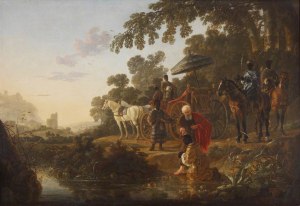
Baptism of the Ethiopian Eunuch c. 1655
Aelbert Cuyp (1620–1691)
There are two “Philips” in the New Testament. There is Philip the Apostle, one of the original twelve disciples, and Philip the Evangelist, one of the seven deacons chosen to serve the Jerusalem church.
Acts 8:26-40 recounts the fascinating story of Philip (the Evangelist) and the Ethiopian eunuch. (Sidebar: The identification of this individual as a eunuch is always a bit jarring! In ancient times, male court officials were often castrated at a young age in order to help them act appropriately around the king’s harem. It was also believed this would make them less susceptible to power struggles, having no possibility of heirs). Philip, prompted by an angel of the Lord, encounters the eunuch, who is a high official of the Ethiopian queen, reading from the book of Isaiah. Philip approaches and helps the eunuch understand the scripture, particularly Isaiah’s prophecy about Jesus. As they travel together, they come across water, and the eunuch asks to be baptized, professing his belief in Jesus as the Son of God. Philip baptizes him, after which the Spirit of the Lord whisks Philip away, leaving the eunuch rejoicing on his journey.
What should we take away from this story? Certainly, this passage highlights the inclusivity of the Gospel message. We assume that Philip had been raised a Jew and had subsequently joined the “people of the way.” I love the fact that when the Angel instructed him to go out on that “wilderness road,” Philip simply went — no hesitation. Further, it is intriguing to imagine this Spirit-led exchange with the Ethiopian man, certainly a Gentile (it is interesting to me that the eunuch is not named). The curiosity of the eunuch and Philip’s enthusiasm in sitting with him for a conversation are so refreshing. And imagine what is going through Philip’s mind when the Ethiopian asked to join the family of God! That moment when the chariot stops, and they go to the water is POWERFUL! It all seems very matter of fact. By baptism, the eunuch is forever changed. Likewise, however, it strikes me that Philip’s life was forever changed by this encounter, and his actions provide a beautiful model for us.
Soli Deo Gloria
(Note: I am indebted to Pastor Debie Thomas for inspiring me with her words regarding this week’s passage from Acts. She contributes to “Journey With Jesus,” a weekly Lectionary Blog).
description of Contemplative prayer (henri nouwen)
(Note: In the next several weeks, I plan to explore the practice of prayer within this space. I want to start with this terrific statement from our friend, Henri Nouwen).

Henri Nouwen (1932-1996)
The practice of contemplative prayer is the discipline by which we begin to “see” the living God dwelling in our own hearts. Careful attentiveness to the One who makes a home in the privileged center of our being gradually leads to recognition. As we come to know and love the Father of our hearts we give ourselves over to this incredible Presence who takes possession of all our senses. By the discipline of prayer we are awakened and opened to God within, who enters into our heartbeat and our breathing, into our thoughts and emotions, our hearing, seeing, touching, and tasting. It is by being awake to this God within that we also find the Presence in the world around us. Here we are again in front of the secret. It is not that we see God in the world, but that God-with-us recognizes God in the world. God speaks to God, Spirit speaks to Spirit, heart speaks to heart. Contemplation, therefore, is a participating in the divine self-recognition. The divine Spirit alive in us makes our world transparent for us and opens our eyes to the presence of the divine Spirit in all that surrounds us. It is with our heart of hearts that we see the heart of the world. . . .
Afterword: A suggested hymn for Easter 5 is “O Blessed Spring,” written by Robert Bucklee Farlee, with lyrics by Susan Cherwien (447 in the ELW). This link will take you to an excellent version of it by the National Lutheran Choir (based out of the Twin Cities). Note the lyrics and their connection to this week’s Gospel. Enjoy the gorgeous imagery also.
Join us after church on Sundays in the library for some in-person discussion of the Lectionary! no prior knowedge or special expertise is necessary — we grapple with scripture every week! All are welcome!

In reading about the eunuch, I feel he was a Jew because he was coming from Jerusalem after worshipping during a Jewish festival.
LikeLiked by 1 person