faithful conversations #66
Introduction to Readers: “Embrace the Process”
Let me start with a reminder today. If you google “lectionary history,” you will quickly realize that we are following a tradition here that has a long and winding backstory. The current three-year cycle we follow in the ELCA, the Revised Common Lectionary (RCL), has its more immediate roots in the late 1960s, and includes four scripture passages for each Sunday — the Old Testament reading, the Psalm as a response to the OT reading, the New Testament reading, and the Holy Gospel (Mark is featured in Year B). We started this project in February of 2023 with one simple goal: to promote the spiritual discipline of Bible reading by focusing on the Sunday readings (realize that there are Daily Readings for the RCL as well).
One of my favorite admonitions to athletes I have coached over the years is, “Embrace the Process.” It is easy to get sidetracked, to lose focus, to lose patience — and one thing I have learned about Bible study is that it takes patience and prayer. Your continuing interest inspires me, and I thank you for that! My reflections this week focus on the Old Testament reading, and especially the third commandment.
Readings for Pentecost 2
Deuteronomy 5: 12-15
Psalm 81: 1-10
2 Corinthians 4: 5-12
Mark 2: 23 – 3:6
A Quick Take on the Readings for Pentecost 2:
These readings invite us to honor God’s commands, trust in his grace, and recognize Jesus as the ultimate authority over tradition and human understanding. Deuteronomy 5:12-15 reiterates the commandment to observe the Sabbath, emphasizing its significance as a day of rest and remembrance of God’s liberation. Psalm 81:1-10 echoes this call to worship and obedience, reminding the people of God’s faithfulness and their covenant responsibilities. In 2 Corinthians 4:5-12, Paul reflects on the challenges of ministry, emphasizing the surpassing power of God’s grace amidst trials. Finally, in Mark 2:23-3:6, Jesus challenges the rigid interpretations of Sabbath observance, asserting his authority as the Lord of the Sabbath and revealing the true spirit of God’s law: mercy and restoration.
The First Reading: Deuteronomy 5: 12-15
12 Observe the Sabbath day and keep it holy, as the Lord your God commanded you. 13 Six days you shall labor and do all your work. 14 But the seventh day is a Sabbath to the Lord your God; you shall not do any work—you, or your son or your daughter, or your male or female slave, or your ox or your donkey, or any of your livestock, or the resident alien in your towns, so that your male and female slave may rest as well as you. 15 Remember that you were a slave in the land of Egypt, and the Lord your God brought you out from there with a mighty hand and an outstretched arm; therefore, the Lord your God commanded you to keep the Sabbath day.
(Compare to Exodus 20: 7-10)
7 “You shall not make wrongful use of the name of the Lord your God, for the Lord will not acquit anyone who misuses his name. 8 “Remember the Sabbath day and keep it holy. 9 Six days you shall labor and do all your work. 10 But the seventh day is a Sabbath to the Lord your God; you shall not do any work—you, your son or your daughter, your male or female slave, your livestock, or the alien resident in your towns.
Reflections on the sabbath day
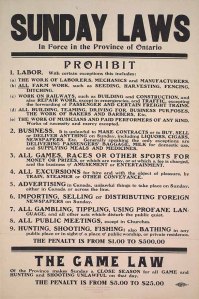 “Blue Laws” (or Sunday Laws) have been on my mind this week, prompted by the Deuteronomy passage. Many of us are old enough to remember such laws, although Wisconsin moved away from them earlier than many other states. Having spent much of my young life in North Dakota, I saw these firsthand. Historically derived from 17th Century Puritanism, Blue Laws (so named, allegedly, because they were originally printed on blue paper) regulated activities that would be permitted on Sundays, or not, thereby enforcing Sabbath observance. The impulse behind such actions in a political system that separates church and state are complicated and over time, Blue Laws have faded. A bit of research tells me that 28 states still operate with Sunday Laws today, primarily related to the sale of alcohol. The relaxation of Blue Laws, I suppose, is but one sign that Sunday has become “just another day of the week” for a huge swath of our population, prompting a good deal of handwringing among the faithful. And we’re all aware that church attendance continues to decline, especially among young adults. That said, how should we interpret the words from Deuteronomy?

“Moses Receiving the Tablets of the Law”
by Benjamin West (1738-1820)
First, some context. According to the Book of Exodus (Chapters 19-20), Moses ascended Mount Sinai, enveloped in smoke and thunder, to meet with God. There, in a dramatic, awe-inspiring moment, he received the Ten Commandments inscribed on two stone tablets, which provided a foundational moral and legal code for the Israelites. This event signaled a covenant between God and His chosen people, establishing guidelines for healthy living and worship. Moses’ descent from the mountain with the tablets symbolized the delivery of divine law to humanity, a cornerstone of Judeo-Christian tradition.
Like many of you, my introduction to the Ten Commandments came through studying and memorizing Luther’s Small Catechism more than fifty years ago. They were not presented to me as a set of rules, but rather as parameters for faithful living (Sidebar: Martin Luther adopted a specific approach to numbering the Ten Commandments that aligned closely with the Augustinian tradition, something that varies within the Christian community). In his explanation of the Third Commandment — Remember the sabbath day and keep it holy — Luther offered these words: We are to fear and love God, so that we do not despise preaching or God’s word, but instead keep that word holy and gladly hear and learn it. Luther is suggesting an attitude toward worship here. But, what about resting on the seventh day?
The idea of a day of rest (“Shabbat” in Hebrew) goes back to Genesis (2: 1-3) and the Creation story where God blessed the seventh day and set it apart. Both the Deuteronomy passage and the earlier one from Exodus (note above) appear to be saying the same thing, but as UCC biblical scholar (Lancaster Theological Seminary) Vanessa Lovelace points out, Deuteronomy 5:15 emphasizes God’s action in freeing the Israelites from slavery in Egypt (the exodus), rather than God resting on the seventh day as the source for this admonition. In other words, keeping the Sabbath meant remembering that period of enslavement, and God’s gift of liberation. Interesting. Further, both passages emphasize that resting from work applies to all, including you, or your son or your daughter, or your male or female slave, or your ox or your donkey, or any of your livestock, or the resident alien in your towns, so that your male and female slave may rest as well as you. In other words, we must take time for rest and focusing on God and allow others to have that same opportunity — this is a central part of our faith tradition. By doing so, we put ourselves in a position to deepen our faith journey and be touched by the miracle of God’s grace!
Soli Deo Gloria
prayer (inspired by Mark 2: 23 – 3:6)
Dear Heavenly Father,
As we reflect on the actions and teachings of Jesus in Mark 2:23-3:6, we ask for Your guidance and wisdom. Teach us to understand and embrace the true purpose of Your commandments, recognizing that compassion and mercy are at their heart. Help us to prioritize love and kindness in our daily lives, just as Jesus did when He healed on the Sabbath. May we have the courage to do what is right and just, even when it challenges conventional norms. Grant us the strength to extend grace and understanding to others, seeking always to do good and to honor You in all our actions. In your name we pray, Amen.
We will resume our in-person discussion of the Lectionary on Sunday (June 2) after the 8:30 worship service at ELC. Please feel welcome to join that discussion! no prior knowedge or special expertise is necessary — we grapple with scripture every week! All are welcome!

1960s Lutheran Humor
by Charles Schultz

I have loved Matthew 11:28-30 for many years. Here Jesus refers to the supernatural Rest we get from Him. “Come to me all who labor and are heavy laden and I will give you Rest. Take my yoke upon you and learn from me for I am gentle and lowly in heart and you will find Rest for your souls for my yoke is easy and my burden is light.” I have found humor at the first line of the verse where Jesus states that only those “who labor and are heavy laden…” need come to Him. Hmmm–who would that NOT be??? I think ALL who roam this planet “labor and are heavy laden” (maybe some people have work and stress-free dreams…) Remember, Jesus states His “Yoke” is easy–not how a yoke is usually thought of. I think of Jesus’s “Yoke” as not a constricting and harsh wooden yoke (like on an oxen) but His Yoke is His Arm around me and my arm around Him– the true Rest for our souls. Hopefully, we seek out Jesus’s Rest for our souls daily but on the Sabbath, I believe, He wants us to not only seek our soul’s Rest via Him but also give our bodies a rest.
LikeLiked by 1 person
Thanks Kris — the importance of rest, yes.
LikeLike