Faithful Conversations #67
Introduction to Readers:
**Renewal is on my mind this week, triggered by three things: recent conversations with various people, the polarizing times we are experiencing in 2024, and next Sunday’s passage from 2 Corinthians. How do we experience renewal as individuals? Further, how are public institutions renewed? Important questions!
Due to my age (born 1957), one of the consistent narratives in my lifetime (especially since 1970) has been declining trust in institutions. Reputable polling organizations track this carefully, and the numbers are daunting. Cynicism lurks around every corner regarding government, political leaders, schools, organized religion (and the list goes on and on). Countless books have been churned out on this topic and explanations run deep. I don’t think it is coincidental, by the way, that decline trust has accelerated since the mid-1990s and the advent of the internet. Information has been democratized in the 21st Century, allowing people to challenge traditional narratives and authority figures more readily. Indeed, agreed upon truths have seemingly disappeared (“my truth is not your truth”).

William Butler Yeats
(1865 –1939)
As is often the case, history provides perspective. We are not the first people in history to confront such anxious times. One of my favorite poems is called The Second Coming by Irish poet, William Butler Yeats. Prompted by the cataclysmic impact of the Great War, and the flu pandemic of 1918-19, Yeats captured the anxiety of his time in haunting language that feels contemporary:
Things fall apart; the centre cannot hold;
Mere anarchy is loosed upon the world,
The blood-dimmed tide is loosed, and everywhere
The ceremony of innocence is drowned;
The best lack all conviction, while the worst
Are full of passionate intensity.
Surely some revelation is at hand;
Surely the Second Coming is at hand.
My reflections for Pentecost 3 will center on the passage from 2 Corinthians and what it has to say to us about renewal. As always, thanks for visiting this space again this week and for your continued interest in exploring the Bible!
*The word “renewal” derives from a 14th Century Middle English word, “reneuen,” meaning to restore (a living thing) to a vigorous or flourishing state.
The Readings for Pentecost 3
Genesis 3: 8-15
Psalm 130
2 Corinthians 4: 13 – 5:1
Mark 3: 20-35
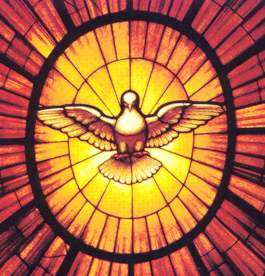
Gian Lorenzo Bernini
“Dove of the Holy Spirit” (c. 1660)
St. Peter’s Basilica, Vatican
A Quick Take on the Sunday Readings:
The readings for Pentecost 3 are interconnected through the themes of human fallibility, divine mercy, faith, and spiritual kinship. In Genesis 3:8-15, we witness the origin of human sin and the resulting estrangement from God, setting the stage for the need for redemption. Psalm 130 responds to this condition with a cry for mercy and forgiveness, emphasizing the hope and trust in God’s redemptive love. In 2 Corinthians 4:13 – 5:1, Paul speaks of enduring faith despite suffering, highlighting the promise of eternal life and the renewal of our beings as a counter to the decay initiated by sin. Mark 3:20-35 ties these themes together by illustrating Jesus’ teaching on true kinship, defining it through obedience to God’s will rather than biological ties. Collectively, these passages reflect the journey from sin and separation towards faith, redemption, and spiritual unity with God.
The Second Reading: 2 Corinthians 4:13 – 5:1 (NRSV)
13 But just as we have the same spirit of faith that is in accordance with scripture—“I believed, and so I spoke”—we also believe, and therefore we also speak, 14 because we know that the one who raised Jesus will also raise us with Jesus and will present us with you in his presence. 15 Indeed, everything is for your sake, so that grace, when it has extended to more and more people, may increase thanksgiving, to the glory of God. 16 So we do not lose heart. Even though our outer nature is wasting away, our inner nature is being renewed day by day. 17 For our slight, momentary affliction is producing for us an eternal weight of glory beyond all measure, 18 because we look not at what can be seen but at what cannot be seen, for what can be seen is temporary, but what cannot be seen is eternal. 5 For we know that, if the earthly tent we live in is destroyed, we have a building from God, a house not made with hands, eternal in the heavens.
reflections on 2 Corinthians 4:13 – 5:1
In his book, Meeting St. Paul Today (2008), Daniel Harrington offers this description of Paul: Next to Jesus, Paul is the most prominent figure in the New Testament. Of the twenty-seven documents that constitute the New Testament, thirteen are letters attributed to Paul. Also, more than half of the Acts of the Apostles describes Paul’s conversion and subsequent activities on behalf of the spread of the good news about Jesus (the gospel).**
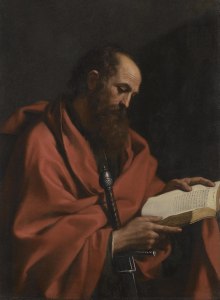
Saint Paul by
Guercino (1591–1666)
Who was this guy? Born in Tarsus, a city in the Roman province of Cilicia (modern day Turkey), Paul was of the tribe of Benjamin and steeped in Judaism (his Hebrew name was Saul). Though contemporaries, Paul never met the earthly Jesus, but around CE 32, he experienced a dramatic conversion to Christianity (recounted in Acts 9, 22, and 26). Roughly ten years later, Paul began a series of missionary journeys that lasted for twelve years. Legend suggests that Paul died a martyr’s death in CE 67 at the hands of Nero, the Roman Emperor of the time.
Paul’s letters were mainly written in response to challenges that arose in Chrisian communities he had founded. 2 Corinthians, for example, comes from Paul and his companion Timothy, addressed to “the church of God that is in Corinth.” Though not full of detail, it is clear that Paul wrote the letter to defend his apostolic authority against a group of critics and false apostles who were undermining his ministry and questioning his legitimacy. In the portion of the letter we’re reading for Sunday, Paul speaks about faith and the eternal hope Christians have despite present sufferings. He acknowledges the hardships faced in life but contrasts them with the eternal glory that awaits. He reminds readers that their current physical bodies are temporary “earthly tents,” but they have the assurance of an eternal, heavenly dwelling from God.
There is much to process in this passage, but one thing stands out to me (note: I am indebted to Associate Professor of New Testament at Luther Seminary, Jennifer Vija Pietz, for her interpretation). Focusing on verses 14 and 16, we hear that powerful promise of eternal life (14), followed by Paul’s admonition not to “lose heart” in the face of present difficulties, and to realize that we are renewed every day in our inner nature (16). In other words, the resurrection, in some mysterious way, is ALREADY PRESENT in us today, that “believers live in a time ‘in-between,’ when their embodied lives can still be wounded by sin and decay even while Christ’s Spirit sustains and renews them” (Professor Pietz). This is what authentic renewal looks like. Nothing can defeat us in this life! This is the authentic joy and optimism of the Christian in a broken world. This is good news that we need to share with others!
Soli Deo Gloria
**Scholars are in broad agreement that seven of the thirteen letters attributed to Paul are directly from Paul’s hand. Here is a list of those, including dates: 1Thessalonians (CE 50 or 51), Galatians (53 or 54), 1 Corinthians (54 or 55), Philippians (54 or 55), Philemon (54 or 55), Corinthians (54 or 55), and Romans (56 or 57). The other six — known as Deuteropaulines — are thought to have been in Paul’s name by his students, most likely after he died: 2 Thessalonians, Colossians, Ephesians, 1 and 2 Timothy, and Titus).
Prayer inspired by psalm 130
Dear God, in our deepest struggles, we call out to You for mercy and place our hope in Your unfailing love and forgiveness. Guide us through our hardships and fill us with the strength that comes from Your steadfast presence. Amen.
finally, if you enjoy inspirational music . . .
The Stellanbosch University Choir (South Africa) is marvelous. This interpretation of Jake Runestad’s “Let My Love Be Heard,” fits well with Psalm 130. The story behind the music is compelling as well. Here is the text:
Angels, where you soar
Up to God’s own light
Take my own lost bird
On your hearts tonight;
And as grief once more
Mounts to heaven and sings
Let my love be heard
Whispering in your wings

Really great blog this week; especially loved the hymn!
LikeLiked by 1 person
Thanks Doris! Renewal is a favorite topic! And that Stellanbosch choir is amazing. They have a lot of great pieces posted in YouTube.
LikeLike