Faithful Conversations #90
Introduction to Readers:
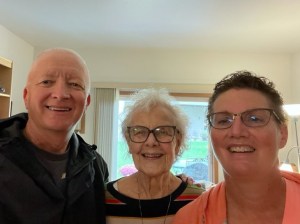
Carol Wambheim
(1928-2024)
As a Christian, it makes perfect sense to me that various people come into our lives to show us how to live. I was reminded of that on Saturday while attending my Aunt Carol’s funeral. It was a simple and contemplative service rooted in Lutheran tradition. Among the many interesting things about her journey, those who spoke mentioned that in the last week of her life (age 96) she participated in a Bible study, something she did throughout her life. Additionally, we learned that she practiced the spiritual discipline of prayer each morning. We left inspired.
We have reached the penultimate Sunday in Year B of the Lectionary (second to last), and two of this week’s readings remind us of Apocalyptic literature in the Bible. That word — apocalypse — derives from a Greek word meaning to uncover, disclose, or reveal (think “Revelation”). In a broad sense, apocalyptic literature within the Jewish and Christian communities flourished from roughly 200 B.C.E. to 200 C.E. The writers reflected great despair about their own times (which often included persecution) and signaled God’s imminent return to defeat the forces of evil in the world. The literary genre featured the seismic battle between God and Satan, revealing a divinely determined time schedule when the final conflict would ensue, ushering in a new and perfect world order. Various denominations — the ELCA, not so much — place great emphasis on the Apocalyptic writings and if you’re interested in a deeper dive into their role in U.S. history, here is a good article.
Thanks for visiting this space again this week! In my reflections, I will provide some framing for the passages from Daniel and Mark.
Pentecost 26 Readings
Daniel 12: 1-3
Psalm 16
Hebrews 10: 11-25
Mark 13: 1-8
Common Themes in the Pentecost 26 Readings
Look for these themes in this week’s readings: hope, endurance, and the promise of God’s ultimate deliverance. In Daniel 12:1-3, the prophecy speaks of a time of great tribulation followed by the resurrection and eternal reward for the faithful, emphasizing God’s power to save. Psalm 16 expresses deep trust in God as the source of refuge and security, reinforcing the belief that God’s presence offers steadfast protection amid uncertainty. Hebrews 10:11-25 encourages believers to hold fast to their faith and gather together, reminding them of Christ’s once-for-all sacrifice and the assurance of forgiveness. In Mark 13:1-8, Jesus warns of future trials, urging his followers to remain vigilant and trust in God’s plan despite the signs of chaos and suffering in the world. Together, these texts highlight the call to persevere with faith, trust in God’s promises, and look forward to the fulfillment of God’s redemptive work.
The First Reading: Daniel 12: 1-3: The Resurrection of the Dead
At that time Michael, the great prince, the protector of your people, shall arise. There shall be a time of anguish such as has never occurred since nations first came into existence. But at that time your people shall be delivered, everyone who is found written in the book. 2 Many of those who sleep in the dust of the earth shall awake, some to everlasting life and some to shame and everlasting contempt. 3 Those who are wise shall shine like the brightness of the sky, and those who lead the many to righteousness, like the stars forever and ever.
The Gospel: Mark 13: 1-8: Destruction of the Temple Foretold
As he came out of the temple, one of his disciples said to him, “Look, Teacher, what large stones and what large buildings!” 2 Then Jesus asked him, “Do you see these great buildings? Not one stone will be left here upon another; all will be thrown down.” 3 When he was sitting on the Mount of Olives opposite the temple, Peter, James, John, and Andrew asked him privately, 4 “Tell us, when will this be, and what will be the sign that all these things are about to be accomplished?” 5 Then Jesus began to say to them, “Beware that no one leads you astray. 6 Many will come in my name and say, ‘I am he!’ and they will lead many astray. 7 When you hear of wars and rumors of wars, do not be alarmed; this must take place, but the end is still to come. 8 For nation will rise against nation and kingdom against kingdom; there will be earthquakes in various places; there will be famines. This is but the beginning of the birth pangs.
reflection: Take a breath
We live in perilous times. As Christians, this should come as no surprise (I’m reminded of my father’s frequent admonition to me: “There’s always been plenty of sin in the world.”). Each time we say the Apostle’s Creed, we finish with these words (the Third Article): I believe in the Holy Spirit, the holy catholic church, the communion of saints, the forgiveness of sins, the resurrection of the body, and the life everlasting. Amen. The final clauses remind us that this life is not all there is, that at some future point, we will transition to a different reality. This belief, of course, informs our view of death. But, let’s be honest, it all remains a great mystery, perhaps the greatest of mysteries.

Rubens (1577-1640)
“Daniel in the Lion’s Den”(1614)
This week’s first reading comes from Daniel, a book nestled within the Prophets section of the Bible. If you have never spent time with Daniel, I encourage you to do so but be ready for “a ride” because it is filled with unresolved puzzles. (Sidebar: Rubens’ famous rendition painting is a reminder of my childlike fascination with Daniel and the story of his journey into the “lion’s den,” now a figure of speech for great trouble that we may be entering). Chapter 12 is the continuation of a discourse that starts in chapter 10, as described here by Anathea Portier-Young, an Old Testament scholar at Duke University Divinity School. I quote her at length here.
A “man,” or angel, dressed in linen, with a face like lightning and eyes like flaming torches (10:5), speaks with Daniel, touches him, and gives him strength to stand (10:10-11,16-19). This angel, also called “one in human form,” explains to Daniel that he has been fighting against the “Prince of Persia” and will later fight the “Prince of Greece” (10:13, 20-21). Alongside him fights Michael, “one of the chief princes” (10:13). The angel who speaks with Daniel tells him, “There is no one who contends with me against these princes except Michael, your prince” (10:21). This passage provides important background for Daniel 12:1. The title “prince” in Daniel 10 and 12 refers to a superhuman, celestial being who represents and has responsibility to protect a particular people. The identification of Michael as the prince of Daniel’s people suggests that Michael has been their guardian from the very beginning of their existence. It emphasizes to Daniel and his audience that when they do not have power to contend against their enemies, the greatest of all princes fights on their behalf. A situation may seem hopeless, but what Daniel’s oppressed people can see and hear does not tell the whole story. Behind the scenes, forces more powerful than those on earth shape the destinies of peoples and nations.
This week’s Gospel reading from Mark, it should be noted, was important enough to the early church that it is repeated in Matthew 24 and Luke 21 (we’re pointed to 13: 1-8, but the entire passage is 1-37). In it, Jesus predicts the destruction of the temple in Jerusalem and then comments on the end times. Again, it is important to bear in mind that his followers were steeped in Judaism and such references would fit well in their worldview, based on their knowledge of the Prophets. He then offers two pieces of advice, as theologian Dan Clendenin points out in a recent commentary. In verse 5, we are told “not to be led astray” by those who claim to be the Savior or speak for Jesus (this is repeated eight times in Chapter 13, in some form). In other words, we must be on our guard and practice discernment amidst the “noise” that surrounds us. And second, we must “not be alarmed” (verse 7) by what is happening in our world — strong words that we need to hear over and over again as Christians. God is in control. He has given us the gift of faith. We need to share that with those in our midst that need words of encouragement!
Soli Deo Gloria!
prayer reflection: transitions
Note: Regular readers know that I am a fan of Nouwen. This is from the Henri Nouwen Society’s website from 9 November 2024. It seems timely and spoke to me during the period of transition we are experiencing in the months ahead in our nation and world.

Henri Nouwen
(1932-1996)
One of the most radical demands for you and me is the discovery of our lives as a series of movements or passages. When we are born, we leave our mothers’ womb for the larger, brighter world of the family. It changes everything, and there is no going back. When we go to school, we leave our homes and families and move to a larger community of people where our lives are forever larger and more expansive. Later when our children are grown and they ask us for more space and freedom than we can offer, our lives may seem less meaningful. It all keeps changing. When we grow older, we retire or lose our jobs, and everything shifts again. It seems as though we are always passing from one phase to the next, gaining and losing someone, some place, something. You live all these passages in an environment where you are constantly tempted to be destroyed by resentment, by anger, and by a feeling of being put down. The losses remind you constantly that all isn’t perfect and it doesn’t always happen for you the way you expected; that perhaps you had hoped events would not have been so painful, but they were; or that you expected something from certain relationships that never materialized. You find yourself disillusioned with the irrevocable personal losses: your health, your lover, your job, your hope, your dream. Your whole life is filled with losses, endless losses. And every time there are losses there are choices to be made. You choose to live your losses as passages to anger, blame, hatred, depression, and resentment, or you choose to let these losses be passages to something new, something wider, and deeper. The question is not how to avoid loss and make it not happen, but how to choose it as a passage, as an exodus to greater life and freedom.

