Faithful Conversations #99
Introduction to readers

Religious Make-Up
119th Congress
Let’s start this week with an understatement: humankind has always been layered with factionalism — it seems to be wired into our DNA. This has been on my mind this week, in part, because of the passage from 1 Corinthians in the lection and our current political environment, both at home and abroad. In that regard, I tracked some interesting information about the 119th Congress, which has been in power since January 3rd. Pew Research has charted the religious makeup of Congress since 2007, and their latest report shows that roughly 87% of the 535 House and Senate members identify as Christians. Of those, 55% are Protestant (only 19 out of 295 Protestants are Lutheran!). Interestingly, 62% of the American public identifies as Christian, which is significantly less than the 87% in Congress. (Notably, since 2007, there has been a drop in the percentage of the general population identifying as Christian, from 78% to 62%, a trend that has elicited much commentary!). And while we have a long tradition of separating church and state and a diverse religious population, it’s clear that religious beliefs influence our politics. The extent of that influence, of course, prompts debates within the political sphere, echoing arguments within and among religious communities. It seems to me that the church may be one of the few places where people of differing beliefs and backgrounds sit next to each other and actually can debate the issues of our time in a healthy way — not easy but always possible.
Thanks for your continued interest in exploring the scriptures, and your willingness to reflect on the big questions prompted by our Christian journey! Continue to be open to those moments of Epiphany in your daily walk — those “thin places” where heaven and earth are close together. My reflections this week will focus on what the Apostle Paul wrote to those Corinthian Christians in the mid-50s CE.
Readings for 2 Epiphany
Isaiah 62: 1-5
Psalm 36: 5-10
1 Corinthians 12: 1-11
John 2: 1-11
Common Themes in the Readings for 2 Epiphany
Look for these two themes in this week’s readings: God’s steadfast love and transformative power. In Isaiah 62: 1-5, we see God’s promise to restore and delight in His people, making them a shining beacon. Psalm 36: 5-10 underscores God’s unfailing love and faithfulness, offering refuge and abundance to those who seek Him. 1 Corinthians 12: 1-11 emphasizes the diverse spiritual gifts given by the same Spirit, meant for the common good. Finally, John 2: 1-11 describes the miraculous transformation of water into wine at the wedding in Cana, revealing Jesus’ glory and signifying the beginning of His public ministry.
** Before tackling the second reading, I encourage you to WATCH THIS EXCELLENT OVERVIEW of 1 Corinthians from The Bible Project.
The Second Reading: 1 Corinthians 12: 1-11: Spiritual Gifts
12 Now concerning spiritual gifts, brothers, I do not want you to be uninformed. 2 You know that when you were pagans you were led astray to mute idols, however you were led. 3 Therefore I want you to understand that no one speaking in the Spirit of God ever says “Jesus is accursed!” and no one can say “Jesus is Lord” except in the Holy Spirit. 4 Now there are varieties of gifts, but the same Spirit; 5 and there are varieties of service, but the same Lord; 6 and there are varieties of activities, but it is the same God who empowers them all in everyone. 7 To each is given the manifestation of the Spirit for the common good. 8 For to one is given through the Spirit the utterance of wisdom, and to another the utterance of knowledge according to the same Spirit, 9 to another faith by the same Spirit, to another gifts of healing by the one Spirit, 10 to another the working of miracles, to another prophecy, to another the ability to distinguish between spirits, to another various kinds of tongues, to another the interpretation of tongues. 11 All these are empowered by one and the same Spirit, who apportions to each one individually as he wills.
reflection: pursuing the common good

Paul’s Second Missionary Journey, 49 CE
Throughout the seven Sundays in Epiphany, we will spend time with chapters 12, 13, and 15 of St. Paul’s first letter to the Corinthians. Paul spent a year and a half in Corinth during his second missionary journey in the late 40s and early 50s and in ensuing years, exchanged four letters with leaders within the church he established there, two of which survived. Written in the mid-50s from Ephesus, 1 Corinthians focuses on disturbing news Paul received concerning divisions among the Corinthian Christians. As theologian Douglas Campbell asserts in a 2018 article in the Christian Century, “The church at Corinth was a mess. I count 15 distinguishable problems that Paul addresses in 1 Corinthians: partisanship, with the Corinthians factionalizing behind rival leaders (1:10–4:21; 16:10–18); incest (5:1–13); prostitution (6:12–21); celibacy within marriage (7:1–7); Christians married to one another asking about divorce (7:8–11, 39); Christians married to pagans asking about divorce (7:12–16); questions surrounding marriage and remarriage (7:25–40); lawsuits (6:1–11); idolatry (8:1–11:1); concerns about women praying and prophesying in immodest ways (11:2–16); chaos in worship, with speaking in tongues and competing voices (chapter 14); inequality in the communal meal (11:17–34); denials of the bodily resurrection of Jesus and of Christians (15:1–58); the collection of a large sum of money to be sent to Jerusalem (16:1–4); and a change in Paul’s travel plans (16:5–9).”
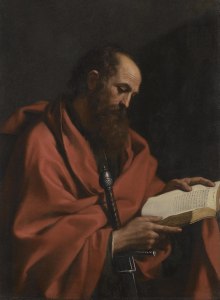
Saint Paul by
Guercino (1591–1666)
In short, those early spiritual ancestors of ours were in the midst of a culture war, a good reminder in our time that there is nothing new under the sun (Ecclesiastes 1:9). Paul wrote to remind them of their unity in Christ. He gave both encouragement and correction, stressing the need for love and respect among all members. In Sunday’s passage, he addresses their disagreements over spiritual gifts, warning against spiritual elitism, highlighting the importance of diverse gifts in the church, all contributing to the common good (verse 7).
Indeed, the interaction between Paul and the Christians in Corinth reminds us that many of the problems we face in our culture today are not new and that living in community is never easy and can be especially challenging for those in leadership positions. Again, Douglas Campbell offers the following commentary: “In sum, the Christian way asks all its followers to be kind and considerate toward one another . . . These actions are fairly simple in theory but incredibly demanding in practice. They are deeply countercultural. If they are to take root, above all they require the right sort of leadership. Christian leaders must help their communities navigate their current locations ethically with due depth, sensitivity, and courage, as Paul did for the Corinthians.”
You and I, indeed, are members of the most powerful countercultural movement in history. May we navigate our days with “depth, sensitivity, and courage” empowered by one and the same Spirit.
My gift to you is always a story; something to think about more than once; something to keep your mind alive and touch your soul so that you can see life fresh and leaping once again.
There is a story from the Desert Fathers and Mothers about a young monk who asked one of the holy men of the desert why it is that so many people came out to the desert to seek God and yet most of them gave up after a short time and returned to their lives in the city. The old monk responded: “Last evening my dog saw a rabbit running for cover among the bushes of the desert and he began to chase the rabbit, barking loudly. Soon other dogs joined the chase, barking and running. They ran a great distance and alerted many other dogs. Soon the wilderness was echoing the sounds of their pursuit, but the chase went on into the night. After a little while, many of the dogs grew tired and dropped out. A few chased the rabbit until the night was nearly spent. By morning, only my dog continued the hunt.” “Do you understand,” the old man said, “what I have told you?” “No,” replied the young monk, “I don’t. Please help me with it.” “It is simple,” said the desert father. “My dog saw the rabbit!”
The gift? A reminder to keep our souls focused on the important dimensions of life, on the purpose for which we have been born, on the gifts we are meant to give to others as life goes by. Otherwise, we simply drift through life: one minute attracted by this; at another moment confused about what we’re doing. Over the long haul, then, we become pilgrims without purpose, looking for what can’t be found. A Happy New Year to you every day of your life. May the gift be born in you and may you keep your eye on it always.

Sister Joan Chittister
Benedictine Order
Joan Daugherty Chittister O.S.B. (born April 26, 1936), is an American Benedictine nun, theologian, author, and speaker. She has served as Benedictine prioress and Benedictine Federation president, president of the Leadership Conference of Women Religious, and co-chair of the Global Peace Initiative of Women.
I accessed this story by Joan from Benetvision, her website. She is a terrific author.
join us for some in-person discussion of the Lectionary on sunday at 10:45 in the elc library — All are welcome! We meet until roughly 11:30.
And, a reminder: the bonhoeffer book study!

Dietrich Bonhoeffer
(1906-1945)

I enjoyed the story of the dog/dogs and the rabbit! I printed it to keep. I have seen the rabbit!
LikeLike