“The communion of saints celebrates how God has created each of us for a purpose, one we cannot fulfill without each other; how God loves us all equally yet loves each one of us as if we were the only one.” (Samuel Wells)
Who am I and why am I here? We spend lifetimes chasing after these two fundamental questions — think identity and purpose. Anglican Vicar Sam Wells’ article in April’s Christian Century Magazine (“The Grace of Identity,” p. 39) reminded me of this. Wells asserts that people tend to understand identity in one of two ways. One is by discovery—seeing identity as something fixed from our past, shaped by upbringing and experiences, and uncovered over time. The other is by construction—viewing identity as something we create through choices and commitments, continually evolving over time. In discovery, identity is inherited; in construction, it’s built (perhaps both are true). Wells, however, suggests that as Christians, our identity is both bestowed and revealed by a God who chose us. In other words, we had no control over that part of the equation. As mysterious as this is, it is fundamental to our faith journey. Further, Wells posits that identity is not about isolating one’s uniqueness (self-centered). Instead, it’s about joining others in believing there is a role for each one of us in the body of Christ — in other words, our identity is fostered in community. Aha! The answer to the two basic questions! These insights were front of mind for me this week as I worked through the passages from Isaiah and Philippians.
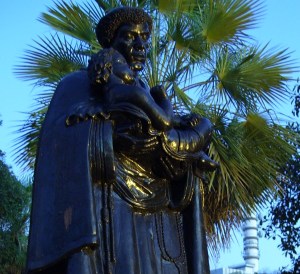
Thanks for visiting this space again this week! We are 18 days out from Good Friday and experiencing the vicissitudes of March weather in the upper midwest. As one who has been coaching track and field for a long, long time, such weather is like the return of an old friend! We venerate two individuals this week on the Lutheran calendar. The English poet John Donne (d. 31 March 1631) and Benedict the Moor (d. 4 April 1589), also known as Benedict the African. His statue pictured here adorns the Church of Our Lady of the Rosary and Saint Benedict, Cuiabá, Mato Grosso, Brazil. Both men have fascinating stories and their connection to church history is worth exploring!
Look for the convergence of the following themes as you explore the readings for the 5th Sunday in Lent: renewal, transformation, and pressing forward with hope and faith. In Isaiah 43:16-21, God promises to make a way in the wilderness, symbolizing new beginnings and divine provision. Psalm 126 rejoices in the restoration of fortunes, expressing the joy that follows God’s intervention in times of despair. Philippians 3:4b-14 emphasizes leaving behind the past and striving toward the future, while John 12:1-8 highlights the sacrificial act of love and devotion, foreshadowing the transformative power of Christ’s death and resurrection.
Focus Passages from Isaiah 43 and Philippians 3
Isaiah 43: 16-21
Thus says the Lord, who makes a way in the sea, a path in the mighty waters, 17 who brings out chariot and horse, army and warrior; they lie down; they cannot rise; they are extinguished, quenched like a wick: 18 Do not remember the former things or consider the things of old. 19 I am about to do a new thing; now it springs forth; do you not perceive it? I will make a way in the wilderness and rivers in the desert. 20 The wild animals will honor me, the jackals and the ostriches, for I give water in the wilderness, rivers in the desert, to give drink to my chosen people, 21 the people whom I formed for myself so that they might declare my praise.
Here’s an excellent video with backround on Isaiah 40-66
Luther’s Seal
TRY LUTHER’S METHOD!
Luther’s Revision of the Lectio Divina (Three Steps)
Oratio (Prayer): This is the starting point, where one humbly prays for the Holy Spirit’s guidance to understand God’s Word. Luther emphasized that prayer prepares the heart and mind to receive divine wisdom.
Meditatio (Meditation): This involves deeply engaging with Scripture, not just reading it but reflecting on it repeatedly. Luther encouraged believers to “chew on” the Word, allowing its meaning to sink in and shape their thoughts and actions.
Tentatio (Struggle): Often translated as “trial” or “temptation,” this refers to the challenges and spiritual battles that arise as one seeks to live according to God’s Word. Luther saw these struggles as a way God refines faith, making it more resilient and authentic.
Philippians 3: 4b-14
If anyone else has reason to be confident in the flesh, I have more: 5 circumcised on the eighth day, a member of the people of Israel, of the tribe of Benjamin, a Hebrew born of Hebrews; as to the law, a Pharisee; 6 as to zeal, a persecutor of the church; as to righteousness under the law, blameless. 7 Yet whatever gains I had, these I have come to regard as loss because of Christ. 8 More than that, I regard everything as loss because of the surpassing value of knowing Christ Jesus my Lord. For his sake I have suffered the loss of all things, and I regard them as rubbish, in order that I may gain Christ 9 and be found in him, not having a righteousness of my own that comes from the law but one that comes through faith in Christ, the righteousness from God based on faith. 10 I want to know Christ and the power of his resurrection and the sharing of his sufferings by becoming like him in his death, 11 if somehow I may attain the resurrection from the dead. 12 Not that I have already obtained this or have already reached the goal,nbbut I press on to lay hold of that for which Christ has laid hold of me. 13 Brothers and sisters, I do not consider that I have laid hold of it, but one thing I have laid hold of: forgetting what lies behind and straining forward to what lies ahead, 14 I press on toward the goal, toward the prize of the heavenly call of God in Christ Jesus.
Reflections: God’s Purpose and Our Identity
This week’s first and second readings focus on our Christian identity. Isaiah 43 reminds us of God’s power, recalling the Exodus from Egypt as proof of His might (16-17). It then shifts to a “new thing” God is doing—bringing renewal, like creating a path in the wilderness and rivers in the desert (19). God’s faithfulness is shown as He calls His people to praise Him, demonstrating His ability to bring hope and restoration, even in hard times (20-21). In Philippians 3, Paul reflects on his past achievements (4-6), calling them worthless compared to knowing Christ (7-8). He highlights righteousness through faith in Christ, not by the law, and his desire to share in Christ’s sufferings and resurrection (9-11). Paul concludes by urging us to press on toward the goal of eternal life, striving to fulfill our calling in Christ Jesus (12-14).
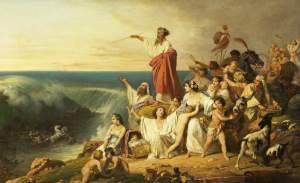
Moses and the Children of Israel Crossing the Red Sea Henri Schopin (1904-1880)
What do these readings say to us in 2025? I’m struck by how each author addresses the nature of history in shaping our identity. Speaking for the Lord, Isaiah hearkens back to a triumphant moment in Jewish history — the crossing of the Red Sea recounted in Exodus 14, a cultural touchstone for the people. We might imagine young Jewish children hearing this story multiple times as they absorb their worldview (did they get tired of hearing it?). Likewise, Paul references his past life — his history as an ardent Jew — as a window into his identity. In stunning reversals, however, both authors suggest that God liberates us from our past — “that was then, this is now!” In other words, our identities transcend what we may have inherited. Whatever has happened, whatever we have experienced, God is about to do a new thing. In the case of the Israelites, their journey to the promised land meant hope in the midst of despair. In Paul’s case, his Jesus moment on the road to Damascus changed everything. Likewise, our Christian identities, both bestowed and revealed by a loving God, remain forever a work in progress. Whatever chaos we may be experiencing, whatever turmoil we may confront, this is good news to share!
Soli deo Gloria!
(I am indebted to Samuel Wells, as noted, regarding the interpretation of the readings. Also, Paul’s writings provided inspiration, especially these passages: 2 Corinthians 5:17, Galatians 6:15, Ephesians 4:24, Colossians 3:10, and Romans 6:4. You may want to look those up!)
Prayer Reflection: Spiritual Maturity
Dear Lord, We humbly seek Your guidance as we strive for spiritual maturity. Help us to deepen our faith, cultivate wisdom, and embrace Your teachings. May we grow in love, patience, and understanding, reflecting Your light in our lives. Strengthen our hearts and minds, that we may walk in Your ways and bear fruit for Your kingdom. Amen.
(Note: The inspiration for this prayer is Colossians 2: 6-7. Retrieved from God’s Blessing prayer site, 30 March 2025)
Musical Offering: Lux Aeterna (Eternal Light)
Lux Aeterna is an enchanting piece of music that has roots deep in Christian history. This version by VOCES8 features great harmony. The Latin lyrics center around themes of eternal light and rest for departed souls — the communions of saints — those who helped shape our identities. Here’s a translation:
May light eternal shine upon them, O Lord, with Thy saints forever, for Thou art kind. Eternal rest give to them, O Lord, and let perpetual light shine upon them.
Update on “Faithful Conversations”
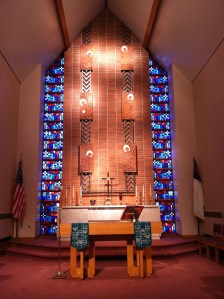
Two years ago, we offered “Journey Into the Bible,” a class which inspired the Lectionary Blog experiment. A digital version of the class is now ready for launch. We hope it can be useful for new members or anyone seeking to get started with Bible study. Special thanks to Pastor Jen Hatleli and the Lectionary Small Group for their support and inspiration throughout! Click on the image of the ELC Sanctuary to access the class.
And . . . Join us on Sunday 30 March at 10:45 in the church library. We talk through the readings (some or all) in an informal setting — no prior preparation is necessary and all are welcome! Come and help us deepen our understanding of the readings!