14 and 17 May 2026: Ascension of Our Lord and 7 Easter

Where Are We in the Lectionary Calendar?

Even though the Lectionary highlights Ascension Day, it often slips by quietly. We’re deep into Eastertide now — the fifty days between Easter and Pentecost — that keep drawing us back to resurrection, renewal, and the church’s first steps into mission. As Thursday approaches, the Ascension stands before us as that hinge moment when Jesus, after forty days with his followers, entrusts his work to the church and returns to the Father. Luke and Acts hold this mystery with both clarity and awe. Christians have honored this day since the earliest centuries; by the fourth century it was widely observed in the East, and by the sixth it was firmly rooted in the Western church. Traditionally kept forty days after Easter, Ascension Day has become a feast of prayer and worship, proclaiming Christ’s exalted reign and the hope of his coming again.

Thanks for your visit!

Two Worlds is a digital ministry space where I share the weekly Revised Common Lectionary readings and a brief homily with supporting images and music. As a nod to our history, I also include the ELCA’s commemorations for the week. Most images come from Wikimedia Commons, and I utilize Copilot for some aspects of the research and writing.

The project grows out of ongoing conversation with Pastor Jen Hatleli of ELC in Black River Falls — a dialogue first sparked by a 2023 Bible Study that set this whole thing in motion.

The Ascension of Our Lord (Thursday)

Acts 1: 1-11

Psalm 47

Ephesians 1: 15-23

Luke 24: 44-53

The Ascension readings hold together around the conviction that Christ’s exaltation reshapes the mission and hope of his people. Acts and Luke present the Ascension not as Jesus’ departure but as the moment he entrusts his witnesses with Spirit‑empowered purpose, sending them into the world with opened minds and burning joy. Psalm 47 lifts this event into cosmic scale, celebrating the risen Christ as the enthroned King whose reign calls all nations to praise. Ephesians then draws the lens even wider, proclaiming that the ascended Christ now fills all things with resurrection power, ruling over every authority for the sake of the Church, his body. Together, the readings declare that Christ’s reign is already active, his presence is not diminished but transformed, and his people now live between promise and commission—anchored in hope, empowered for witness, and lifted into the life of the risen Lord.
7 Easter (Sunday)

Acts 1: 6-14

Psalm 68: 1-10, 32-35

1 Peter 4: 12-14; 5: 6-11

John 17: 1-11

The readings for 7 Easter gather around the tension and promise of a community learning to live in the space between Christ’s Ascension and Pentecost. Acts shows the disciples waiting in obedient hope, trusting Jesus’ promise even as they cannot yet see its fulfillment. Psalm 68 lifts that waiting into a vision of God as the victorious, mountain‑riding defender who scatters enemies, shelters the vulnerable, and reigns with unmatched strength. 1 Peter speaks directly into this in‑between time, urging believers to endure trials with humility and courage, confident that God will restore and strengthen them. In John 17, Jesus’ prayer anchors all of this: he entrusts his followers to the Father, asking that they be protected, unified, and sustained in the world. Together, the readings portray a people held by God’s power, shaped by Christ’s intercession, and prepared for the Spirit’s coming as they wait with trust, humility, and expectant hope.

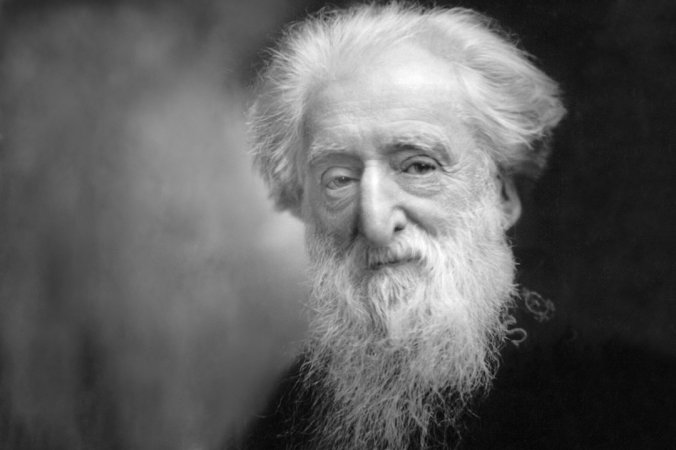
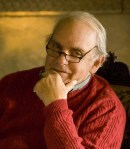
Gordon Thunder
(1939-2025)

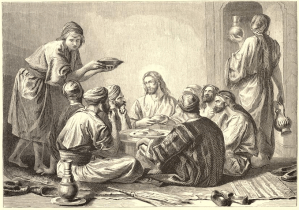
Ho‑Chunk elder Gordon Thunder visited my classroom many times during my years at BRFHS. On his first visit in the 1990s, he said something that lodged itself in me and never left: “Education is much more a matter of the heart than of the head.” As he spoke, he tapped his chest and told a story from his childhood. He remembered walking in the woods with his Cooka—his grandfather—who would stop along the trail to teach him things. Nothing formal. Nothing scripted. Just a grandfather, a child, and the quiet wisdom of the woods. That memory still reminds me that real learning begins with inspiration, not information. Gordon’s words came back to me again this week as I sat with the readings from Ephesians and Luke. In Ephesians, Paul prays that believers receive a spirit of wisdom and that “the eyes of their heart” be enlightened. I love that phrase. One commentator suggests that the heart, in Paul’s world, meant the core of who we are — mind, will, emotions, maybe even what we would call the soul. So when Paul prays for the eyes of our heart to open, he’s asking God to help us see fully, to perceive truth in a way that goes deeper than intellect. It strikes me that this is a prayer worth whispering every time we open scripture. Jesus gives what Paul prays for. After the resurrection — after the Emmaus conversation and the breaking of bread — Jesus appears again to the disciples in Jerusalem. He reminds them that everything written about him in the Law, the Prophets, and the Psalms has come to life in him. Then Luke offers that luminous line: “He opened their minds to understand the scriptures.” It mirrors the Emmaus moment when their eyes were opened at the table. Jesus is doing for them what Paul later longs for in the church: awakening the heart, clearing the fog, helping them see. From there, Jesus gives them a kind of summary of the Christian story — his suffering, his rising, the forgiveness he brings, and the mission they will carry into the world. He names them as witnesses. He promises the Holy Spirit. And then Luke gives us that dramatic scene of the ascension—so striking that he repeats it again at the start of Acts. None of the other Gospel writers tell it quite this way.

“Jesus Ascending into Heaven” by
John Singleton Copley, 1775

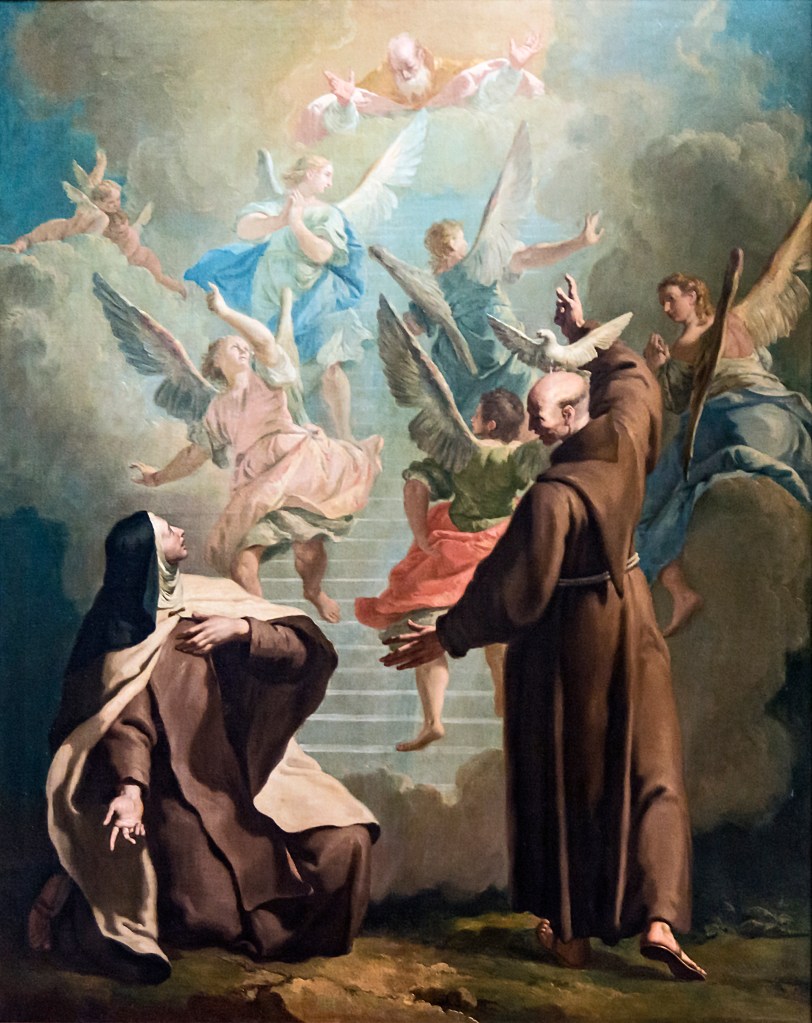
How do we make sense of that moment? Artists like John Singleton Copley and Albertino Piazza (below) tried to capture it on canvas, but even the best paintings can only gesture toward mystery. As one thoughtful Christian philosopher has suggested, the ascension is not about Jesus rocketing through the sky to some far‑off “heaven.” It is not a change of location at all, but a change of state — Jesus stepping from the realm of time into the realm of eternity. That way of seeing it rings true. The disciples weren’t watching a departure; they were witnessing a transformation. Something real happened — something beyond their categories — something that told them Jesus was not gone but glorified, not absent but now present in a new and deeper way.

And here we are, two thousand years later, still trying to see with the eyes of our hearts. We remain in that “between time” — still trying to understand scripture. Still trying to follow the risen Christ into a world that aches for hope. Like those first disciples, we are witnesses in our own time and place. Guided by the Spirit, we carry light into the corners around us. And yes — the world still desperately needs the message of Jesus Christ. May God open our hearts to see it, and our lives to live it.

Soli Deo Gloria!

Albertino Piazza’s Ascension of Christ presents the apostles gathered around the empty tomb, their faces lifted in awe as Christ rises beyond the frame. The composition centers on the circle of disciples, each rendered with distinct gestures that convey wonder, confusion, and devotion. Piazza uses warm earth tones and soft modeling to ground the scene in human emotion while hinting at the divine action unfolding above. The empty tomb anchors the lower half of the painting, symbolizing both the Resurrection completed and the mission about to begin. The overall effect is a quiet but powerful meditation on the moment when earthly followers look upward toward a heavenly Christ.

Ascension of Christ
Albertino Piazza
(1490–1528)

In Luke–Acts, the Ascension and the church’s mission flow together as one moment. Jesus opens the Scriptures, promises the Spirit, names the disciples as His witnesses, and then ascends — handing the mission to them as He goes. That same sense of calling runs through “Lord, You Give the Great Commission,” which Jeffery Rowthorn wrote in 1978 for Yale and Berkeley Divinity School students who wanted a hymn that spoke honestly about ministry. Each verse lifts a direct saying of Jesus and turns it into a clear picture of the church’s work—teaching, healing, forgiving, serving, and staying hopeful—always grounded in the Spirit’s power rather than our own. Paired with Cyril Taylor’s confident tune ABBOT’S LEIGH, the hymn has become a favorite for ordinations, mission Sundays, and any moment when the church sends people out with purpose and heart.

This powerful version of the hymn is offered by the combined choirs of two Episcopal churches: Christ Church, Cambridge and Church of the Redeemer, Chestnut Hill (Massachusetts).

Note: The ELCA shares full communion with six U.S. church bodies: the Presbyterian Church (U.S.A.), the Reformed Church in America, and the United Church of Christ (all since 1997); the Moravian Church in America and The Episcopal Church (both since 1999); and the United Methodist Church (since 2009).

Lyrics

Verse 1
Lord, you give the great commission:
“Heal the sick and preach the word.”
Lest the church neglect its mission
and the gospel go unheard,
help us witness to your purpose
with renewed integrity:
With the Spirit’s gifts empower
us for the work of ministry.

Verse 2
Lord, you call us to your service:
“In my name baptize and teach.”
That the world may trust your promise,
life abundant meant for each,
give us all new fervor, draw us
closer in community:
With the Spirit’s gifts empower
us for the work of ministry.

Verse 3
Lord, you make the common holy:
“This my body, this my blood.”
Let us all, for earth’s true glory,
daily lift life heavenward,
asking that the world around us
share your children’s liberty:
With the Spirit’s gifts empower
us for the work of ministry.

Verse 4
Lord, you show us love’s true measure:
“Father, what they do, forgive.”
Yet we hoard as private treasure
all that you so freely give.
May your care and mercy lead us
to a just society:
With the Spirit’s gifts empower
us for the work of ministry.

Verse 5
Lord, you bless with words assuring:
“I am with you to the end.”
Faith and hope and love restoring,
may we serve as you intend,
and, amid the cares that claim us,
hold in mind eternity:
With the Spirit’s gifts empower
us for the work of ministry.

Thursday 14 May: Matthias, Apostle

Matthias is the man chosen to replace Judas after Judas’ betrayal and death, and his story shows up only in Acts 1. The early believers wanted to restore the symbolic number of twelve apostles, so Peter laid out the criteria: the replacement had to be someone who had been with Jesus from the beginning and had witnessed the resurrection. Two men fit the bill — Joseph Barsabbas (called Justus) and Matthias. The community prayed, cast lots, and the lot fell to Matthias, which they understood as God’s choice. After that moment, Scripture doesn’t mention him again, and most of what people say about his later ministry comes from much later traditions, not the Bible itself. Matthias wasn’t a random pick; he was a long‑time follower of Jesus whose quiet faithfulness made him a natural fit. His story highlights how the early church trusted God’s guidance, valued faithful witness, and sought to continue Jesus’ mission even in a moment of uncertainty.

Source: GotQuestions.org, a website devoted to exploring questions regarding the Bible and Christianity.

Saint Matthias by Simone Martini (c. 1284 – July 1344)

The Lectionary Study Group will meet Sunday (5.17) at 10:45 in the library. All are welcome!

Note: We will be taking a pause from Memorial Day through Labor Day. Look for further adult education announcements throughout the summer.

Are You Looking for a Church Home?

Evangelical Lutheran Church in Black River Falls, is part of the Northwest Synod of Wisconsin (ELCA). We stream our Sunday worship at 9:30 each week. Please feel free to join us!
All are welcome!

Access our YouTube Channel here.

This cartoon from the pen of Charles Schulz is drawn from Robert L. Short’s 1968 classic, The Parables of Peanuts. As a history teacher, it reminded me of how tricky it can be to navigate the three time dimensions in our lives! As with many of Schulz’s cartoons, the message is timeless!

10 May 2026: 6 Easter

Welcome to Two Worlds!

Two Worlds is a digital ministry space where I share the weekly Revised Common Lectionary readings and a brief homily with supporting images and music. As a nod to our history, I also include the ELCA’s commemorations for the week. Most images come from Wikimedia Commons, and I utilize Copilot for some aspects of the research and writing.

The project grows out of ongoing conversation with Pastor Jen Hatleli of ELC in Black River Falls — a dialogue first sparked by a 2023 Bible Study that set this whole thing in motion.

Feel free to offer your comments on the blog. And I welcome any feedback: pstrykken@gmail.com

Common Themes

The readings for 6 Easter hold together around the promise that God draws near, sustains, and empowers a people who witness with courage and hope. In Athens, Paul announces a God who is not distant but the One in whom “we live and move and have our being,” calling all people toward life in the risen Christ. Psalm 66 echoes that nearness with thanksgiving for a God who hears, delivers, and refuses to abandon those who cry out. First Peter urges believers to embody that same hope with gentleness and endurance, trusting that Christ has already gone ahead of them through suffering into new life. And in John 14, Jesus seals the promise with the gift of the Advocate, assuring the disciples that love, obedience, and the Spirit’s presence will bind them to him even after his departure. Together, the texts paint a picture of a God who refuses distance—choosing instead to dwell with, strengthen, and send a people shaped by resurrection.

Think for a moment about the most enthusiastic person you know. A number of people come to mind for me — people who change the room with their presence. They remind me that enthusiasm comes from the Greek entheos, “God in us,” which is exactly what Jesus promises in this week’s Gospel. In John 14:15–21, Jesus is preparing the disciples for life after his departure. He promises “another Advocate” (v. 16), someone who will stand beside them and dwell within them—the Spirit of Truth the world can’t quite grasp (v. 17). He assures them they won’t be left orphaned (v. 18), and in verse 20 he gives a remarkable glimpse into the life of the Trinity. It’s worth lingering over that line.

And when we do, we realize the Church has been lingering over it for centuries. Every time we confess the faith in our three ecumenical creeds, we echo what Jesus is saying here. The Apostles’ Creed names Father, Son, and Holy Spirit with a kind of elegant simplicity. The Nicene Creed widens that frame, reminding us that the Son is “of one being with the Father” and the Spirit is “the Lord, the giver of life” — language that mirrors the unity Jesus describes in verse 20. And the Athanasian Creed, with its careful insistence on “one God in Trinity and Trinity in Unity,” underscores that this isn’t abstract theology. It’s the very life of God — shared, relational, overflowing. Which means that when Jesus promises the Advocate, he’s not offering a spiritual accessory. He’s drawing us into that divine life itself. That is the heart of entheos “God in us.”

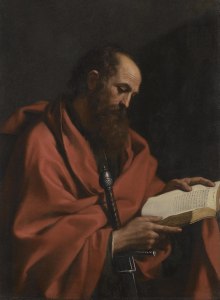
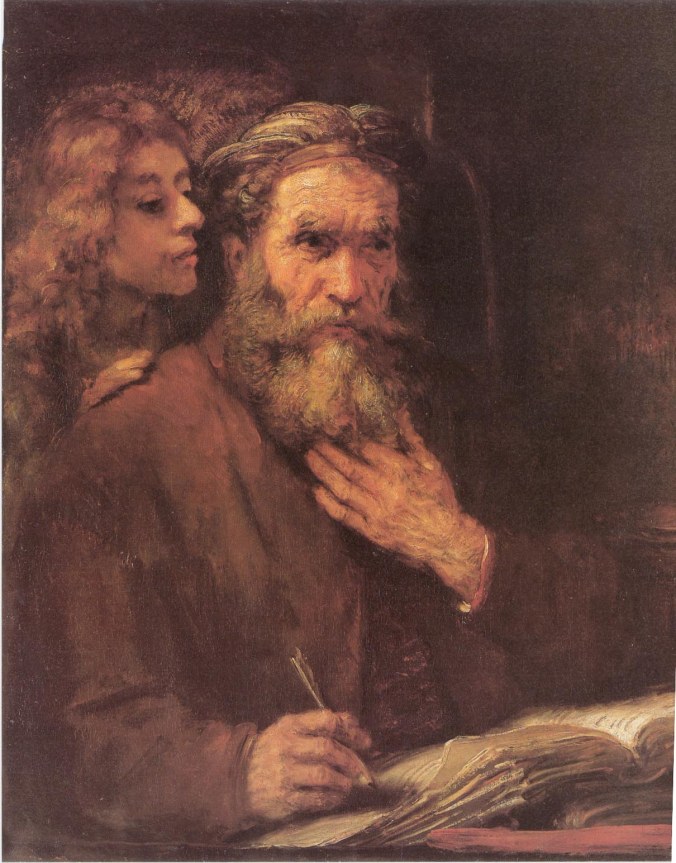
Saint Paul
by Rembrandt (1606-1669)

That same theme —“God in us” — runs straight into the reading from Acts. Paul’s conversion took place around 34 CE, and roughly twelve years later he launched the first of several missionary journeys. Between 46–60 CE, he traveled more than 10,000 miles across the Mediterranean world, most of it on foot. In Acts 17, we meet him on his second journey (around 51 CE), standing on the Areios Pagos in Athens after being chased out of Thessalonica and Berea. Picture Paul surrounded by a mix of philosophers, poets, civic leaders, skeptics, and people who are simply curious about this “new teaching” he’s bringing to town. Athens was a city that loved ideas, so Paul meets them on their own ground. He begins with something familiar—their altar “to an unknown god”—and uses it as a bridge to proclaim the God “who gives to all mortals life and breath” (v. 25). Then he goes a step further. To show he’s not attacking their culture but building on it, he quotes two of their own poets, Epimenides and Aratus, to affirm that “we too are his offspring” (v. 28). It’s a brilliant move: he honors their intellectual world while gently redirecting it toward the God revealed in Christ. And as Acts tells us, the response is mixed. Some laugh him off, but others—like Dionysius the Areopagite and a woman named Damaris—lean in and become part of the early Christian movement (vv. 32–34).

So what do we take from these readings? First, God’s love and the gift of the Spirit are not limited to insiders. They reach everyone — an unsettling truth in a world that thrives on division. Second, the Spirit doesn’t let us stay insulated. If we only talk to people who think like we do, we shrink. We freeze. We lose the story we’ve been given to share. The Spirit pushes us outward — into conversations, into community, into the messy, beautiful work of living what we proclaim. That’s where “God in us” becomes more than a word study. It becomes a way of life.

Soli Deo Gloria!

View of the Areios Pagos and the Acropolis (atop the hill)
Saint Paul Preaching at Athens

Leo von Klenze’s (1784-1864) painting (left) imagines the Acropolis and the Areios Pagos the way 19th‑century Europe wished classical Athens had looked—bright, orderly, and perfectly composed. Klenze wasn’t just guessing; he was one of the leading Neoclassical architects of his day and a major voice in the early archaeological debates about how ancient Greek buildings were actually painted and decorated. In this 1846 work, he gives us a sun‑washed Acropolis with temples and statues restored to their ideal form, while everyday Athenians gather on the Areios Pagos below. It’s less a literal reconstruction and more a love letter to the classical world — a blend of scholarship, imagination, and Klenze’s own vision for what a reborn Athens could be. Let’s imagine the Apostle Paul preaching there. James Thornhill’s (1675-1734) 1710 painting (right) captures that moment.

In John 14:15–21, Jesus promises that we are not left orphaned — that the Spirit will come alongside us, lifting us into a life shaped by love. Though her music is not explicitly spiritual, Mary Chapin Carpenter’s “Why Walk When You Can Fly?” carries that same invitation. Her song urges us to rise above fear and step into the freedom already given to us. Both the Gospel and the song remind us that courage is not self-generated; it comes from knowing we are accompanied. When we trust that presence, we discover that walking is no longer enough. We were made to fly. Enjoy this artist!

In this world, there’s a whole lot of trouble, baby
In this world, there’s a whole lot of pain
In this world, there’s as whole lot of trouble but
A whole lot of ground to gain
Why take when you could be giving?
Why watch as the world goes by?
It’s a hard enough life to be living
Why walk when you can fly?

In this world, there’s a whole lot of sorrow
In this world, there’s a whole lot of shame
In this world, there’s a whole lot of sorrow
And a whole lot of ground to gain
When you spend your whole life wishing
Wanting and wondering why
It’s a long enough life to be living
Why walk when you can fly?

And in this world, there’s a whole lot of golden
In this world, there’s a whole lot of plain
In this world, you’ve a soul for a compass
And a heart for a pair of wings
There’s a star on the far horizon
Rising bright in an azure sky
For the rest of the time that you’re given
Why walk when you can fly high?

Mary Chapin Carpenter (b. 1958) is an American singer‑songwriter whose warm voice and thoughtful, poetic writing blend folk, country, and Americana into songs that explore love, loss, resilience, and the quiet spiritual textures of everyday life.

St. Monica and Son

Monday 4 May
Monica, Mother of Augustine (d. 387)

Friday 8 May
Julian of Norwich, church renewer (d. 1416)

Saturday 9 May
Nicolaus Ludwig von Zinzendorf
church renewer and hymnwriter (d. 1760)


(Information on each is linked)

Statue of Dame Julian,
Norwich, England

A Spiritual Profile

Pew’s 2025 report (linked below) shows that American religious life has stopped its long slide and settled into a period of stability. After decades of steady decline, rates of religious identity, prayer, and worship attendance have basically held their ground since 2020.

Some observers have talked about a spiritual comeback among young adults, especially young men, but the data doesn’t support a broad revival. Younger Americans are still far less religious than older generations, and most of their current engagement simply mirrors the habits of their parents. Instead of a rebound, Pew describes a pause — a moment when the religious landscape isn’t shrinking the way it once did, but isn’t growing either, giving us a clearer picture of where American spirituality now stands.

Check Out the Polling Results Here!

Are You Looking for a Church Home?

Evangelical Lutheran Church in Black River Falls, is part of the Northwest Synod of Wisconsin (ELCA). We stream our Sunday worship at 9:30 each week. Please feel free to join us!
All are welcome!

Access our YouTube Channel here.

3 May 2026: 5 Easter

Introduction: “Many Mansions”

“When you look back on your life, what are the pivotal moments when you perceived the grace of an invitation to a different way of being, a way closer to God? How does it change your understanding of such moments if you think of them as the Lord at work, trying to ‘take you to myself, so that where I am, there you may be also’ — in other words, into deeper fullness of life and truth and communion with the Creator? Hearing anew this promise of Jesus as a way-maker to abundant life, not just once and for all through his death and resurrection but even and especially through the intimate details of your life, can be electrifying.” (Laurel Mathewson)

As I sat with this week’s readings — and especially John 14 — I kept returning to a recent article by Reverand Laurel Mathewson that reframed Jesus’ promise about “many dwelling places” (or “many mansions” in the King James version). As she suggests, we typically hear that line at funerals, but the author pushed me to hear it as a present invitation: the soul as an “interior castle,” full of rooms where Christ meets us now in the day to day of our earthly lives.

That image helped me rethink Jesus’ words, “I will take you to myself,” not as a distant hope but as something unfolding now in the daily rhythm of our lives. And when I set that beside Stephen’s story and Jesus’ exchange with Thomas and Philip — “I am the way, the truth, and the life” — the connection sharpened. Those first Christians were called “People of the Way” for a reason. Our gaze stays fixed on Christ because he is the one who draws us inward, builds us into a spiritual house, and leads us toward the Father.

In a world fractured by division and despair, this is the message we carry: a God who stands with us, restores us, and fills us with hope — not someday, but today. Later in this week’s blog, I am offering a hymn that follows the more traditional view of John 14. Consider both interpretations as you explore the readings this week!


Soli Deo Gloria!

Three Steps

Oratio (Prayer): This is the starting point, where one humbly prays for the Holy Spirit’s guidance to understand God’s Word. Luther emphasized that prayer prepares the heart and mind to receive divine wisdom.

Meditatio (Meditation): This involves deeply engaging with Scripture, not just reading it but reflecting on it repeatedly. Luther encouraged believers to “chew on” the Word, allowing its meaning to sink in and shape their thoughts and actions.

Tentatio (Struggle): Often translated as “trial” or “temptation,” this refers to the challenges and spiritual battles that arise as one seeks to live according to God’s Word. Luther saw these struggles as a way God refines faith, making it more resilient and authentic.

Image of the Week: The Stoning of Stephen

Rembrandt: The Stoning of Stephen (1625)
Rembrandt’s Self-Portrait

There is a lot going on in Rembrandt’s 1625 painting! The scene is derived from this week’s first reading (Acts 7: 55-60) — a Biblical passage that is deeply personal to me because of my name. Unk — my father — told me later in life that he chose Paul Stephen because he wanted me to grow up knowing the power of conversion (such is the life of a PK). As I studied the piece more closely, a few details jumped out. Rembrandt gives Stephen and Saul the same face. Saul sits in the upper center of the painting, holding the cloaks of the executioners, just as Acts describes. Once I noticed the shared features, it felt intentional –almost like Rembrandt was hinting at the transformation that will unfold in Acts 9. Violence and grace sit in the same frame. And then there’s Rembrandt himself. He slips into the crowd, peeking out from behind the man about to strike Stephen. His expression looks pained, almost conflicted. I read that as a quiet admission of our human tendency to stand by when injustice erupts around us. But the detail that keeps pulling me back is Stephen’s gaze. He doesn’t look at the men with stones in their hands. He looks up. Scripture says he sees Jesus standing at the right hand of God — a posture one commentator described as Christ choosing to stand with us rather than sit in judgment. Rembrandt paints that truth into Stephen’s face. It’s calm, illuminated, anchored somewhere beyond the chaos. That upward gaze still challenges me. It asks where I’m looking when pressure closes in—and whether I trust the God who stands with us.

The readings for 5 Easter unite around the call to entrust our lives to Christ, who forms us into a people grounded in God’s steadfast care and drawn into the life of the Father through him. Stephen’s martyrdom in Acts 7:55–60 shows a disciple who entrusts himself fully to the risen Christ, even in the face of violence, and whose final words echo Jesus’ own mercy. Psalm 31 reinforces this posture of trust, declaring that our times rest securely in God’s hands. 1 Peter 2:2–10 expands the vision by naming believers as “living stones” built into a spiritual house, chosen and called to reflect God’s light in the world. In John 14:2–14, Jesus promises that he prepares a place for his followers and reveals himself as the way to the Father, inviting them into a life shaped by faith, intimacy, and purposeful action. Together, these texts emphasize that God forms a people who rely on Christ’s presence, embody his mercy, and live with confidence in the future he secures.

ELCA Commemorations This Week

The ELCA’s Lesser Festivals and Commemorations grow from an old Christian practice—shared with Roman Catholicism—of remembering saints as fellow believers. Early Christians honored martyrs, apostles, and teachers whose lives made the gospel visible. Lutherans kept the practice but shifted the focus: we remember these people to point to the God who worked through them. Today, these commemorations root us in the church’s broad story and remind us that the same Spirit who inspired earlier believers is still shaping our witness. They appear on pages 15–17 of the ELW.

Catherina of Siena
(1347-1380)

Wednesday 29 April
Catherine of Siena, theologian (d. 1380)


Friday 1 May
Philip and James, APOSTLES


Saturday 2 May
Athanasius, Bishop of Alexandria (c. 373)

Music and Meditation: Mansions of the Lord

“Mansions of the Lord,” written by Randall Wallace and Nick Glennie‑Smith for the 2002 film We Were Soldiers, takes its title directly from Jesus’ promise in John 14:2 (KJV): “In my Father’s house are many mansions.” The hymn embraces the traditional, future‑tense reading of that passage—Christ preparing a place of rest, peace, and welcome beyond death. Its language of “no more weeping, no more fear” naturally resonates in military contexts, honoring those who have fallen in battle. Yet the imagery also extends to anyone who has “fought the good fight” of faith, offering comfort to all who long for God’s promised home. This stands in contrast to Laurel Mathewson’s reading in The Christian Century, where she shifts the focus from a future heavenly dwelling to the present, interior rooms where Christ meets us now. If Mathewson invites us to explore the soul’s inner chambers in this life, “Mansions of the Lord” points us toward the home Christ prepares in the next.

The West Point Glee Club’s interpretation of the song is offered here — they are accompanied by the West Point band. It raises some nostalgia for me due to our son’s experience at USMA in the early 2000s — we visited there a half dozen times and it is a remarkable school.

The West Point Glee Club is the premier choral ensemble of the U.S. Military Academy, known for its clear, disciplined sound and its role as a musical ambassador for West Point. The group performs at major national events, memorial services, and public ceremonies, often singing music that honors service and sacrifice—including their well‑known rendition of “Mansions of the Lord.” Their repertoire ranges from patriotic pieces to classical and contemporary works, all shaped by the Academy’s values of duty, honor, and country.

To learn more, you can visit the official West Point Glee Club page on the U.S. Military Academy’s website.

Going Beyond: Digital Ministry: The Bible Project

If you’re not familiar with The Bible Project, I heartily recommend this incredible resource to you. This devotional (below) is an example of the kind of work they are doing in helping millions of people explore scriptures more richly!

Explore their Website Here!

Are You Looking for a Church Home?

Evangelical Lutheran Church in Black River Falls, is part of the Northwest Synod of Wisconsin (ELCA). We stream our Sunday worship at 9:30 each week. Please feel free to join us!


Access our YouTube Channel here.

Reminder: Blog Purpose and Format

26 April 2026: 4 Easter

Introduction: Day by Day

Lincoln in May of 1860

As Christians, how do we hold the past, present, and future in a healthy balance? That question has been sitting with me this week. Having spent more than 45 years teaching history, I have spent much time wandering through the past. And while history can be a gift, it can also be perilous if we get stuck there. Sometimes we linger too long in the darker chapters — our own or the broader narratives of community or nation — and the weight of it keeps us from moving forward. Other times nostalgia takes over, that aching homesickness for a “better time” when life seemed simpler. A little nostalgia is harmless; too much can keep us from meeting life as it actually is. The future can trap us just as easily. Fear of what might be around the corner — especially in a world as anxious as 2026 — can leave us cynical or even despairing. A quote attributed to Abraham Lincoln comes to mind: “The best thing about the future is that it comes one day at a time.” I appreciate Lincoln’s simplicity and perspective — and I pray the Serenity Prayer each morning.

Maybe that’s why the phrase “day by day” in this week’s reading from Acts caught my attention. It appears twice, and it sent me back to my high school days and the 1973 film Godspell. You might remember the song Day by Day, inspired by both Acts 2 and the 13th‑century Prayer of Saint Richard of Chichester: “to know thee more clearly, love thee more dearly, follow thee more nearly, day by day.” The Swedish hymnwriter Lina Sandell penned a hymn by the same name in 1865 — I have included that story and a version of the hymn later in the blog.

What strikes me is how the earliest Christians lived this rhythm. They carried a living memory of the resurrection — imagine the energy in that community! They experienced “wonders and signs,” shared what they had, and leaned into a mission bigger than themselves. As indicated in Acts 2, they did it day by day, trusting God with what came next. Maybe that’s the model for us too. Not to deny the past or ignore the future, but to stop letting either one swallow the present. Today is the only day we are actually given. We can’t change yesterday, and we can’t control tomorrow. But we can show up today, with faith, courage, and hope. After all, “This is the day the Lord has made; let us rejoice and be glad in it.”

Soli Deo Gloria!

Three Steps

Oratio (Prayer): This is the starting point, where one humbly prays for the Holy Spirit’s guidance to understand God’s Word. Luther emphasized that prayer prepares the heart and mind to receive divine wisdom.

Meditatio (Meditation): This involves deeply engaging with Scripture, not just reading it but reflecting on it repeatedly. Luther encouraged believers to “chew on” the Word, allowing its meaning to sink in and shape their thoughts and actions.

Tentatio (Struggle): Often translated as “trial” or “temptation,” this refers to the challenges and spiritual battles that arise as one seeks to live according to God’s Word. Luther saw these struggles as a way God refines faith, making it more resilient and authentic.

Image of the Week

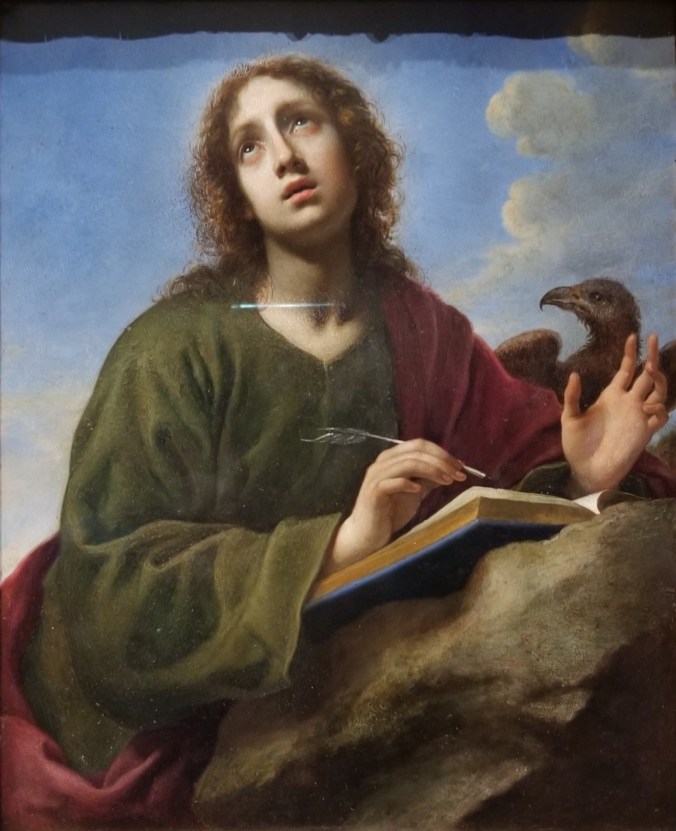
St. John and the Eagle

St. John, the author of this week’s Gospel, has been the focus of many artists. The Russian artist Vladimir Borovikovsky (1757-1825) depicted John as young and deeply attentive, almost as if he’s pausing to listen before he writes. That quiet, upward focus fits the long Christian tradition that sees John as the evangelist whose vision “soars” toward the divine. The eagle beside him comes straight out of that tradition: early Church Fathers linked John to the eagle in Ezekiel and Revelation, saying his Gospel rises highest into the mystery of Christ’s divinity. Borovikovsky leans into that symbolism but softens it—his eagle isn’t dramatic or fierce, just steady and companion-like, echoing John’s contemplative gaze. Painted in the early 1800s, the whole scene feels gentle and intimate, shaped by the luminous, polished style that marks Borovikovsky’s mature work and by the deep iconographic heritage he’s quietly carrying forward.

The readings for 4 Easter circle around one central promise: the risen Christ is the shepherd who gathers, guides, and guards a community shaped by his self‑giving love. Acts shows the early believers living this out in real time — devoted to teaching, fellowship, shared meals, and generous care — embodying the kind of life that grows when people trust the Shepherd’s voice. Psalm 23 gives the inner landscape of that trust: God leading, restoring, and accompanying us even through shadowed valleys. First Peter connects this care to the cross, reminding believers that Christ’s suffering is not defeat but the healing path that brings us back to the Shepherd and Guardian of our souls. And in John 10, Jesus names himself as both the shepherd who knows his sheep and the gate that opens into abundant life, tying the whole set of readings together in a vision of a community sustained, protected, and made whole by his presence.

ELCA Commemorations This Week

The ELCA’s Lesser Festivals and Commemorations grow out of a much older Christian instinct — shared with Roman Catholicism — to remember the saints as companions in faith rather than distant icons. Early Christians, especially in the Western (and later Roman Catholic) tradition, honored martyrs, apostles, and teachers whose lives made the gospel visible in their own generations. Lutherans kept that rhythm after the Reformation but shifted the emphasis: we remember these people not to elevate them, but to point to the God who worked through them. In the ELCA today, these commemorations help us stay grounded in the wide, diverse story of the church across time and remind us that the same Spirit who stirred courage, creativity, and compassion in earlier believers is still shaping our lives and our witness right now. You will find the listing of these on pages 15-17 of the ELW.

Toyohiko Kagawa
(1888-1960)

Tuesday 21 April
Anselm, Bishop of Canterbury (d. 1109)


Thursday 23 April
Toyohiko Kagawa, renewer of society (d. 1960)


Saturday 25 April
Mark, EVANGELIST

Music and Prayer: Day by Day (Sandell and Ahnfeldt)

Lina Sandell (1832-1903)

Carolina (“Lina”) Sandell Berg wrote Day by Day in 1865, several years after witnessing the tragic drowning of her father — a Lutheran pastor — a moment that shaped her lifelong emphasis on God’s daily care. Sandell wrote more than 650 hymns, many of them centered on trust, providence, and the nearness of God in ordinary life. When Oskar Ahnfelt (1813-1882) later set Blott en dag to music in 1872, his gentle melody helped carry the hymn across Sweden and eventually into the Swedish‑American community, where it was translated into English in the early 20th century. It became a favorite hymn of Scandinavian-Americans and was often sung at funerals.

There’s no evidence Sandell was thinking of Acts 2:46–47 when she wrote the hymn, even though the passage uses the same phrase “day by day.” But the thematic overlap is unmistakable. Acts describes the early church receiving God’s gifts one day at a time — daily bread, daily fellowship, daily grace. Sandell’s hymn echoes that same rhythm of trust: God gives strength for today and tomorrow rests in God’s hands. Whether or not she had Acts 2 open on her desk, she was writing out of a pietist tradition that loved the idea of daily dependence on God. That’s why the pairing feels so natural: both the Scripture and the hymn invite us to live in the present moment, trusting that God meets us there.

The hymn is part of the ELW (#790) and this piano interpretation by Sangah Noona is especially good. If you need a few moments of peace this week, enjoy this hymn!

Sangah Noona (born 1987) is a South Korean–born pianist known for her expressive playing and easy connection with listeners. She grew up in Seoul, started piano at five, and later studied music at Dongduk Women’s University before building a busy career as a session musician and hotel pianist. After moving to the United States, she kept performing in high‑end venues but also found a huge audience online, where her YouTube livestreams mix classical training with pop, jazz, rock, and whatever her viewers request. Her style is warm, versatile, and unpretentious — the kind of playing that makes you feel like you’re right there in the room with her.

Going Beyond: Digital Ministry and Global Refuge

Global Refuge—once known as Lutheran Immigration and Refugee Service—has spent more than eight decades doing something that sits right at the heart of the Gospel: welcoming people who’ve been pushed to the margins and helping them rebuild their lives with dignity. What started in 1939 as a Lutheran effort to care for families displaced by war has grown into a nationwide network that accompanies refugees, asylum seekers, unaccompanied children, and migrants with legal support, resettlement services, mental‑health care, and practical help that restores hope. At its core, the organization lives out Jesus’ call to love the stranger, protect the vulnerable, and see every person as a neighbor worth showing up for—no prerequisites, no exceptions, just the steady work of compassion in action.

VISIT THE GLOBAL REFUGE WEBSITE

Are You Looking for a Church Home?

Evangelical Lutheran Church in Black River Falls, is part of the Northwest Synod of Wisconsin (ELCA). We stream our Sunday worship at 9:30 each week. Please feel free to join us!


Access our YouTube Channel here.

Reminder: Blog Purpose and Format

Two Worlds: 22 March 2026: 5 Lent

Henri Nouwen (1932-1996)


“Discipline means to prevent everything in your life from being filled up. Discipline means that somewhere you’re not occupied, and certainly not preoccupied. In the spiritual life, discipline means to create that space in which something can happen that you hadn’t planned or counted on.”

(Henri Nouwen, Dutch Theologian)

This Week’s Readings

Themes and Connections

The readings for 5 Lent trace a movement from death’s grip toward the life-giving breath of God. Ezekiel’s vision of the dry bones and the psalmist’s cry “out of the depths” both name the stark reality of human despair while trusting that God can raise what seems lost. Paul deepens this hope by contrasting the futility of the flesh with the Spirit who brings life to mortal bodies. In John’s account of Lazarus, Jesus embodies this promise by stepping into grief, calling forth new life, and revealing God’s power to transform even the tomb into a place of awakening.

The Readings are Linked!

The Raising of Lazarus by Van Gogh (1890)

Image of the Week

Francisco Collantes’ The Vision of Ezekiel (1630) plunges the viewer into the drama of Ezekiel 37 with a sweeping, almost theatrical sense of scale. The prophet stands elevated in his blue robe, arm outstretched as he confronts a valley littered with bones and half‑formed bodies—figures caught in the very moment between death and restoration. Around him, ruins and crumbling architecture heighten the sense of desolation, while the turbulent sky above suggests divine power breaking into the scene. The whole composition captures the tension and hope of the biblical vision: God’s breath stirring a devastated people back to life, an “exceeding great army” rising where only despair once lay.

“The Vision of Ezekiel” (1630) by Spanish painter Francisco Collantes (1599-1656)

This Week’s ELCA Commemorations

Jonathan Edwards was born in 1703 in East Windsor, Connecticut, into a prominent Puritan family, and his early brilliance carried him to Yale at thirteen. He emerged as a central figure of the First Great Awakening in Northampton, where his preaching and writing helped redefine Calvinist theology for a changing colonial world. After conflicts over church membership led to his dismissal, he spent productive years as a missionary and scholar in Stockbridge, working among Mohican and Mohawk communities while completing major theological works. In 1758 he became president of the College of New Jersey, but died shortly after from a smallpox inoculation, leaving a legacy as one of early America’s most influential theologians

Learn More About His Story Here!

Musical Meditation: Abide With Me

Henry Francis Lyte 
(1793-1847)

Abide With Me comes out of Henry Francis Lyte’s own season of weakness and uncertainty, and that’s part of why it still feels so human. He wrote it near the end of his life, when the days really were “fast falling,” and his simple plea for God to stay close has the same emotional honesty you hear in Psalm 130. The psalmist cries “out of the depths” and waits for God the way a watchman waits for morning; Lyte is doing something similar, just in the language of evening—naming the fears that surface when things grow dim and trusting that God’s presence won’t slip away. Put together, the hymn and the psalm sound like two voices in the same room: one calling from the depths, the other from the edge of night, both leaning on the same steady mercy. The version I’m including here comes from a performance by the Concordia Choir at Central Lutheran in Minneapolis from 2024. Enjoy!

Lyrics

Abide with me; fast falls the eventide;
The darkness deepens; Lord, with me abide;
When other helpers fail and comforts flee,
Help of the helpless, oh, abide with me.

Swift to its close ebbs out life’s little day;
Earth’s joys grow dim, its glories pass away;
Change and decay in all around I see—
O Thou who changest not, abide with me.

I need Thy presence every passing hour;
What but Thy grace can foil the tempter’s pow’r?
Who, like Thyself, my guide and stay can be?
Through cloud and sunshine, Lord, abide with me.

I fear no foe, with Thee at hand to bless;
Ills have no weight, and tears no bitterness;
Where is death’s sting? Where, grave, thy victory?
I triumph still, if Thou abide with me.

Hold Thou Thy cross before my closing eyes;
Shine through the gloom and point me to the skies;
Heav’n’s morning breaks, and earth’s vain shadows flee;
In life, in death, O Lord, abide with me.

Prayer Meditation: The Prayer of St. Patrick

The Prayer of St. Patrick (483) — often called St. Patrick’s Breastplate — is a bold, rhythmic call to “bind” oneself to God’s strength, presence, and protection. It paints a vivid picture of Christ surrounding the believer on every side, turning faith into something embodied and fiercely alive. Rooted in early Irish Christianity, the prayer endures because it speaks to our deep desire for courage, grounding, and the sense that God walks with us into every moment. I’m including it this week in honor of St. Patrick and for those with Irish heritage — in my case, twelve percent according to DNA testing. My Viking ancestors, apparently, made trips to Ireland!

St. Patrick by Giovanni Battista Tiepolo (1696-1770)

Christ with me, Christ before me, Christ behind me,
Christ in me, Christ beneath me, Christ above me,
Christ on my right, Christ on my left,
Christ where I lie, Christ where I sit, Christ where I arise,
Christ in the heart of everyone who thinks of me,
Christ in the mouth of every one who speaks to me,
Christ in every eye that sees me,
Christ in every ear that hears me.
Salvation is of the Lord.
Salvation is of the Christ.
May your salvation, Lord, be ever with us.

Going Beyond (Faith At Work)

Greetings from Texas! We’re spending time with Jake and family this week.

FOR THOSE INVOLVED . . . .

Our in-person Lectionary discussion group that meets at ELC will be off until APRIL 12TH. This is due to travel on my part and activities on Palm Sunday and Easter.


Join Us for Worship and Study

Evangelical Lutheran Church in Black River Falls, Wisconsin, and is part of the Northwest Synod of Wisconsin (ELCA). We stream our Sunday worship at 9:30 each week. Please feel free to join us!


Access our YouTube Channel here.

Evangelical Lutheran Church (2024)
Joel Busse Photograph

Two Worlds: 15 March 2026: 4 Lent

“The world desperately needs this Lutheran witness. In our current context, we see so much yelling — even as many people don’t feel heard or seen. There is so much anger, even as so many people’s hearts are breaking with grief. We are surrounded by so many voices, images and opinions, even as many people feel isolated and alone. God’s love has the power to break through all this noise, break down all this division, break apart all this cruelty. One person — you, the bearer of this love — can make all the difference. Put your body where love is needed.”

(Reverand Kristin Johnston Largen, President of Warburg Seminary, Iowa)

Thanks for your visit here again this week! Monday (9 March) marks Day 16 of the Lenten season (40 days from Ash Wednesday to Easter Sunday (not counting Sundays).

A reminder: Utilize the Table of Contents to navigate various sections of the blog and also take note of links within the text (italicized and bolded) that offer further explanations.

This Week’s Readings

Themes and Connections

The readings for 4 Lent trace how God sees and restores what human eyes overlook, moving people from shadow into true sight. Samuel learns that God chooses by the heart, Psalm 23 voices trust in a shepherd who leads through darkness, and Ephesians calls believers to awaken as children of light. John 9 embodies all of this as Jesus opens the eyes of a man born blind, revealing that real vision comes through encounter with God’s mercy rather than human judgment.

Image of the Week

“Healing of the Blind Man” by Danish painter Carl Bloch (1834-1890)

Carl Bloch’s Healing of the Blind Man (1871) shows Jesus meeting Bartimaeus with a calm, steady authority as the blind man kneels and reaches toward him. The scene unfolds against dark stone walls, where townspeople, children, skeptics, and disciples gather — each reacting in their own way to the moment of grace. Bloch, a Danish painter trained at the Royal Danish Academy and shaped by years studying Italian masters, became known for religious works that combine emotional clarity with dramatic light. This painting highlights the shift from darkness to light, both in the setting and in Bartimaeus’s awakening, reflecting Bloch’s conviction that Christ’s miracles reveal a deeper kind of sight.

This Week’s ELCA Commemorations

Among this week’s commemorations, Harriet Tubman and Sojourner Truth come across as two women who simply refused to let the world stay as it was, and they carried a fierce, grounded faith that shaped everything they did. Tubman’s courage on the Underground Railroad and Truth’s preaching and public witness both grew out of a deep conviction that God intends freedom, dignity, and wholeness for every person. The ELCA remembers them as renewers of society because their lives didn’t just challenge injustice — they helped re‑imagine what a just society could look like, insisting that faith must take the side of the oppressed. Their stories still nudge us today to put our own bodies where love, courage, and truth are needed most.

Learn More About Their Remarkable Stories Here!

Sojourner Truth (1797-1883)
Harriet Tubman (1822-1913)

Musical Meditation and Prayer: Amazing Grace

John Newton (1725-1807)

Amazing Grace began as a New Year’s Day sermon illustration John Newton wrote in 1772, long after a violent storm at sea first shook him awake to God’s mercy during his years in the slave trade. Newton later became an Anglican priest in Olney, England, where he and poet William Cowper published the text—then titled Faith’s Review and Expectation—in their 1779 collection Olney Hymns, printed without any musical setting. The hymn remained relatively modest in England, but it flourished in the United States during the early 19th century, especially amid the revivalism of the Second Great Awakening, where its message of grace resonated across denominations. Its now‑familiar melody, New Britain, was added in 1835 by American composer William Walker, and that pairing transformed Amazing Grace into one of the most widely sung hymns in the world, cherished for its simple poetry, its honest confession, and its enduring promise of redemption.

The version offered here is a wonderful interpretation of the song performed by the Salt Lake Choral Artists. Enjoy!

Lyrics

Amazing grace! How sweet the sound
That saved a wretch like me!
I once was lost, but now am found;
Was blind, but now I see.

’Twas grace that taught my heart to fear,
And grace my fears relieved;
How precious did that grace appear
The hour I first believed.

Through many dangers, toils, and snares,
I have already come;
’Tis grace hath brought me safe thus far,
And grace will lead me home.

The Lord has promised good to me,
His Word my hope secures;
He will my Shield and Portion be,
As long as life endures.

When we’ve been there ten thousand years,
Bright shining as the sun,
We’ve no less days to sing God’s praise
Than when we’d first begun.


Note: These lyrics are drawn from the ELW (779).

Going Beyond (Faith At Work)

And, here is something you may find hopeful regarding the situation in the Middle East — it is from the Lutheran World Federation (LWF) website:

Joint statement from Anglican, Lutheran, Methodist and Reformed church leaders 

Leaders of four global Christian communions say they are “profoundly dismayed” at the international community’s failure to prevent wars including the escalation of conflict in Iran and the Middle East.

Read the Full Statement Here

Join Us for Worship and Study

Evangelical Lutheran Church in Black River Falls, Wisconsin, and is part of the Northwest Synod of Wisconsin (ELCA). We stream our Sunday worship at 9:30 each week. Please feel free to join us!


Access our YouTube Channel here.

Pioneer Chapel and Christ Statue, ELC

ONE MORE THING!

Our in-person Lectionary discussion group that meets at ELC will be off until APRIL 12TH. This is due to travel on my part and activities on Palm Sunday and Easter.

Two Worlds: 8 March 2026: 3 Lent

In his encounter with the Samaritan woman at the well, Jesus must overcome a number of barriers to interaction, much less to genuine, vulnerable conversation. Their contrasting genders, ethnic identities, faiths, and social roles all discourage them from speaking to each other . . . And when she leans in, connecting his proclamation to her own sacred teachings, Jesus honors her with his own trust. He confesses to her — the first person to whom Jesus himself makes this claim in John’s Gospel — that he is the expected Messiah.” (Serena Rice)

The Samaritan Women” by Tito (c. 1919)

This Week’s Readings

Themes and Connections

The readings for Lent 3 tighten around a single arc: people thirst, hearts harden, and God meets that resistance with sustaining mercy. Israel’s quarrel at Massah and Meribah becomes the backdrop for Psalm 95’s warning, even as Paul names the deeper truth—God pours out love precisely when we are weakest. That love takes flesh in Jesus’ encounter with the Samaritan woman, where living water breaks open old boundaries and turns skepticism into witness.

Image of the Week

“Christ and the Samaritan Woman,” (c. 1593) by Annibale Carracci (1560-1609)

Carracci’s Christ and the Samaritan Woman captures the moment when an ordinary stop at a well turns into a life‑changing conversation. Jesus leans toward her with a calm, open gesture, meeting her right in the middle of her daily routine—much like Pastor Serena Rice describes, breaking through every barrier that should have kept them apart. The woman pauses with her jar, caught between the world she knows and the unexpected trust he offers, and the whole scene glows with the quiet revelation of someone realizing, perhaps for the first time, who is standing before her.

Learn more about this painting here.

This Week’s ELCA Commemorations

Perpetua and Felicity were part of a small group of North African Christians martyred in Carthage in 203, during a wave of persecution under Emperor Septimius Severus. Perpetua — a young noblewoman and new mother — and Felicity — an enslaved woman who gave birth in prison days before the execution — stood alongside their companions as a community formed not by status but by baptismal identity. Their story, preserved in The Passion of Saints Perpetua and Felicity, shows them crossing social, economic, and gender boundaries with the same kind of courageous trust Pastor Serena Rice highlights in the Samaritan woman: when Christ meets people across the lines meant to divide them, they respond with a boldness that still speaks to us today.

Learn More About Their Story Here!

Musical Meditation

“I Heard the Voice of Jesus Say” comes from Horatius Bonar (1808–1889), a Scottish pastor who wrote it in the 1840s during his ministry in Kelso. He crafted it as a simple, direct invitation to Christ — part of his wider effort to give congregations and young people clear, memorable gospel language. Its imagery of thirst, rest, and living water echoes the story of Jesus and the Samaritan woman in John 4, where Christ meets human need with an offer of life that never runs dry. The hymn appears in Evangelical Lutheran Worship at ELW 332, placed in the Lent section, and most hymnals trace its origin to Bonar’s early collections such as The Bible Hymn‑Book (1845–1850), where several of his texts first appeared.

Lyrics

1. I heard the voice of Jesus say,
“Come unto Me and rest;
Lay down, O weary one, lay down
Thy head upon My breast.”
I came to Jesus as I was,
Weary, and worn, and sad;
I found in him a resting-place,
And he has made me glad.

2. I heard the voice of Jesus say,
“Behold, I freely give
The living water; thirsty one,
Stoop down, and drink, and live.”
I came to Jesus, and I drank
Of that life-giving stream;
My thirst was quench’d, my soul revived,
And now I live in him.

3. I heard the voice of Jesus say,
“I am this dark world’s Light;
Look unto me, your morn shall rise,
And all your day be bright.”
I looked to Jesus, and I found
In him my Star, my Sun;
And in that Light of life I’ll walk,
Till trav’ling days are done
.

Prayer Meditation: The Serenity Prayer

The latest U.S.–Israeli bombing strikes in the Middle East have stirred that familiar heaviness — the sense that the world might be sliding toward another war. With a soldier in the family for more than twenty years, we have learned to take these moments in stride and not overreact, but they still land hard. In times like this, the heart reaches for words that steady us, which is why Reinhold Niebuhr’s Serenity Prayer still feels so alive. When it first appeared in the 1944 Book of Prayers and Services for the Armed Forces, chaplains used it to help soldiers face fear, uncertainty, and the limits of their own control. But the prayer was never meant for military life alone. Its quiet movement—from accepting what can’t be changed, to acting where we must, to discerning the difference—speaks just as clearly to civilians watching events unfold from a distance yet feeling their weight. In every era of conflict, it offers a way to stay grounded without becoming resigned, and hopeful without becoming naïve.

Protestant Theologian Reinhold Niebuhr
(1892-1971)

God grant me the serenity
to accept the things I cannot change;
courage to change the things I can;
and wisdom to know the difference.

Living one day at a time;
Enjoying one moment at a time;
Accepting hardships as the pathway to peace;
Taking, as He did, this sinful world
as it is, not as I would have it;
Trusting that He will make all things right
if I surrender to His Will;
That I may be reasonably happy in this life
and supremely happy with Him
Forever in the next.
Amen.

Going Beyond (Faith At Work)

The Lutheran World Federation—a global communion of Lutheran churches that includes the ELCA—marks four years of accompanying Ukrainians through the trauma and displacement caused by Russia’s full‑scale invasion. Its teams and member churches continue to repair homes, support schools, and provide psychosocial care even as violence intensifies and winter conditions worsen. Ukrainian church leaders express deep gratitude for global solidarity and urge continued support as international funding declines and humanitarian needs grow.

Read more about this story here!

Join Us for Worship and Study

Evangelical Lutheran Church in Black River Falls, Wisconsin, and is part of the Northwest Synod of Wisconsin (ELCA). We stream our Sunday worship at 9:30 each week. Please feel free to join us!


Access our YouTube Channel here.

Pioneer Chapel and Christ Statue, ELC

Access the Homepage of Two Worlds here
(linked to the picture). I offer more background there and also the entire archive of the first three years
.


Two Worlds: 1 March 2026: 2 Lent

African Methodist Episcopal Church
Nicodemus, Kansas
Nicodemus by Tissot, 1850

This Week’s Readings

Themes and Connections

The readings for 2 Lent trace a movement of trust: Abram steps into an unknown future on the strength of God’s promise, the psalmist lifts his eyes to the One who guards every step, and Paul insists that such trust—faith apart from works—is the true inheritance of God’s people. Nicodemus’s nighttime conversation with Jesus extends this theme, revealing that new birth and salvation flow not from human effort but from God’s initiative and love. Together, the texts invite a posture of receptive faith that opens us to God’s surprising, life‑giving future.


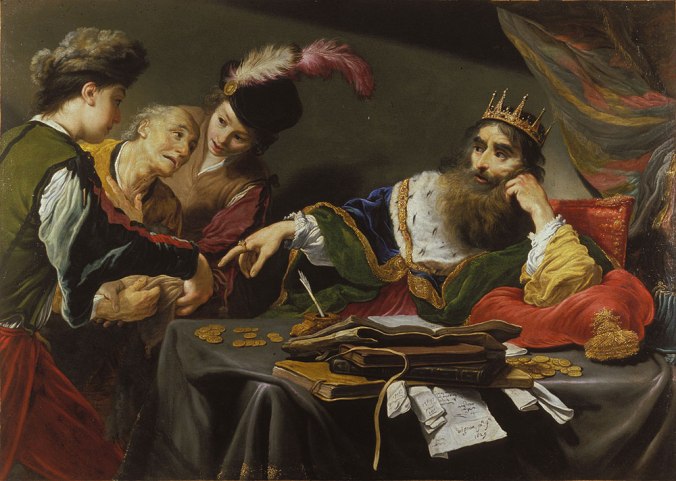
Image of the Week: “Christ and Nicodemus

“Christ and Nicodemus” by Matthias Stom (c.1600 –1652) Dutch-Flemish

Matthias Stom’s depiction of John 3: 1-17 comes from the mid-1600s. Stom was drawn to moments when people were wrestling with big spiritual questions, so Nicodemus’s late‑night conversation was a natural fit for him. In the world Stom inhabited — where the church was urging people toward personal renewal — the scene underscores the heart of the passage: a respected teacher trying to make sense of new birth and the depth of God’s love revealed in Christ.

Learn more about the artist here.

This Week’s ELCA Commemorations

Elizabeth Fedde
(1850-1921)

Norwegian immigrant Elizabeth Fedde played a significant role in the Deaconess movement, a Christian tradition focused on social service and ministry. Drawing from her own experiences and convictions, she championed the idea of women serving in practical, hands-on roles within their communities, particularly in addressing the needs of the poor and marginalized.

Fedde came to Minneapolis in 1888 at the invitation of Midwestern Lutherans who wanted to replicate the deaconess work she had pioneered in Brooklyn. During her brief but influential stay, she founded a deaconess home and helped launch what became the Hospital of the Lutheran Free Church — Deaconess Hospirtal. Her Minneapolis work anchored Lutheran social ministry in the Upper Midwest and shaped care for generations of Norwegian‑American immigrants. Thanks to my pal Rollie Lee for putting me on to Fedde’s story! 


Read about Elizabeth here!

Musical Meditation

“There Is a Balm in Gilead” has long been one of my favorites because my mother, Cathy Rykken, sang it often, and its soaring melody fit her soprano voice beautifully. The song itself grew out of the 19th‑century African American spiritual tradition, drawing on Jeremiah’s question about healing in Gilead and transforming it into a Christian affirmation that Christ restores the “sin‑sick soul.” Included as one of roughly fourteen spirituals in the Evangelical Lutheran Worship hymnal (#614), it isn’t officially a Lenten hymn, yet congregations often sing it during Lent because its message of healing and hope speaks so directly into the season’s themes. My sense is they sang this often in that AME Church in Nicodemus, Kansas!

The interpretation I posted here is remarkable in a couple ways. The sound quality is superb (especially good with headphones), and the style makes it meditative. Enjoy!


Prayer Meditation: Psalm 121

Psalm 121, one of the “Songs of Ascents,” likely accompanied pilgrims on their climb to Jerusalem and speaks with steady confidence about God’s protective care. It has long been my favorite. Known as “The Traveler’s Psalm,” my father requested it for his funeral in 2013, echoing his saying that “we’re all just traveling through.” I later learned it had been read at his father’s funeral as well, a quiet thread of faith that binds our family across generations. The accompanying prayer reflects the Psalm.

Further Information Here

God, you know the roads we walk and the ones we can’t yet see. Lift our eyes when we grow tired, and steady us with the promise that you never drift off or look away. Watch over our coming and going today—every step, every conversation, every quiet moment—and keep us rooted in the trust that you travel with us. Amen.

Going Beyond (Faith At Work)

1960s Lutheran Humor

If you grew up within the tradition of 1950s and 60s Lutheranism, these cartoons by Charles Schultz resonate!
Schultz had a gift.

Join Us for Worship and Study

Evangelical Lutheran Church in Black River Falls, Wisconsin, and is part of the Northwest Synod of Wisconsin (ELCA). We stream our Sunday worship at 9:30 each week. Please feel free to join us!


Access our YouTube Channel here.

Pioneer Chapel and Christ Statue, ELC

Access the Homepage of Two Worlds here
(linked to the picture). I offer more background there and also the entire archive of the first three years
.

15 February 2026: Transfiguration of our Lord


“The same thing should happen here in the Christian Church; none other should be preached or taught except the Son of God alone. Of Him alone it is said, ‘This is My beloved Son; listen to Him’ (Matthew 17:5) and no other, be he emperor, pope, or cardinal. Therefore, this is what I say: I grant that emperor, pope, cardinals, princes, and nobles are wise and understanding, but I shall believe in Christ. He is my Lord. He is the one God bids me to listen to. From Him He bids me to learn what real, divine wisdom and understanding are.” (Martin Luther, 15 February 1546)

Mount Tabor, Israel

After completing the full three‑year Revised Common Lectionary cycle begun in February 2023, I’m shifting this blog to a refreshed format. Much will feel familiar, but a few new features stand out.

First, the Table of Contents on the right now helps you navigate the site. Second, the scripture readings are linked for quick access. Third, a new section — Going Beyond — offers additional resources to deepen your engagement.

The blog remains a work in progress, and any errors are mine.

The Readings

Themes and Connections

The Transfiguration readings center on God revealing divine glory and naming the beloved Son as the one we are called to hear. Sinai’s fire, Psalm 2’s royal claim, and 2 Peter’s witness all converge in the radiance of Christ. That revelation sends the disciples—and the church—back into the world shaped by what they have seen and heard.

Try the Four-Question Approach to the Readings

What is something NEW?

What is something that made you REFLECT?

What is something that RELATES to prior knowledge?

What is something you would like to further DISCUSS?

Image of the Week

The Transfiguration by Carl Heinrich Bloch (1834–1890)

Explore Bloch’s Painting Here

This Week’s Commemoration

Saturday 14 February

Cyril (d.869) and Methodius (d.885) were ninth‑century brothers whose mission to the Slavic peoples shaped the religious and cultural landscape of Eastern Europe. They created the first Slavic alphabet and translated Scripture and liturgy so people could worship in their own language. Their work eventually gave rise to the Cyrillic script and established a lasting vernacular Christian tradition. Both East and West honor them as saints who embodied a generous, culturally rooted vision of the gospel.

Musical Meditation: “I Am Light” (India Arie)

India Arie’s “I Am Light” reminds me of Matthew’s Transfiguration account because both name a transformation rooted in God’s love rather than in human striving. On the mountain, Jesus’ radiance reveals the truth already alive in him, and that revelation becomes a promise for us: in Christ, God’s love reshapes who we are and how we see ourselves. Both the gospel moment and the song remind us that this light is not meant to stay on the mountain; we carry it with us as we return to the world, living out the transformation God has begun.

I hope you will enjoy this interpretation of the song performed by the Vancouver Youth Choir
!

India Arie (b. 1975)


The Vancouver Youth Choir is one of Canada’s most acclaimed youth choral organizations, known for its high artistic standards and inclusive community. Founded in 2013 by artistic director Carrie Tennant, it now includes more than 700 singers ages 5–24 across multiple ensembles and is recognized for adventurous programming and innovative performances. The flagship choir has earned national and international attention, with highlights that include first prize in the Canadian National Choral Competition and appearances at major festivals and venues such as the IFCM World Symposium on Choral Music and Carnegie Hall.

Visit Their Website for More Information

Prayer (Collect) for Transfiguration Sunday

O God, in the transfiguration of your Son you confirmed the mysteries of the faith by witnesses of Moses and Elijah, and in the voice from the bright cloud declaring Jesus your beloved Son, you foreshadowed our adoption as your children. Make us heirs with Christ of your glory, and bring us to enjoy its fulness, through Jesus Christ, our Savior and Lord, who lives and reigns with you and the Holy Spirit, one God, now and forever. Amen.

Going Beyond

Further Exploration

Richard Lischer is an author and professor emeritus at the Duke Divinity School. In the following essay, he provides great insights into the Transfiguration story.

Access it here.

Luther’s FINAL SERMON is worth your time. The last paragraph is especially personal — realize he died three days later.

Access it here.

Access the Homepage of Two Worlds here
(linked to the picture).

I offer more background there and also the entire archive of the first three years.

Join Us for Worship and Study

Evangelical Lutheran Church in Black River Falls, Wisconsin, and is part of the Northwest Synod of Wisconsin (ELCA). We stream our Sunday worship at 9:30 each week. Please feel free to join us!

Access our YouTube Channel here.

Also, join us Sunday for in-person discussion of the Lectionary in the church library from 10:45-11:00. All are welcome!


8 February 2026: 5 Epiphany

Dr. Jennifer T. Kaalund
New Testament Scholar

“The past teaches us that the role of memory in identity formation is profound. Remembering who we really are is a sacred act. Histories are never objective, are always complicated, and are most often contested. We don’t have to look beyond our own families to know how often people respond to another’s memories with, “Well, that’s not how I remember it happening.” Both truths sit beside each other. Though memory is always haunted by the possibility of forgetting, it is the very act of remembering that fortifies our identity and reminds us who we are.” (Jennifer T. Kaalund)

Jennifer Kaalund’s words feel like an apt doorway into this final entry of a three‑year experiment. When I began walking through Years A, B, and C of the Revised Common Lectionary in February of 2023, it was simply a way to understand the weekly rhythm of readings more deeply. I didn’t know where it would lead. But staying open — to scholars and pastors, to poets and historians, to voices outside my own tradition — became its own kind of spiritual practice. Week by week, I found myself learning from perspectives I hadn’t expected and discovering how wide the conversation of faith really is.

So what have I learned? Many things, of course. But one truth rises to the surface as I close this chapter: our faith is rooted in history, and through Scripture we are in conversation with people across centuries. Their memories, their questions, their hopes still meet us in the text. And it is our responsibility to remain rooted in those memories and to carry them forward with care. Christianity emerged from the deep roots of Judaism, yet it also opened a profoundly liberating moment in human history. That tension — continuity and newness, memory and transformation — remains compelling to me as a historian. When we stay open, history doesn’t confine us. It grounds us, enriches us, and sometimes even sets us free. As I get ready to turn the page and move this blog into its next season, one truth stays with me: remembering who we are matters, and it’s something we do side by side.

Second, in the past 36 months, I have realized over and over again that knowledge of the Bible is an infinite process. A metaphor: let’s imagine Lake Superior represents the full understanding of God’s Word. Now picture me walking around with a small pail of water — that is what I know!

And one other thing. I remain convinced that we have much work to do as a society in how we experience the news of our world day to day — this feels like a recurring theme for me. I have spent my adult life trying to figure this out and how to relay it to students. The intersection of our spiritual lives with the complexities of our world remains a challenge, one that I suspect we share with our Christian ancestors across time. In that regard, let me point you to a terrific meditation I stumbled on this week from a woman named Peggy Haslar. I commend it to your reading this week — I linked it here.

Commemorations This Week

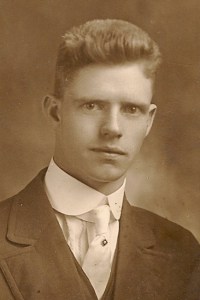
Unk Rykken (1943)
Bishop Ansgar
(801-865)

Thanks for visiting this space again this week and for your participation in this experiment! And let’s try to wrap our heads around this: By the time you may be reading this, Ash Wednesday is two weeks away! Hard to believe!

We have three commemorations on the ELCA calendar this week: The Presentation of Our Lord on Monday (2 February), Ansgar, Bishop of Hamburg, missionary to Denmark and Sweden on Tuesday (3 February), and the Martyrs of Japan on Thursday (5 February). Ansgar is of particular interest to me owing to the fact that my father’s name was Thorwald Ansgar and his rough attempts to “say” his middle name as a child (“Unksgar”) led to his nickname (“Unk”). My grandfather, also Thor, named his son for the Nordic pagan god and the Bishop who later Christianized Norway (go figure), something that always brought a good laugh from Unk. As they say, “you can’t make it up!” Oh, these ancestors of mine . . . .

Changes Coming Soon With the Lectionary Blog!

This week’s post wraps up the three‑year lectionary cycle we started back in February 2023. Beginning with Transfiguration Sunday (15 February), the blog will shift to a simpler design and a new name—Two Worlds—as part of a renewed focus on digital ministry and easier online engagement. Since I’m discontinuing the mailing list, you’ll need to subscribe directly through WordPress to keep receiving posts at no cost: enter your email near the bottom of the page, confirm the message WordPress sends, and you’re set. If the confirmation email goes missing, check your spam folder, and remember you can adjust your settings anytime through the “Manage Subscription” link. And for anyone on the old mailing list who runs into trouble, just send me a note — I can add you manually. If you go or stay, thanks again for your participation!

Luther’s Approach to Reading the Bible — Give it a try!

Lectio Divina is a quiet, thoughtful way of reading the Bible to connect with God. It grew out of early Christian traditions and was shaped by thinkers like Augustine, who believed Scripture speaks to the heart. Augustine didn’t invent the practice, but his ideas helped form its spirit—listening deeply and responding with love. Later, others gave it a clear structure, but its roots go back to that longing for God’s voice.

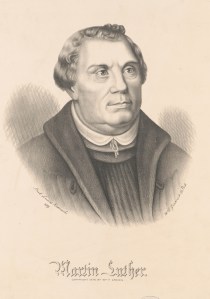
Martin Luther
(1483-1546)

Readings for 5 Epiphany


Isaiah 58: 1-9a (9b-12)
Psalm 112: 1-9 (10)
1 Corinthians 2: 1-12 (13-16)
Matthew 5: 13-20

Common Themes Among the Readings

The readings for the Fifth Sunday after Epiphany converge around the truth that authentic faith is revealed through a life shaped by God’s light, wisdom, and justice. Isaiah insists that true worship is inseparable from acts of mercy — loosening the bonds of oppression, sharing bread with the hungry, and rebuilding what has been broken — promising that God’s light dawns precisely through such compassion. Psalm 112 echoes this vision, portraying the righteous as people whose generosity, steadiness, and justice make them shine in the darkness. Paul reminds the Corinthians that this way of life is grounded not in human brilliance but in the Spirit’s wisdom, which reveals the mind of Christ and reorients the believer’s imagination. In Matthew, Jesus calls his followers salt and light, urging them to embody God’s purposes so visibly and faithfully that their lives fulfill the law by directing others toward the One who gives life.

Co-Pilot Prompt: “Comment on the themes from the Revised Common Lectionary for 5 Epiphany.” 28 January 2026.

Focus: The First Reading (Isaiah) and the Gospel (Matthew)

The First Reading (Isaiah)

Shout out; do not hold back!
    Lift up your voice like a trumpet!
Announce to my people their rebellion,
    to the house of Jacob their sins.
Yet day after day they seek me
    and delight to know my ways,
as if they were a nation that practiced righteousness
    and did not forsake the ordinance of their God;
they ask of me righteous judgments;
    they want God on their side.[a]
“Why do we fast, but you do not see?
    Why humble ourselves, but you do not notice?”
Look, you serve your own interest on your fast day
    and oppress all your workers.
You fast only to quarrel and to fight
    and to strike with a wicked fist.
Such fasting as you do today
    will not make your voice heard on high.
Is such the fast that I choose,
    a day to humble oneself?
Is it to bow down the head like a bulrush
    and to lie in sackcloth and ashes?
Will you call this a fast,
    a day acceptable to the Lord?

Is not this the fast that I choose:
    to loose the bonds of injustice,
    to undo the straps of the yoke,
to let the oppressed go free,
    and to break every yoke?
Is it not to share your bread with the hungry
    and bring the homeless poor into your house;
when you see the naked, to cover them
    and not to hide yourself from your own kin?
Then your light shall break forth like the dawn,
    and your healing shall spring up quickly;
your vindicator[b] shall go before you;
    the glory of the Lord shall be your rear guard.
Then you shall call, and the Lord will answer;
    you shall cry for help, and he will say, “Here I am.”

The Gospel (Matthew)

13 “You are the salt of the earth, but if salt has lost its taste, how can its saltiness be restored? It is no longer good for anything but is thrown out and trampled under foot.

14 “You are the light of the world. A city built on a hill cannot be hid. 15 People do not light a lamp and put it under the bushel basket; rather, they put it on the lampstand, and it gives light to all in the house. 16 In the same way, let your light shine before others, so that they may see your good works and give glory to your Father in heaven.

17 “Do not think that I have come to abolish the Law or the Prophets; I have come not to abolish but to fulfill. 18 For truly I tell you, until heaven and earth pass away, not one letter, not one stroke of a letter, will pass from the law until all is accomplished. 19 Therefore, whoever breaks one of the least of these commandments and teaches others to do the same will be called least in the kingdom of heaven, but whoever does them and teaches them will be called great in the kingdom of heaven. 20 For I tell you, unless your righteousness exceeds that of the scribes and Pharisees, you will never enter the kingdom of heaven

Reflection: “Living the Story We Inherit”

Jesus Teaching in Galilee
(A.I. Generated, 2023)

We find ourselves back on that hillside this week, listening again to the young teacher whose ministry is already turning heads. Matthew wants us to see more than a gifted preacher; he wants us to hear the deep echoes of Israel’s story in Jesus’ words. Remember, he’s writing for a predominantly Jewish‑Christian community — people who know their Scriptures, people who carry the weight of their history. It’s no accident that Matthew nods to Isaiah again and again. Scholars point out that he quotes Isaiah explicitly eight times and alludes to him far more. Matthew is stitching Jesus’ ministry directly into the prophetic fabric his audience already trusts. And that audience, most likely hearing this Gospel sometime around 80–90 CE, is still living in the long shadow of Rome’s destruction of the Temple in 70 CE. They know what it feels like to have their world shaken by a foreign oppressor. They know what it means to wonder how faith survives when the center of worship has been torn down. Into that landscape, Matthew brings Isaiah’s voice back to life — and lets Jesus carry it forward.

A Winter Sun Over Green Bay, Wisconsin

That’s why Isaiah 58 and Matthew 5 sit so naturally together. Both insist that faith has to look like something in the real world. Isaiah pushes hard against any version of religion that stays tucked safely inside the sanctuary. He says light breaks forth when people loosen the chains around others, share what they have, and repair what’s broken. Jesus picks up that same thread in Matthew 5. He tells his followers that they become salt and light when their lives actually reflect God’s justice and mercy — not by tossing out the Law and the Prophets, but by living them more deeply. It’s a word we need right now, when public life feels frayed and trust runs thin. Isaiah and Jesus both remind us that the world still hungers for people whose everyday choices — how they speak, give, vote, work, and show up — help others see a little more clearly and breathe a little easier. In a moment when many feel unmoored, these texts call us back to the simple, steady practices that reveal God’s character in ordinary life. They invite us to become the kind of people whose faith doesn’t just shine in worship but spills out into the world in ways that heal, restore, and illuminate. May we walk in that light.


Soli Deo Gloria!

Musical Meditation: “O Emmanuel”

Andrej Makor

“O Emmanuel” by Andrej Makor is one of those newer choral works that somehow feels ancient and immediate at the same time. The text comes from the final O Antiphon, part of that centuries‑old sequence of Advent prayers the church sings from December 17–23—each one naming Christ with a different title and carrying its own kind of longing. Makor, a Slovenian composer born in 1987, has a real gift for taking these old liturgical roots and opening them up with fresh harmonic color. He starts with the simple chant for “O Emmanuel,” then slowly lets it bloom into layered harmonies that the hope of Advent. And, yes, we are in the season of Epiphany and this is Advent focused, but it speaks powerfully to our time!

Lyrics

O Emmanuel, our King and Legislator,
expected by the nations,
come to save us, O Lord.

The Seven Antiphons

O Sapientia (O Wisdom)

O Adonai

O Radix Jesse (O Root of Jesse)

O Clavis David (O Key of David)

O Oriens (O Dawn of the East)

O Rex Gentium (O King of the Nations)

O Emmanuel

Under the directorship of André van der Merwe the SU Choir has built a national and international reputation as a choir of exceptional excellence that delivers performances celebrated for their rigorous technical accomplishment and the ability to touch the hearts of audiences everywhere.
 
The artistic dimension of the choir continues to deepen as it shares the soul of South Africa on both the local and international stage. Stellenbosch University regards the SU Choir as one of its foremost ambassadors of excellence and testament to the power of music to bring about understanding of our world and those who share it with us.
 

Source: The Stellanbosch Choir Website


Prayer: Resisting Fearful Questions (Nouwen)

The agenda of our world – the issues and items that fill newspapers and newscasts – is an agenda of fear and power. It is amazing, yes frightening, to see how easily that agenda becomes ours. The things and people we think about, worry about, reflect upon, prepare ourselves for, and spend time and energy on are in large part determined by a world which seduces us into accepting its fearful questions…. A huge network of anxious questions surrounds us and begins to guide many, if not most of our daily decisions. Clearly, those who can pose those fearful questions which bind us within, have true power over us….

Henri Nouwen
(1932-1996)

Some people just know how to write, and Henri Nouwen was one of them. I’ve quoted him dozens of times in this blog over the past three years because he had a way of naming the inner life with clarity and grace. Though he died in 1996, his voice still feels uncannily tuned to the struggles and hopes of our own moment. Nouwen reminds us that honesty, vulnerability, and compassion never go out of style—they’re the language the soul still understands. The quote offered above showed up in my inbox on Sunday. Let it sink in and guide your prayers this week.


Faithful Conversation Updates

Join us for some free-flowing conversation about the Lectionary readings each Sunday. We meet from 10:45-11:30 in the church library, with some exceptions. No prior knowledge is necessary! ALL ARE WELCOME!

THIS WEEK’S BIBLE 365
READING CHALLENGE

Monday 2 February: Hosea 1-5, Psalm 122
Tuesday 3 February: Hosea 6-10, Psalm 123
Wednesday 4 February: Hosea 11-14, Psalm 124
Thursday 5 February: Joel 1-3, Psalm 125
Friday 6 February: Amos 1-5, Psalm 126
Saturday 7 February: Amos 6-9, Psalm 127
Sunday 8 February: Obadiah 1, Psalm 128

Here is a LINK to the full Bible 365 Plan!

The Bible 365 Challenge!
More than 60 members of our faith community have committed to the Bible 365 Challenge—a shared journey of reading through the entire Bible in one year.