Faithful Conversations #116
Introduction to Readers
It’s been quite a week in the world of Christendom! After two days and four ballots, Cardinal Robert Prevost was selected as the 267th Pope, the first time an American has held the position (he is also a citizen of Peru). Of the roughly 2.6 billion Christians worldwide, 1.2 billion (48%) are Catholic, making Leo instantly the most identifiable Christian leader in the world. Globally, 619 million Christians are in the Protestant camp, including 110 million who call ourselves “Lutherans” (To put that in perspective, the ELCA represents slightly more than 2.5% of the global Lutheran population). To further explore numbers, there are 5.3 million Lutherans in the United States, and roughly 3 million of them are members of an ELCA congregation.
My sense over the past few days is that Pope Leo’s first moments presented a joyful and ecumenical aura. Regular blog readers will note that my father’s example is ever-present for me and a defining mark of his 50-year ministry was a commitment to ecumenical efforts within Christianity. Unk enjoyed healthy dialogue with colleagues across denominations in every community he served, and especially Catholic priests. As a tag-along, I witnessed so many interesting conversations in that regard. His impulses reflected the traditions of what became the ELCA in 1988, and we should celebrate that more than we do. We currently share communion, for example, with the following bodies: the Presbyterian Church (USA), the Reformed Church in America, the United Church of Christ, The Episcopal Church, The Moravian Church, and the United Methodist Church. Beyond that, the ELCA has an important global reach.**
**The ELCA reach is extensive. We are members of Churches Beyond Borders, a coalition that includes the the Evanglical Lutheran Church in Canada, The Episcopal Church, and the Anglican Church of Canada. More broadly, the ELCA is a member of the World Council of Churches (WCC), the Lutheran World Federation (LWF), the National Council of Churches (NCC), Churches Uniting in Christ (CUIC), and Christian Churches Together (CCT).
We are three weeks into the period of Eastertide, the 50 days between Easter (April 20) Pentecost (June 8). Acts, Revelation, and John’s Gospel are receiving much attention in the Year C readings, giving us a great opportunity to learn more about each book. My reflections this seek will focus on the Revelation passage and included a video for some background on that. In addition, I’m including a poem/prayer from Jane Joyce Wilson and a rich musical piece called Earth Song. As always, thanks for your continued interest in exploring the Lectionary readings each week!

“Therefore, without fear, united hand in hand with God and among ourselves, we move forward. We are disciples of Christ. Christ precedes us. The world needs his light. Humanity needs him as the bridge to allows it to be reached by God and by his love.”
Cardinal Robert Prevost in his first speech as Pope Leo XIV
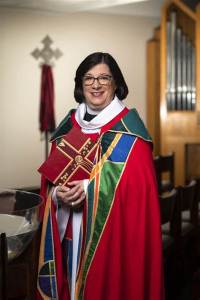
The leader of the ELCA, Bishop Elizabeth Eaton, joined other Christians leaders in welcoming the new Pontiff: “We pray that the Holy Spirit will sustain Pope Leo XIV for the ministry to which he has been called, and will strengthen us all in our vocations as bridge-builders and as witnesses to God’s love for all people and creation.”
Common Themes Among the Readings
5 Easter
Acts 11: 1-18
Psalm 148
Revelation 21: 1-6
John 13: 31-35
Look for the following themes in the Easter 5 Readings: inclusion, renewal, and love. In Acts 11, Peter learns that God’s grace extends beyond traditional boundaries, welcoming all people into faith. Revelation 21 speaks of a new creation, where God dwells among humanity, bringing healing and restoration. Psalm 148 and John 13 reinforce the call to praise and love, reminding believers that God’s presence transforms the world through unity and compassion.
Focus: Revelation 21: 1-6
Then I saw a new heaven and a new earth, for the first heaven and the first earth had passed away, and the sea was no more. 2 And I saw the holy city, the new Jerusalem, coming down out of heaven from God, prepared as a bride adorned for her husband. 3 And I heard a loud voice from the throne saying,
“See, the home of God is among mortals.
He will dwell with them;
they will be his peoples,
and God himself will be with them and be their God;
4 he will wipe every tear from their eyes.
Death will be no more;
mourning and crying and pain will be no more,
for the first things have passed away.”
5 And the one who was seated on the throne said, “See, I am making all things new.” Also he said, “Write this, for these words are trustworthy and true.” 6 Then he said to me, “It is done! I am the Alpha and the Omega, the Beginning and the End. To the thirsty I will give water as a gift from the spring of the water of life.
For the context of this passage, take time to watch this excellent background video!
TRY LUTHER’S METHOD OF BIBLE READING
A Revision of the Lectio Divina, a method he learned in his Augustinian training (Three Steps)
Oratio (Prayer): This is the starting point, where one humbly prays for the Holy Spirit’s guidance to understand God’s Word. Luther emphasized that prayer prepares the heart and mind to receive divine wisdom.
Meditatio (Meditation): This involves deeply engaging with Scripture, not just reading it but reflecting on it repeatedly. Luther encouraged believers to “chew on” the Word, allowing its meaning to sink in and shape their thoughts and actions.
Tentatio (Struggle): Often translated as “trial” or “temptation,” this refers to the challenges and spiritual battles that arise as one seeks to live according to God’s Word. Luther saw these struggles as a way God refines faith, making it more resilient and authentic.

Reflections: “I am making all things new”

Let me start with a quick story. Johann Georg Rapp (1757-1847) was no ordinary preacher—he was a spiritual disruptor, shaking off Lutheranism in Germany like dust from his feet, convinced it had lost its way and fallen into the grip of state control. With his eyes set on prophecy, he led his devoted flock across the Atlantic in 1803, carving out a New Jerusalem in the American wilderness. The Harmony Society was no half-hearted congregation—it was a self-sufficient, celibate, fiercely disciplined movement, grinding out industry and waiting for the heavens to split open with Christ’s return. Rapp’s take on Revelation 20-21 was pure pre-millennial urgency—his people weren’t making casual predictions, they were living on the edge of eternity on the American frontier. Though he never thundered in revival tents, his movement pulsed with the raw energy of the Second Great Awakening, blending faith, prophecy, and industry into a bold experiment in millennial expectation. (Sidebar: Rapp’s Harmony Society, rooted in Germany, and Han Nielson Hauge’s revival movement in Norway both fostered self-sufficient communities, though Rapp’s followers embraced communal living and celibacy, while Haugeans focused on lay preaching and social reform. Both were rooted in pietism. Our parish — ELC in Black River Falls — had Haugean influence in its early years).
Any number of spiritual movements across the centuries have predicted (and they have all been wrong) that Christ’s return is imminent, and in fact, can be pegged to a specific date. George Rapp is one such example. He and his fervid followers believed Christ would return before the Millennium—a thousand-year reign—to establish His kingdom on earth, with a period of tribulation coming first. (Post-millennialists, both in Rapp’s time and today, believe Christ will return after the Millennium, seeing it as an era of spiritual progress where society improves through the Gospel before Christ comes for the final judgment).
And therein lies one of the great challenges prompted by the book of Revelation. Those of us reared within the ELCA tradition most likely did not have a lot of exposure to the book of Revelation growing up. The symbolic imagery, apocalyptic themes, and complex structure are challenging. And, you might wonder, where does the ELCA fit into the pre vs. post-millennialism argument? We have been described as embracing amillennialism (sorry for all the jargon!), which interprets the Millennium in Revelation symbolically rather than as a literal thousand-year reign. Amillennialists believe that Christ is already reigning spiritually through His Church and that His Second Coming will bring about the final judgment and the new creation, rather than a distinct millennial kingdom on earth. With that as a backdrop, let’s take on this week’s Revelation passage. (Sidebar: I can never read 21:1 without recalling a paper I wrote in a religion class as a freshman in college. The topic of the paper was comparing millennial movements, and I was trying to swim in water that was way over my head! The paper was returned to me with a large red “D” on it and one comment from the tough professor: “This is not a good paper.” I had to go in and meet with him on it — not a pleasant experience!)
A quick summary. Revelation 21: 1-6 describes a vision of a renewed creation, where God establishes a new heaven and earth and brings forth the holy city, the New Jerusalem, as a symbol of divine restoration. In this new reality, God dwells among humanity, offering comfort and ending sorrow, death, and pain, marking the fulfillment of His promise to redeem and renew. The passage concludes with God’s declaration—He is the Alpha and the Omega, the source of all life, and He freely gives the water of life to those who seek Him.
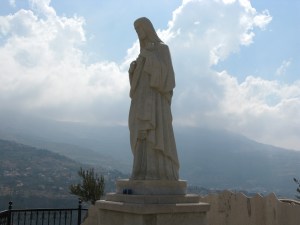
What should we take away from these verses? First, it is tempting with the state of our world, I must admit, to cling to the idea that at some point God is simply going to wipe everything out and start over. There is some appeal to that. But, as theologian Anna M.V. Bowden asserts in her commentary on this passage, the original language John used in verse one suggests, not the destruction of the world, but rather a departure. The first heaven and first earth have departed and a new heaven and earth are arriving. As Bowden asserts, “This scene from Revelation images heaven coming down to earth. Despite popular depictions of heaven, God comes to us. God chooses to join us. It isn’t the other way around. God, it seems, isn’t in the business of starting over.” Second, verses 3-4 offer a beautiful reminder for us. Our lives are intertwined with God. He is with us. In fact, he mourns with us. Let that sink in especially when you are carrying grief in your heart. Again, from Anna Bowden, “What God offers in this moment is not a one-way ticket out of Dodge. God offers care. God does more than simply rescue God’s people. God joins God’s people in their pain and suffering and expresses sympathy and concern for them. Just as they see God, God sees them.”
Finally, in our despairing world, verses 5-6 powerfully resonate. We have a compassionate God who is in charge and continually makes all things new. We are called to join Him in that work. Yes, the Kingdom of God is here!
Soli Deo Gloria!
Prayer Reflection and Poem: Crazy Quilt (Jane Joyce Wilson)
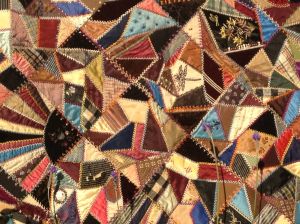
The Liberty Bell in Philadelphia
is cracked. California is splitting
off. There is no East or West, no rhyme,
no reason to it. We are scattered.
Dear Lord, lest we all be somewhere
else, patch this work. Quilt us
together, feather-stitching piece
by piece our tag-ends of living,
our individual scraps of love.
Jane Wilson Joyce (PhD University of Texas, Austin) retired in 2012 as Luellen Professor Emerita of Classics at Centre College in Kentucky. A classical scholar with wide-ranging interests, This poem comes from her book The Quilt Poems (1984). Retrieved from JourneywithJesus.net, 11 May 2025.
A Musical Offering: Earth Song
Lyrics: Earth Song
Sing, be, live, see
This dark stormy hour
The wind, it stirs
The scorched Earth cries out in vain
Oh war and power, you blind and blur
The torn heart cries out in pain
But music and singing have been my refuge
And music and singing shall be my light
A light of song, shining strong Hallelujah, hallelujah
Through darkness and pain and strife
I’ll sing, I’ll be, live, see Peace
Frank Ticheli is an American composer known for his orchestral, choral, and concert band works. Born in Monroe, Louisiana in 1958, he studied composition at Southern Methodist University before earning his master’s and doctoral degrees from the University of Michigan.
Earth Song is a deeply personal reflection on the turmoil and violence he witnessed in the world, particularly during the Iraq War. The piece serves as a quiet yet powerful response to conflict, offering a sense of refuge and hope through its serene melody and uplifting message. It fits well with this week’s Revelation passage and more broadly, with the tumultuous world of 2025!

Mount Royal Kantorei is an award winning mixed-voice auditioned choir based in Calgary, Alberta, affiliated with Mount Royal University’s Conservatory. Established in 1995, the choir has built a reputation for exceptional choral performances, blending traditional and contemporary classical music.
