Faithful Conversations #121
Introduction to Readers
“The church meets to imagine what our lives can be like if the gospel were true.” ~ Walter Brueggemann
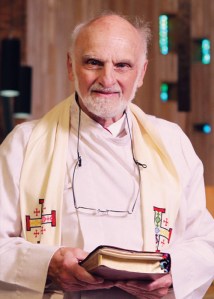
(1933-2025)
God calls us to imagine a better future. In June 2025, that call feels especially urgent. Let me explain. The death of Walter Brueggemann two weeks ago stirred me to return to his writings, especially those that speak of imagination as a tool of faith. Brueggemann challenged the Church to resist the forces that numb and divide us, and to dream boldly in the Spirit of the prophets. And just as I began writing this week’s blog posting, I learned of the heartbreak in Brooklyn Park, Minnesota (Saturday 14 June). With family members who live there, the sorrow feels close to home. I hold this grief in tandem with Brueggemann’s vision, asking what it means to live as if the gospel is true. May we dare to imagine more—and may God carry those who have suffered an unspeakable tragedy. I will revisit imagination-inspired faith in my reflections on this week’s passage from Galatians.

Thanks for taking some time in the space again this week! We are in Ordinary Time, the longest season in the Church calendar, but don’t let the name fool you—it’s anything but boring. The word “ordinary” comes from ordinal, meaning “counted,” because the Sundays are numbered (like the 12th Sunday in Ordinary Time). It comes in two parts: the first begins after Epiphany and ends before Lent, and the second starts after Pentecost and runs until Advent. Unlike the dramatic seasons of Christmas or Easter, Ordinary Time focuses on the day-to-day life and teachings of Jesus, inviting us to grow in faith, discipleship, and spiritual maturity. Think of it as the Church’s “green season”—a time for steady growth, reflection, and living out the gospel in ordinary moments. Along with this week’s reflections, I’m offering a prayer reflection and musical selection that will hopefully prompt peace in the midst of the turmoil of our times.
** Note 1: Links to outside references are bolded and italicized and are meant for further reading or research on your part. While the text I am including in the blog is my own, I am pulling from a multitude of sites for ideas and connections.
** Note 2: In my increasing use of A.I. (Copilot), I will cite sourcing of how I am using the tool, if necessary. I don’t want that to be overly cumbersome, but I am gradually incorporating more tools. And, by the way, I am exploring the A.I. world this summer prior to my next teaching semester. As you can imagine, it is a great challenge right now and will forever change the face of education!
Common Themes Among the Readings
PENTECOST 2
Isaiah 65: 1-9
Psalm 22: 19-28
Galatians 3: 23-29
Luke 8: 26-39
These readings for Pentecost 2 in the Revised Common Lectionary are bound together by themes of divine inclusion, restoration, and transformation. Isaiah 65:1-9 reveals God’s willingness to embrace those who were once distant, demonstrating grace beyond human expectation. Psalm 22:19-28 echoes this by affirming that God’s reign extends to all nations, ensuring that even the afflicted find hope and renewal. Galatians 3:23-29 reinforces the radical inclusivity of faith, declaring that all believers—regardless of status, ethnicity, or gender—are united in Christ. Luke 8:26-39 illustrates personal transformation through Jesus’ healing of the possessed man, showing how divine intervention restores dignity and reintegrates the outcast into community. Together, these passages emphasize God’s unwavering commitment to redemption, breaking barriers and inviting all into His promise.
“Describe the common themes among the readings for Pentecost 2.” Copilot, 12 June 2025, Copilot website.
Background video on Galatians from the Bible Project — check it out!
Galatians 3: 23-29
23 Now before faith came, we were imprisoned and guarded under the law until faith would be revealed. 24 Therefore the law was our disciplinarian until Christ came, so that we might be reckoned as righteous by faith. 25 But now that faith has come, we are no longer subject to a disciplinarian, 26 for in Christ Jesus you are all children of God through faith. 27 As many of you as were baptized into Christ have clothed yourselves with Christ. 28 There is no longer Jew or Greek; there is no longer slave or free; there is no longer male and female, for all of you are one in Christ Jesus. 29 And if you belong to Christ, then you are Abraham’s offspring, heirs according to the promise.
Note on Sourcing: I utilize Bible Gateway for the scripture passages cited each week.
TRY LUTHER’S METHOD OF BIBLE READING
A Revision of the Lectio Divina, a method he learned in his Augustinian training (Three Steps)
Oratio (Prayer): This is the starting point, where one humbly prays for the Holy Spirit’s guidance to understand God’s Word. Luther emphasized that prayer prepares the heart and mind to receive divine wisdom.
Meditatio (Meditation): This involves deeply engaging with Scripture, not just reading it but reflecting on it repeatedly. Luther encouraged believers to “chew on” the Word, allowing its meaning to sink in and shape their thoughts and actions.
Tentatio (Struggle): Often translated as “trial” or “temptation,” this refers to the challenges and spiritual battles that arise as one seeks to live according to God’s Word. Luther saw these struggles as a way God refines faith, making it more resilient and authentic.

Reflections: “Faith and Imagination”
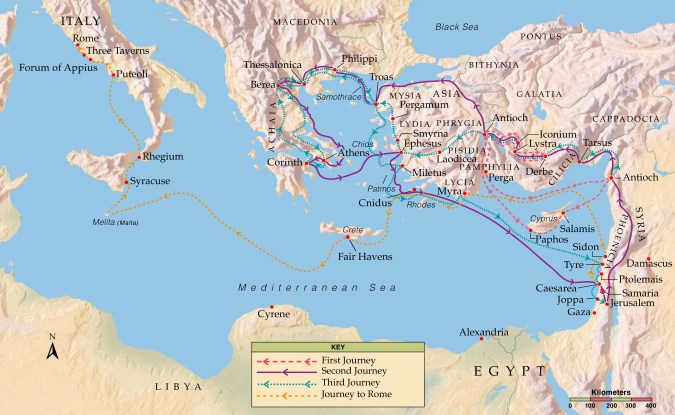
Like so much of scripture, context is key to understanding what we are reading. Paul likely wrote Galatians between 47 and 50 CE, during or just after his first missionary journey. It was a moment of intense debate over the inclusion of Gentiles in the Christian movement. Christianity, recall, began as a Jewish messianic movement, but as it spread beyond Israel, conflicts arose over whether non-Jewish believers needed to follow Jewish customs (like circumcision and dietary laws). This controversy came to a head in Acts 15, where church leaders debated whether Gentiles should be required to observe the Torah’s laws (found in the first five books of the Old Testament). Some Jewish Christians insisted that Gentiles must follow these practices to be fully part of God’s covenant family, while Paul argued that faith in Christ alone was sufficient. His letter to the Galatians was written in response to Judaizers—Jewish Christians who were pressuring Gentile believers to adopt Jewish customs. You can feel his frustration throughout the book!
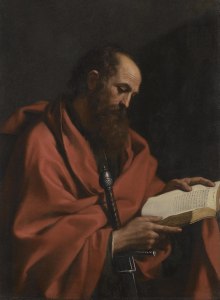
Galatians 3:23–29 brings us to the heart of the Christian story: faith has arrived, and the law no longer defines us. Once, the law guided and instructed, but now baptism clothes us in Christ, transforming our identities! Paul declares, “There is no longer Jew or Greek, slave or free, male and female.” The divisions that once separated people no longer hold power—a radical claim in his time and just as revolutionary today. If we take this seriously, we must see every person as equally beloved, fully included, and truly part of the body of Christ.
And that brings me back to Walter Brueggemann and his challenge. He urges the Church to ignite imaginations through the Holy Spirit, inspiring people not just to read the gospel but to embody it in their lives — to offer hope in a troubled world. As a counter-cultural people, we must reveal what life looks like when love—not hierarchy—leads the way. Now, more than ever, is the time to live this truth.
Soli Deo Gloria!
Prayer Reflection: Finding Hope and Strength in Turbulent Times
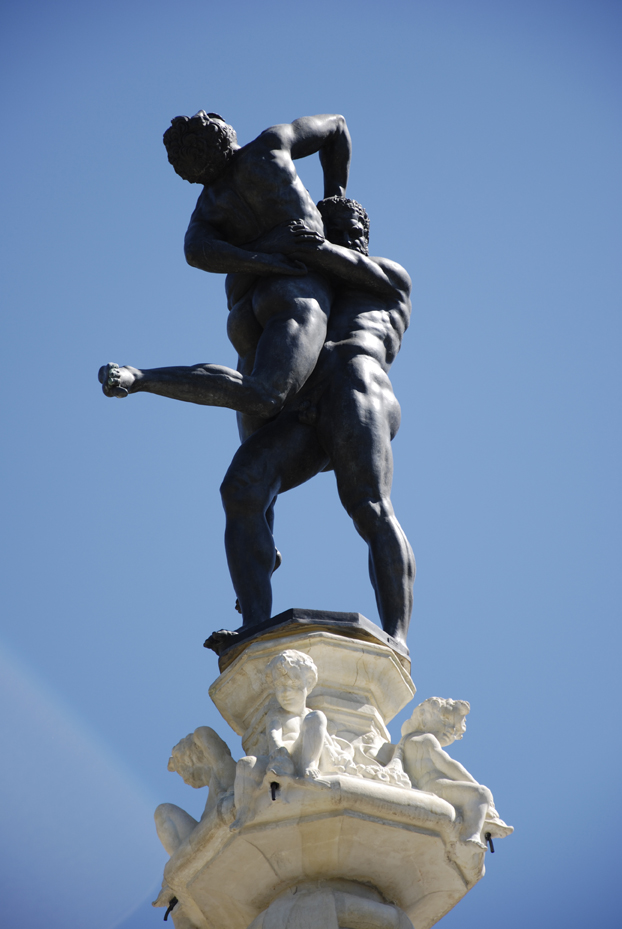
The story of Hercules wrestling Antaeus is a classic myth about strength and strategy. Antaeus, a giant and son of Gaia (Earth) and Poseidon, was invincible as long as he remained in contact with the ground. He challenged all travelers to wrestling matches, always winning and using their skulls to decorate a temple. When Hercules encountered Antaeus, he realized that the giant’s power came from the earth. Instead of continuing to throw him down, Hercules lifted Antaeus into the air, cutting off his connection to the ground. Without his source of strength, Antaeus weakened, and Hercules was able to crush him to death. (“Describe the myth of Hercules wrestling with Antaeus.” Copilot, 13 June 2025, Copilot website).
I ran across this beautiful interpretation of the Hercules/Antaeus myth by Glenn Clark — widely applicable and so fitting for our present circumstances!
“We, who are not children of Earth but children of God, could learn much from the lesson of Antaeus. We too, whenever troubles cast us back upon the bosom of our Father, rise with renewed strength. But just as Antaeus let Hercules, who was smaller in stature than he, lift him away from the source of his power, so circumstances, infinitely small and trivial, may drag us away from God. Troubles, misfortunes, disappointments, and handicaps, if they but throw us back upon God, if they merely give us opportunity of bringing into play our God-directed imagination and our heaven-blessed sense of humor, may become converted into marvelous good fortune. For trouble, if it merely turns us to God and hence renews our strength, ceases to be evil, and becomes good; it becomes the best thing that could possibly come to us, next to God Himself. For our growth in power and happiness depends upon the number of seconds out of each twenty-four hours that we are resting in God.”
Source: The Soul’s Sincere Desire
(Glenn Cark)
A Musical Offering: “You Are the New Day” (John David)
One of the things that has become clear to me in recent times, is that as Christians we are called to be purveyors of hope within our communities. This has been a theme of conversations with Pastor Jen in recent weeks. To do that, of course, we have to maintain our own sense of well-being. This song, though not overtly Christian, expresses the power of hope that is ours in Jesus Christ.
You are the new day
You are the new day
I will love you more than me
And more than yesterday
If you can but prove to me
You are the new day
Send the sun in time for dawn
Let the birds all hail the morning
Love of life will urge me say
You are the new day
When I lay me down at night
Knowing we must pay
Thoughts occur that this night might
Stay yesterday
Thoughts that we as humans small
Could slow worlds and end it all
Lie around me where they fall
Before the new day
One more day when time is running out
For everyone
Like a breath I knew would come I reach for
The new day
Hope is my philosophy
Just needs days in which to be
Love of life means hope for me
Borne on a new day
You are the new day
“You Are the New Day”
John David wrote You Are the New Day in 1978 during a time of deep concern about the state of the world—particularly the threat of nuclear war. He later shared that he composed the song in a moment of quiet reflection, hoping to express a longing for peace, renewal, and the fragile hope that each new day brings. Though David was known for his work in rock music, this song emerged as a gentle, hymn-like meditation. Its message—centered on love, life, and the possibility of change—struck a chord far beyond its original context.
The Singapore Symphony Youth Choir (SSYC) is an ensemble of young singers aged 17 to 28, performing under the umbrella of the Singapore Symphony Orchestra. Founded in 2016, the SSYC builds on the success of the Singapore Symphony Children’s Choir and offers older youth a platform to continue their choral journey with artistic excellence and expressive depth. At the helm is Wong Lai Foon, a seasoned choirmaster and educator who has shaped Singapore’s choral landscape for nearly two decades. They are impressive!
Update on “Faithful Conversations”
Our regular gatherings for discussing the weekly lectionary are on a pause. Summer worship at ELC is at 8:30 in town and 10:15 at Hatfield by the lake. The 8:30 service will be streamed. Please stay in touch!
Recent News From Luther Seminary in St. Paul!
“After engaging in careful consideration and faithful conversation about Luther Seminary’s important mission and future, the seminary’s board of directors voted unanimously to begin the process to shift to a more nimble model and divest from its current physical campus in Saint Paul. Luther Seminary will initiate a process to seek new space in the Twin Cities area that aligns with its needs going forward and helps maintain the seminary’s enduring commitment to ensuring Christian leaders are equipped for the realities of ministry today and into the future.”
Read the full article here!
