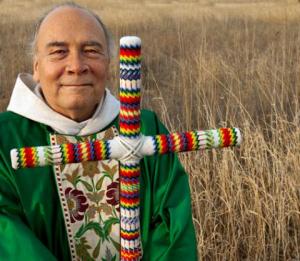
“I saw an older man standing alone by the side of the road. He kept looking down that road as if he was expecting a bus, but no bus stopped there, so I mentioned that to him. He said he was not waiting for a bus. He was waiting for a parade. He had heard that if you waited long enough, the parade would come back down your street. He had missed it before. He did not want to miss it again. I looked at him. He was different than me. Different color. Different culture. Different religion. He looked a little grubby and he had an accent. But I decided that didn’t matter. He was a person. I was a person. He needed a parade. I needed a parade. He had hope. I had hope. So I just started waiting beside him, looking down the street in the same direction. And the minute I did: we both heard music in the distance.” (Steven Charleston)
In a world increasingly fractured by noise and suspicion, we need stories that quiet our fears and call us back to each other. One of my regrets in the modern age is that, too often, Americans consume the news of the day already filtered through a partisan lens. Every headline becomes a battle cry—another excuse to choose sides, defend our tribe, and vilify the other. We shrink people into caricatures, place them in boxes, exaggerating what we fear, rather than seeking what we share. In Ladder to the Light, Steve Charleston—a retired Episcopal bishop and member of the Choctaw Nation—cuts through this noise. He tells of an older man waiting not for a bus, but for a parade, believing that if he waited long enough, music and joy would return. When the narrator chooses to wait with him, divided identities dissolve into common hope. Side by side, they listen—not for argument, but for music. That is where healing begins. And maybe, if we choose to wait together—with open hearts and listening ears—we’ll find that the music never truly stopped. That is my hope for all of us.
Catherine Winkworth (1827-1878)
Thanks for returning to this space again this week! We are turning the corner into July and have reached the 14th Sunday in Ordinary Time. We celebrate the 4th of July on Friday, a good time to think about the meaning of freedom within our Christian worldview. Among those we venerate in the ELCA calendar this week are prolific hymn translator Catherine Winkworth (d. July 1, 1878) and Czech reformer and martyr Jan Hus (d. July 6, 1415). Hus, a precursor to Luther, died an especially tragic death.
My reflections this week will focus on the story of Naaman, the Syrian commander healed by Elisha (an alternate Old Testament reading for Pentecost 4), with commentary on how his story connects to the Gospel. Beyond that, I will provide a poem from Langston Hughes, a powerful reflection on freedom, and offer a song from my era that I hope you will appreciate. Also, take time to read my description of the Revised Common Lectionary at the end of this week’s blog.
** Note 1: Links to outside references are bolded and italicized and are meant for further reading or research on your part. While the text I am including in the blog is my own, I am pulling from a multitude of sites for ideas and connections. ** Note 2: In my increasing use of A.I. (Copilot), I will cite sourcing of how I am using the tool, if necessary. I don’t want that to be overly cumbersome, but I am gradually incorporating more tools. And, by the way, I am exploring the A.I. world this summer prior to my next teaching semester. As you can imagine, it is a great challenge right now and will forever change the face of education!
** Note 3: The images I include in the blog are drawn from Wikimedia Commons to the fullest extent possible.
The readings for the 14th Sunday in Ordinary Time (Pentecost 4) share a common thread of God’s healing, restoration, and the surprising ways divine grace is made known. Isaiah 66 and Psalm 66 celebrate God’s nurturing care and power to bring joy and renewal, even out of suffering. The story of Naaman in 2 Kings and the mission of the seventy in Luke both highlight how healing and salvation come not through status or spectacle, but through humble obedience and trust in God’s word. Galatians 6 ties these themes together by urging believers to live by the Spirit, sowing goodness and bearing one another’s burdens as signs of the new creation God is bringing into the world.
“Describe the common themes among the readings for Pentecost 4.” Copilot, 28 June 2025, Copilot website.
2 Kings 5: 1-14
5 Naaman, commander of the army of the king of Aram, was a great man and in high favor with his master because by him the Lord had given victory to Aram. The man, though a mighty warrior, suffered from a skin disease. 2 Now the Arameans on one of their raids had taken a young girl captive from the land of Israel, and she served Naaman’s wife. 3 She said to her mistress, “If only my lord were with the prophet who is in Samaria! He would cure him of his skin disease.” 4 So Naaman went in and told his lord just what the girl from the land of Israel had said. 5 And the king of Aram said, “Go, then, and I will send along a letter to the king of Israel.” He went, taking with him ten talents of silver, six thousand shekels of gold, and ten sets of garments. 6 He brought the letter to the king of Israel, which read, “When this letter reaches you, know that I have sent to you my servant Naaman, that you may cure him of his skin disease.” 7 When the king of Israel read the letter, he tore his clothes and said, “Am I God, to give death or life, that this man sends word to me to cure a man of his skin disease? Just look and see how he is trying to pick a quarrel with me.” 8 But when Elisha the man of God heard that the king of Israel had torn his clothes, he sent a message to the king, “Why have you torn your clothes? Let him come to me, that he may learn that there is a prophet in Israel.” 9 So Naaman came with his horses and chariots and halted at the entrance of Elisha’s house. 10 Elisha sent a messenger to him, saying, “Go, wash in the Jordan seven times, and your flesh shall be restored, and you shall be clean.” 11 But Naaman became angry and went away, saying, “I thought that for me he would surely come out and stand and call on the name of the Lord his God and would wave his hand over the spot and cure the skin disease! 12 Are not Abana and Pharpar, the rivers of Damascus, better than all the waters of Israel? Could I not wash in them and be clean?” He turned and went away in a rage. 13 But his servants approached and said to him, “Father, if the prophet had commanded you to do something difficult, would you not have done it? How much more, when all he said to you was, ‘Wash, and be clean’?” 14 So he went down and immersed himself seven times in the Jordan, according to the word of the man of God; his flesh was restored like the flesh of a young boy, and he was clean.
My source for the Bible readings each week is the Bible Gateway website.
TRY LUTHER’S METHOD OF BIBLE READING
A Revision of the Lectio Divina, a method he learned in his Augustinian training
Three Steps
Oratio (Prayer): This is the starting point, where one humbly prays for the Holy Spirit’s guidance to understand God’s Word. Luther emphasized that prayer prepares the heart and mind to receive divine wisdom.
Meditatio (Meditation): This involves deeply engaging with Scripture, not just reading it but reflecting on it repeatedly. Luther encouraged believers to “chew on” the Word, allowing its meaning to sink in and shape their thoughts and actions.
Tentatio (Struggle): Often translated as “trial” or “temptation,” this refers to the challenges and spiritual battles that arise as one seeks to live according to God’s Word. Luther saw these struggles as a way God refines faith, making it more resilient and authentic.
Luther’s Seal
Luke 10: 1-11, 16-20
10 After this the Lord appointed seventy-two others and sent them on ahead of him in pairs to every town and place where he himself intended to go. 2 He said to them, “The harvest is plentiful, but the laborers are few; therefore ask the Lord of the harvest to send out laborers into his harvest. 3 Go on your way; I am sending you out like lambs into the midst of wolves. 4 Carry no purse, no bag, no sandals, and greet no one on the road. 5 Whatever house you enter, first say, ‘Peace to this house!’ 6 And if a person of peace is there, your peace will rest on that person, but if not, it will return to you. 7 Remain in the same house, eating and drinking whatever they provide, for the laborer deserves to be paid. Do not move about from house to house. 8 Whenever you enter a town and its people welcome you, eat what is set before you; 9 cure the sick who are there, and say to them, ‘The kingdom of God has come near to you. 10 But whenever you enter a town and they do not welcome you, go out into its streets and say, 11 ‘Even the dust of your town that clings to our feet, we wipe off in protest against you. Yet know this: the kingdom of God has come near.
16 “Whoever listens to you listens to me, and whoever rejects you rejects me, and whoever rejects me rejects the one who sent me.” 17 The seventy-two returned with joy, saying, “Lord, in your name even the demons submit to us!” 18 He said to them, “I watched Satan fall from heaven like a flash of lightning. 19 Indeed, I have given you authority to tread on snakes and scorpions and over all the power of the enemy, and nothing will hurt you. 20 Nevertheless, do not rejoice at this, that the spirits submit to you, but rejoice that your names are written in heaven.”
Reflections: The Power of the Powerless
The Jordan River, once again, is a feature of this week’s Old Testament Reading, and Elisha is a central character. Here’s a quick summary. Naaman, a respected Syrian military commander, suffers from leprosy and seeks healing after hearing from a captive Israelite girl about the prophet Elisha. Expecting a dramatic cure, Naaman is initially offended when Elisha simply instructs him—through a messenger—to wash seven times in the Jordan River. After some persuasion from his servants, Naaman humbles himself, follows the prophet’s instructions, and is miraculously healed. This passage highlights the power of God working through humility, obedience, and unexpected messengers. What to make of this unusual story about this long-ago Syrian military man?
Gina Burkhart
So often when reading these stories, I find myself drawn to the peripheral players — in this case the Israelite girl. This remarkable, nameless young woman, captured in a raid and forced into servitude in Naaman’s household, sets in motion a chain of events leading to Naaman’s healing and spiritual transformation. She reminds us that God works through even the most marginalized and voiceless individuals. In a terrific commentary in the July edition of The Christian Century, Mennonite pastor Gina Burkhardt, offers the following commentary and contemporary application regarding the role of the young Israelite, “In our current political milieu, many feel powerless . . . We need the reminder that ordinary, relatively powerless people are very often the links to life-giving change for our spiritual lives. As followers of Jesus, we can imagine the healing and wholeness that our hurting world needs.”
Landscape with Jesus and His Disciples by Jean-François Millet (c. 1667)
This theme resonates in this week’s Gospel story from Luke 10. Jesus sends out seventy disciples with minimal provisions to proclaim the kingdom and bring healing. Their mission is marked by vulnerability and dependence, yet they return rejoicing at the power of God working through them. Jesus affirms that their authority comes not from status or strength, but from their participation in God’s mission. Together, these readings emphasize that God’s healing and power are not reserved for the mighty, but are revealed through obedience, humility, and the faithful witness of those the world might overlook. These are good words for us to hear in 2025!
Soli Deo Gloria!
Prayer Reflection: Freedom (Langston Hughes)
Freedom will not come today, this year Nor ever Through compromise and fear. I have as much right As the other fellow has To stand On my two feet And own the land. I tire so of hearing people say, Let things take their course. Tomorrow is another day. I do not need my freedom when I’m dead. I cannot live on tomorrow’s bread. Freedom Is a strong seed Planted In a great need. I live here, too. I want my freedom Just as you.
Langston Hughes’s poem Freedom refuses to accept delay, and echoes Jesus’ own words in Luke 4:18 about release for the captives and good news for the poor. Drawing on America’s own tradition of liberty, Hughes exposes the painful distance between its ideals and the lived experience of those still waiting for justice. Read through a Christian lens, the poem takes on a prophetic urgency, calling us to recognize the image of God in every neighbor and to live into the gospel’s vision of a freedom that is real, present, and shared. My prayer for July 4th is that we live into that vision!
A Musical Offering: Here to Love You (The Doobie Brothers)
In the category of, songs that are not explicitly Christian, but reverberate with Christian themes,” the 1978 Doobie Brothers hit Here to Love You, always caught my attention (sidebar: this song immediately transports me back to my high school and college days — and yes, me and my friends loudly sang another great Doobie Brothers hit “Black Water” while driving around Fargo, but I digress!). The song reflects the Christian message of steadfast, unconditional love that mirrors God’s faithful presence through silence and struggle. Its gospel-tinged sound deepens the call not only to receive such grace but to embody it—loving our neighbors with the same steady compassion. Michael McDonald, the composer, has spoken publicly about his faith and in a Guideposts article, shared how faith helped him through periods of personal struggle and disillusionment, particularly during the height of his success with the Doobie Brothers. Enjoy!
“Here To Love You”
I’ve heard it said that the weight of the world’s problems Is enough to make the ball fall right through space That it ain’t even worth it to live With all that’s goin’ wrong Well, let me just go down as saying That I’m glad to be here Here with all the same pain and laughs everybody knows
Some men think they’re born to be king Maybe that’s true But I think passing love around Is all we were born to do
Let them build their kingdoms Let them make the laws for this world to heed ‘Cause you and I make life worth living Right here in each other’s arms
I’m here to love you, baby No more loneliness No more emptiness I’m here to love you
Let them build their kingdoms Let them make the laws for this world to heed ‘Cause you and I make life worth living Right here in each other’s arms
I’m here to love you, baby No more loneliness No more emptiness I’m here to love you…
I’m here to love you
Just let me go on loving you Don’t stop me now while I’m feeling this way..
“Here to Love You” (1976)
The Doobie Brothers are an American rock band formed in San Jose, California, in 1970, known for their rich vocal harmonies and genre-blending sound that spans rock, soul, country, and pop. They rose to prominence in the 1970s with hits like “Listen to the Music,” “Long Train Runnin’,” and “Black Water,” and later reinvented their sound with Michael McDonald’s soulful influence on tracks like “Takin’ It to the Streets” and “What a Fool Believes.” Their ability to evolve musically while maintaining a strong identity helped them earn a place in the Rock and Roll Hall of Fame in 2020. With over 40 million records sold worldwide, the Doobie Brothers remain a defining voice in American popular music.
“Provide a description of the Doobie Brothers.” Copilot, 29 June 2025, Copilot website.
Update on “Faithful Conversations”
Our regular gatherings for discussing the weekly lectionary are on a pause. Summer worship at ELC is at 8:30 in town and 10:15 at Hatfield by the lake. The 8:30 service will be streamed. Please stay in touch!
A Reminder: The Background of the RCL
The Revised Common Lectionary, often called the RCL, is a three-year cycle (A-B-C) of Scripture readings used in worship by many Christian churches, including the Evangelical Lutheran Church in America (ELCA). It was developed in the late twentieth century by an ecumenical group called the Consultation on Common Texts, which brought together leaders from various denominations to create a shared pattern of readings. Their goal was to help congregations hear a broader range of Scripture and to foster unity across the Christian community. The RCL was officially published in 1992 and later adopted by the ELCA with the release of Evangelical Lutheran Worship in 2006. Each Sunday, the RCL offers four readings that are meant to speak to one another. The Old Testament reading and the Gospel often share a common theme, showing how God’s promises unfold across time. The Psalm serves as a poetic or emotional response to the Old Testament reading, giving voice to praise, lament, or trust. The Epistle, usually drawn from the New Testament letters, may not always connect directly to the other readings but often adds theological depth or seasonal insight. Together, these texts create a rich and layered conversation that invites worshipers into a deeper experience of Scripture and the rhythms of the church year.
2 thoughts on “6 July 2025: Pentecost 4 (14 Ordinary)”
I practiced Lecto Divina/Martin Luther study technique with Luke 10: 1-20 and boy it’s like squeezing the very last drop out of a lemon and then grinding up the skin to make a lemon cake!
I notice that the disciples are to say “Peace be to this house!” AND if a son of peace IS there, the disciple’s peace will rest upon the house BUT if not, the disciple’s peace will return BACK to the disciple! It’s like the supernatural “Peace” the disciples were bringing –from the Finger of God–couldn’t cohabitate in a non-peaceful house!
It was also interesting that if the disciples went into a town (I always thought it was a house) and they are received, then they are to heal the sick in the town and say to them, “The kingdom of God has come near TO YOU.” BUT if the town does NOT receive the disciples, they are to go into the streets and shake the very dust of that town off their feet due to the town’s rejection and also say to them, “…the kingdom of God has come NEAR.” Not near TO YOU, but only near. It’s as if the disciples are to let the town know that the kingdom was so, so very close to them but since the town rejected/rebuffed the disciples then the town lost out big. I wonder what this ungrateful and nasty town thought in the days and weeks in the future when they realize what they missed out on.
I also thought it interesting when in verse 12, Jesus says it will be more bearable on that day for Sodom that for that town (the town that rejects any of the 70 disciples)! Wow–worse than Sodom! The general picture of Sodom is they’re all in hell and so what is worse than hell????
Thanks, Kris, for those reflective insights to the passage! The warning, as you say, seems incredibly stern. I’ve been reading a biography of Breuggeman these days, and it reminds me of his notion of the “prophetic imagination” and how we tend to gloss over these parts of scripture, I suppose, because they make us so uncomfortable. Reading Amos, for example, through the lens of our contemporary world, is a startling exercise. Your reflections, by the way, are an example of Luther’s description of the Meditatio phase of reading.






I practiced Lecto Divina/Martin Luther study technique with Luke 10: 1-20 and boy it’s like squeezing the very last drop out of a lemon and then grinding up the skin to make a lemon cake!
I notice that the disciples are to say “Peace be to this house!” AND if a son of peace IS there, the disciple’s peace will rest upon the house BUT if not, the disciple’s peace will return BACK to the disciple! It’s like the supernatural “Peace” the disciples were bringing –from the Finger of God–couldn’t cohabitate in a non-peaceful house!
It was also interesting that if the disciples went into a town (I always thought it was a house) and they are received, then they are to heal the sick in the town and say to them, “The kingdom of God has come near TO YOU.” BUT if the town does NOT receive the disciples, they are to go into the streets and shake the very dust of that town off their feet due to the town’s rejection and also say to them, “…the kingdom of God has come NEAR.” Not near TO YOU, but only near. It’s as if the disciples are to let the town know that the kingdom was so, so very close to them but since the town rejected/rebuffed the disciples then the town lost out big. I wonder what this ungrateful and nasty town thought in the days and weeks in the future when they realize what they missed out on.
I also thought it interesting when in verse 12, Jesus says it will be more bearable on that day for Sodom that for that town (the town that rejects any of the 70 disciples)! Wow–worse than Sodom! The general picture of Sodom is they’re all in hell and so what is worse than hell????
All so interesting! Thank you, Paul!
LikeLike
Thanks, Kris, for those reflective insights to the passage! The warning, as you say, seems incredibly stern. I’ve been reading a biography of Breuggeman these days, and it reminds me of his notion of the “prophetic imagination” and how we tend to gloss over these parts of scripture, I suppose, because they make us so uncomfortable. Reading Amos, for example, through the lens of our contemporary world, is a startling exercise. Your reflections, by the way, are an example of Luther’s description of the Meditatio phase of reading.
LikeLike