Faithful Conversations #140

“Thus a Christian man is righteous and a sinner at the same time, holy and profane, an enemy of God and a child of God.” (Martin Luther)
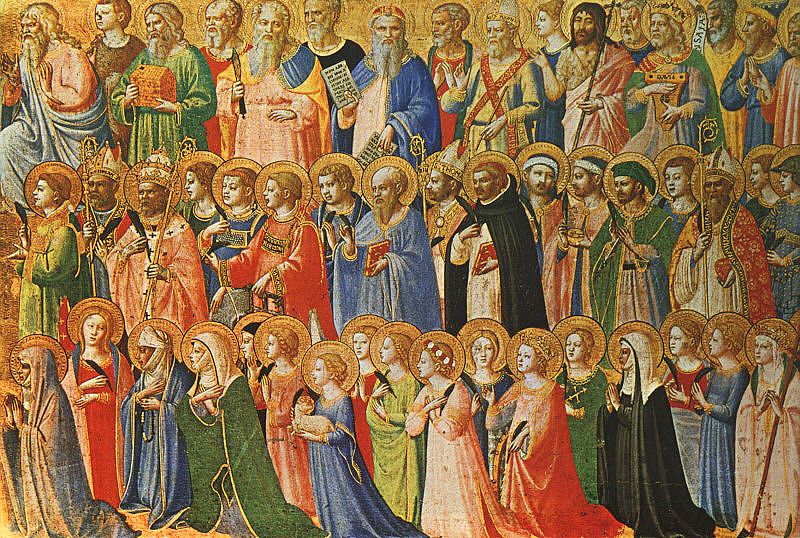
All Saints Day may have had roots in a pre-Christian Celtic festival honoring the dead, held in early November as autumn fades into winter. For the ancient Celts, a liminal time was a sacred threshold—when the veil between worlds grew thin and the ordinary gave way to the mysterious. These moments, like the shift from harvest to winter, were seen as openings for spiritual encounter, transformation, and ancestral connection. Early Christians honored unnamed martyrs whose faithful witness shaped the Church and by the 4th century, regional communities set aside days to remember the departed. In the 9th century, Pope Gregory IV designated November 1 as All Saints Day in the Western Church. Over time, the celebration grew to include all believers whose lives reflected God’s grace. Lutheran and Anglican traditions preserved the observance, emphasizing the **communion of saints as a living fellowship that spans generations. When we confess this in the Apostles’ Creed, we affirm a spiritual bond rooted not in perfection but in grace—a truth Martin Luther captured in his 1535 Commentary on Galatians with the phrase simul justus et peccator: simultaneously justified and sinner.
Luther honored saints as examples of faith but rejected the Catholic practice of invoking them for intercession. He insisted that Christ alone mediates between God and humanity, and warned that praying to saints or venerating relics distracted from the gospel. For Luther, saints belonged to the body of Christ—not as intermediaries, but as fellow witnesses whose lives point us back to God’s mercy. His theology redirected Christian devotion toward Scripture and the sufficiency of Christ, shaping worship and doctrine for generations. All Saints Sunday, in this light, becomes not a celebration of spiritual elites, but a remembrance of grace at work in ordinary lives.

Thanks for your visit to this space again this week! It’s hard to imagine that beyond All Saints Sunday we have three Sundays remaining in the church year! Time flies. This week we do commemorate the Apostles Simon and Jude (28 October) and Reformation Day on Friday, as you know. Pastor Jen and Patti Whitworth will be traveling back from Malawi in the early part of the week, and we pray for a safe journey. Also, a reminder that on All Saints Sunday, ELC will have a joint worship experience with our neighbors from the United Church of Christ at the Ho-Chunk Nation District 1 Community Center at the Mission at 2:00. This builds on our collaboration started four years ago. All are welcome!
My reflections this week will focus on the passage from the Sermon on the Plain and its connection to our understanding of sainthood. I’m also sharing a song and prayer that seem especially fitting for All Saints Sunday.
** The “communion of saints” is part of the Third Article of the Apostles Creed. For a good explanation of the history of the Creed and also Luther’s commentary on it, go to this link.
** Note 1: Links to outside references are bolded and italicized and are meant for further reading or research on your part. While the text I am including in the blog is my own, I am pulling from a multitude of sites for ideas and connections.
** Note 2: In my increasing use of A.I. (Copilot), I will cite sourcing of how I am using the tool, if necessary. I don’t want that to be overly cumbersome, but I am gradually incorporating more tools. I am exploring the A.I. world this summer prior to my next teaching semester. As you can imagine, it is a great challenge right now and will forever change the face of education!
** Note 3: The images I include in the blog are drawn from Wikimedia Commons to the fullest extent possible.
Common Themes Among the Readings
All Saints Readings
Daniel 7: 1-3, 15-18
Psalm 149
Ephesians 1: 11-23
Luke 6: 20-31
My source for the Bible readings each week is the Bible Gateway website. I generally use the NRSVUE translation.
The readings for All Saints Sunday highlight God’s promise to the faithful, who receive and inherit the kingdom. Daniel envisions holy ones triumphing over chaos, while Psalm 149 celebrates God’s delight in the humble and victorious. Ephesians reminds believers they are marked by the Spirit and destined for a glorious inheritance. Luke’s Beatitudes flip worldly values, blessing the poor and warning the comfortable, showing how saints live by grace, not status. Together, these texts call us to live with hope, humility, and courage as part of God’s unfolding story.
“Describe the common themes among the readings for All Saints Sunday.” Copilot, 24 October 2025, Copilot website.
Lectio Divina is a quiet, thoughtful way of reading the Bible to connect with God. It grew out of early Christian traditions and was shaped by thinkers like Augustine, who believed Scripture speaks to the heart. Augustine didn’t invent the practice, but his ideas helped form its spirit—listening deeply and responding with love. Later, others gave it a clear structure, but its roots go back to that longing for God’s voice.
LUTHER’S METHOD OF BIBLE READING
A Revision of the Lectio Divina (Augustinian)
Three Steps
Oratio (Prayer): This is the starting point, where one humbly prays for the Holy Spirit’s guidance to understand God’s Word. Luther emphasized that prayer prepares the heart and mind to receive divine wisdom.
Meditatio (Meditation): This involves deeply engaging with Scripture, not just reading it but reflecting on it repeatedly. Luther encouraged believers to “chew on” the Word, allowing its meaning to sink in and shape their thoughts and actions.
Tentatio (Struggle): Often translated as “trial” or “temptation,” this refers to the challenges and spiritual battles that arise as one seeks to live according to God’s Word. Luther saw these struggles as a way God refines faith, making it more resilient and authentic.
Focus Passage: Luke 6: 20-31
20 Then he looked up at his disciples and said:
“Blessed are you who are poor,
for yours is the kingdom of God.
21 “Blessed are you who are hungry now,
for you will be filled.
“Blessed are you who weep now,
for you will laugh.
22 “Blessed are you when people hate you and when they exclude you, revile you, and defame you[a] on account of the Son of Man. 23 Rejoice on that day and leap for joy, for surely your reward is great in heaven, for that is how their ancestors treated the prophets.
24 “But woe to you who are rich,
for you have received your consolation.
25 “Woe to you who are full now,
for you will be hungry.
“Woe to you who are laughing now,
for you will mourn and weep.
26 “Woe to you when all speak well of you, for that is how their ancestors treated the false prophets.
27 “But I say to you who are listening: Love your enemies; do good to those who hate you; 28 bless those who curse you; pray for those who mistreat you. 29 If anyone strikes you on the cheek, offer the other also, and from anyone who takes away your coat do not withhold even your shirt. 30 Give to everyone who asks of you, and if anyone takes away what is yours, do not ask for it back again. 31 Do to others as you would have them do to you.
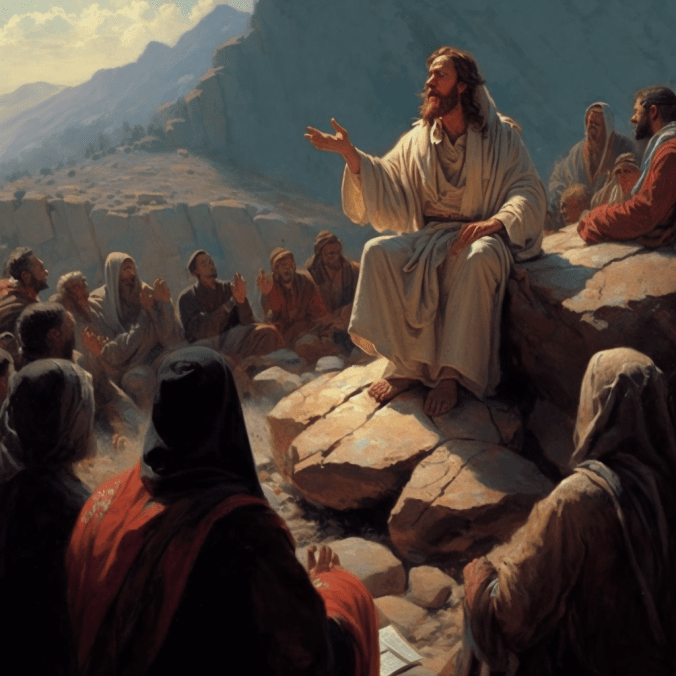
(A.I. Generated, 2023)
Reflection: Grace and Grit and the Courage to Love

Reinhold Niebuhr (1892–1971) was a towering figure in 20th-century American theology, ethics, and public thought—a Protestant theologian rooted in the Evangelical and Reformed tradition, yet unafraid to wrestle with the messiness of modern life. He’s best known for developing Christian Realism, a framework that confronts the persistent tension between moral ideals and political necessity, between the call to justice and the reality of sin. I first encountered Niebuhr’s writings in a religion class as a college student in the 1970s — a time when questions of war, civil rights, and institutional power pressed hard on my conscience. His voice—clear-eyed, unsentimental, and deeply faithful—helped me navigate the uneasy terrain where religion and politics meet. He taught me that faith is not an escape from complexity but a lens through which to engage it with humility and courage. As I reflect on this week’s Gospel reading, Niebuhr’s realism echoes: the saints we honor are not plaster-perfect, but those who dared to love in a broken world, trusting that grace can do what idealism alone cannot. Niebuhr once quipped that he didn’t much care for saints—at least not the kind who seemed too perfect, too pious, too removed from the grit of real life. Yet even Niebuhr, with his sharp theological realism, recognized the quiet heroism of those who live faithfully in the tension between ideal and reality (“the impossible possibility,” in his words).
The Sermon on the Plain in Luke 6 marks a defining moment early in Jesus’ ministry, delivered just after he calls the twelve apostles. Unlike Matthew’s mountaintop sermon, Luke places Jesus on “a level place,” symbolizing his solidarity with the crowd—poor, sick, and marginalized. This sermon lays out the ethical heart of the kingdom: blessings for the suffering, woes for the comfortable, and a radical call to love enemies and live mercifully. It’s a manifesto for discipleship in the real world. On All Saints Sunday, this passage reminds us that sainthood is not about moral perfection or spiritual polish. It’s about showing up in the mess, loving enemies, giving generously, and trusting that mercy matters more than merit. Saints are those who, by grace, live into the golden rule with courage and compassion. As we remember the great cloud of witnesses, we’re invited not to admire from afar, but to join them—ordinary people responding to an extraordinary call. Niebuhr put it this way: “The cross symbolizes a cosmic as well as historic truth. Love conquers the world, but its victory is not an easy one.”
Soli Deo Gloria!
A Musical Connection: Let My Love Be Heard (Jake Runestad)
Jake Runestad’s Let My Love Be Heard is a poignant choral setting of Alfred Noyes’ brief poem “A Prayer,” composed in 2014 for Choral Arts Northwest. The piece gained emotional resonance in 2015 when students at Cal State Long Beach performed it in memory of Nohemi Gonzalez, a classmate killed in the Paris terrorist attacks. The performance, shared widely online, transformed the work into a communal expression of grief and hope. Musically, the piece builds from a quiet invocation to a soaring climax, with layered harmonies that evoke angels carrying love and longing heavenward. The repeated plea—“Let my love be heard”—offers a sacred echo of remembrance, making it especially fitting for All Saints Sunday, when we honor those whose love still whispers in our lives.
‘A Prayer’ by Alfred Noyes
Angels, where you soar
Up to God’s own light,
Take my own lost bird
On your hearts tonight;
And as grief once more
Mounts to heaven and sings,
Let my love be heard
Whispering in your wings.
The Grammy-nominated British vocal ensemble VOCES8 is proud to inspire people through music and share the joy of singing. Touring globally, the group performs an extensive repertoire both in its a cappella concerts and in collaborations with leading orchestras, conductors and soloists. Versatility and a celebration of diverse musical expression are central to the ensemble’s performance and education ethos which is shared both online and in person.
**Information from the Voces8 Website
Prayer Reflection: Remembering Those We Carry With Us
“God of the generations,
when we set our hands to labor,
thinking we work alone,
remind us that we carry
on our lips
the words of prophets,
in our veins
the blood of martyrs,
in our eyes
the mystics’ visions,
in our hands
the strength of thousands.” Amen.
Source:
“God of the generations” by Jan Richardson, in “Inspired: On the Feast of All Saints,” The Painted Prayerbook (Oct. 29, 2011); originally published in Jan Richardson, In Wisdom’s Path: Discovering the Sacred in Every Season (Orlando: Wanton Gospeller, 2012)
Faithful Conversations Updates
Join us for some free-flowing conversation about the Lectionary readings each Sunday. We meet from 10:45-11:30 in the church library each week, with some exceptions. No prior knowledge is necessary! ALL ARE WELCOME! And, let’s discuss these questions when we gather (or any other questions you would like to raise for the group!):
1. Niebuhr spoke of the “impossible possibility” of living faithfully in a broken world. How does this idea challenge or affirm your understanding of sainthood, especially in light of Luke 6:20–31?
2. Luke’s Beatitudes offer a reversal of worldly values. How might this challenge our assumptions about success, holiness, and who we honor in our communities?
THIS WEEK’S BIBLE 365
READING CHALLENGE:
Monday 27 October: Exodus 35-40, Psalm 29
Tuesday 28 October: Leviticus 1-4, Psalm 30
Wednesday 29 October: Leviticus 5-7, Psalm 31
Thursday 30 October: Leviticus 8-10, Psalm 32
Friday 31 October: Leviticus 11-13, Psalm 33
Saturday 1 October: Leviticus 14-15, Psalm 34
Sunday 2 October: Leviticus 16-18, Psalm 35
Here is a LINK to the full Bible 365 Plan!
The Bible 365 Challenge!
More than 60 members of our faith community have committed to the Bible 365 Challenge—a shared journey of reading through the entire Bible in one year. Each day, we engage with selected passages weaving together stories of faith, struggle, grace, and redemption. This challenge isn’t just about completing a task; it’s about deepening our spiritual roots, building community, and discovering how scripture speaks into our lives today.
