Faithful Conversations #141

“It appears to me as if the world itself were approaching its end and, as the Psalmist says, is waxing old. … So there is nothing to hope for, except the day of our great God.” (Martin Luther, 1544)
This week’s lectionary readings—especially Jesus’ bold affirmation that God is “not of the dead, but of the living,” and Paul’s steadying words to the Thessalonians—draw us into the deep waters of eschatology, that rich and unsettling branch of theology that ponders the ending days. Martin Luther, like many before and after him, felt the tremors of history and believed Christ’s return was near. In fact, in the late 1520s, as the Ottoman Empire pressed into Europe, he feared he might not even finish translating the Old Testament before the world unraveled! This foreboding seemed to stay with him for his remaining years, as noted in the opening quote. I remember my own brush with apocalyptic awareness: eighth grade, 1970, a classroom moment when I learned the U.S. had over 30,000 nuclear weapons—enough to erase the Soviet Union several times over, and they could do the same to us (I remember thinking, “why do we need to be able to destroy them many times?”). Today, the specter of Artificial Intelligence has taken up residence in our cultural imagination, whispering new versions of the old fear: that we may be the architects of our own undoing. As always, there is much to fear in our stormy times!
Many who are reading this were born and raised in the Lutheran tradition. The ELCA — our particular branch of this tradition — invites us to live with bold hope, trusting that Christ’s resurrection is not just a past event but the heartbeat of God’s future for the world. Instead of fear or speculation, we’re called to see the end as a horizon of justice, peace, and renewal—where God’s promises come alive. Scripture’s visions of the last things aren’t blueprints to decode but poetic truths that shape how we walk through uncertainty with courage. This eschatology doesn’t pull us away from the world—it sends us into it, grounded in grace and ready to embody the reign that’s already breaking in. It’s a lot to think about.
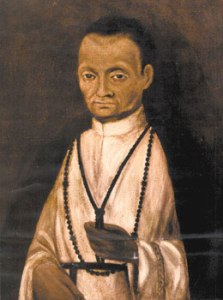
(1579-1839)
Thanks for your visit to this space again this week! Your interest in using the Revised Common Lectionary as a means of exploring scripture inspires me. And notably, November has been deemed Global Bible Month by three leading Bible Apps, including YouVersion which many of us are using with our Bible 365 Challenge. We have three Sundays remaining in Year C (through 23 November) and this week, among others, we commemorate Martin de Porres, renewer of society, who died on 3 November 1639. His story is powerful. And, as I’m writing this, I’m reflecting on a tremendous worship experience that we shared on Sunday with the Ho-Chunk UCC, Little Norway, and Spirit Creek. It is truly humbling and empowering to use the language of faith as a means of healing centuries of brokenness with our Indigenous brothers and sisters! Thanks to all involved!
My reflections this week will focus on the 2 Thessalonians passage, continuing the theme of our view of the final days.
** Note 1: Links to outside references are bolded and italicized and are meant for further reading or research on your part. While the text I am including in the blog is my own, I am pulling from a multitude of sites for ideas and connections.
** Note 2: In my increasing use of A.I. (Copilot), I will cite sourcing of how I am using the tool, if necessary. I don’t want that to be overly cumbersome, but I am gradually incorporating more tools. I am exploring the A.I. world this summer prior to my next teaching semester. As you can imagine, it is a great challenge right now and will forever change the face of education!
** Note 3: The images I include in the blog are drawn from Wikimedia Commons to the fullest extent possible.
Common Themes Among the Readings
Pentecost 22 Readings
Job 19: 23-27a
Psalm 17: 1-9
2 Thess 2:1-5, 13-17
Luke 20- 27-38
My source for the Bible readings each week is the Bible Gateway website. I generally use the NRSVUE translation.
The readings for Pentecost 22 share a deep longing for resurrection, justice, and divine presence amid suffering and uncertainty. Job declares hope in a living Redeemer, while the psalmist seeks refuge in God’s face and protection from harm. Paul urges steadfastness in the face of confusion about the end times, and Jesus affirms that God is the God of the living, not the dead. Together, these texts invite believers to trust in a future shaped by divine faithfulness, even when the present feels fractured or unclear.
“Describe the common themes among the readings for Pentecost 22.” Copilot, 1 November 2025, Copilot website.
Lectio Divina is a quiet, thoughtful way of reading the Bible to connect with God. It grew out of early Christian traditions and was shaped by thinkers like Augustine, who believed Scripture speaks to the heart. Augustine didn’t invent the practice, but his ideas helped form its spirit—listening deeply and responding with love. Later, others gave it a clear structure, but its roots go back to that longing for God’s voice.
LUTHER’S METHOD OF BIBLE READING
A Revision of the Lectio Divina (Augustinian)
Three Steps
Oratio (Prayer): This is the starting point, where one humbly prays for the Holy Spirit’s guidance to understand God’s Word. Luther emphasized that prayer prepares the heart and mind to receive divine wisdom.
Meditatio (Meditation): This involves deeply engaging with Scripture, not just reading it but reflecting on it repeatedly. Luther encouraged believers to “chew on” the Word, allowing its meaning to sink in and shape their thoughts and actions.
Tentatio (Struggle): Often translated as “trial” or “temptation,” this refers to the challenges and spiritual battles that arise as one seeks to live according to God’s Word. Luther saw these struggles as a way God refines faith, making it more resilient and authentic.
Focus Passage: 2 Thessalonians 2: 1-5, 13-17
Concerning the coming of our Lord Jesus Christ and our being gathered to him, we ask you, brothers and sisters, 2 not to become easily unsettled or alarmed by the teaching allegedly from us—whether by a prophecy or by word of mouth or by letter—asserting that the day of the Lord has already come. 3 Don’t let anyone deceive you in any way, for that day will not come until the rebellion occurs and the man of lawlessness is revealed, the man doomed to destruction. 4 He will oppose and will exalt himself over everything that is called God or is worshiped, so that he sets himself up in God’s temple, proclaiming himself to be God. 5 Don’t you remember that when I was with you I used to tell you these things?
13 But we ought always to thank God for you, brothers and sisters loved by the Lord, because God chose you as firstfruits to be saved through the sanctifying work of the Spirit and through belief in the truth. 14 He called you to this through our gospel, that you might share in the glory of our Lord Jesus Christ. 15 So then, brothers and sisters, stand firm and hold fast to the teachings we passed on to you, whether by word of mouth or by letter. 16 May our Lord Jesus Christ himself and God our Father, who loved us and by his grace gave us eternal encouragement and good hope, 17 encourage your hearts and strengthen you in every good deed and word.

Reflection: “Echoes from the Via Egnatia”
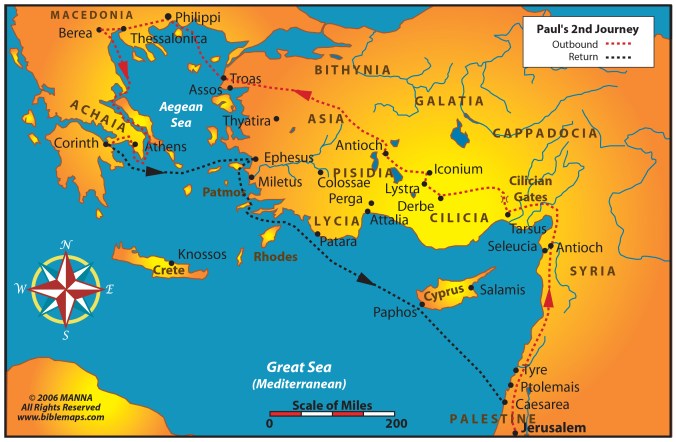
Thessalonica was a thriving port city in Macedonia, strategically located along the Via Egnatia—the major Roman road linking east and west—which made it a hub of commerce, culture, and political influence. As a Roman provincial capital with a diverse population of Greeks, Romans, and Jews, it was an ideal place for Paul to plant a church during his second missionary journey (49-52 CE). He preached in the synagogue for three Sabbaths, and despite facing opposition, his message took root among both Jews and Gentiles. Forced to leave prematurely, Paul later wrote 1 and 2 Thessalonians while in Corinth (50-51 CE) to encourage the fledgling community, clarify teachings about Christ’s return, and strengthen their faith amid persecution. (Sidebar: Paul’s authorship of 2 Thessalonians is disputed and it could have been written by one of his co-workers, Timothy or Silvanus). The city’s vibrancy and volatility made it a powerful setting for Paul’s eschatological reflections and pastoral care.
As pointed out in the Lutheran Study Bible, a good framework for understanding the correspondence between Paul and the Thessalonian believers is to realize that in his absence, three questions seemed to be swirling and remain relevant in 2025: “Can we trust this guy? If God is truly Lord of all, why are we who worship this God still suffering? Why is Christ’s return taking so long, and what will happen to those who die before he comes?” (LSB, page 1842). That third question seems to be at the center of 2 Thessalonians.

In 2 Thessalonians 2:1–5, Paul urges believers not to be shaken or alarmed by claims that the Day of the Lord has already come. He explains that certain events—like the rebellion and the revealing of the “man of lawlessness”—must happen first and reminds them that he had already taught them this. Then, in verses 13–17, Paul shifts to encouragement, thanking God for choosing them for salvation through the Spirit and truth. He calls them to stand firm, hold fast to his teachings, and be strengthened in every good word and deed, offering comfort and hope in the face of confusion and fear.
What should we take away from this portion of the letter? First, it is clear that we should not be shaken by false claims about the timing of Christ’s return. The author suggests that certain events (a rebellion, a revelation of a “man of lawlessness,” both rather vague and applicable to many situations!) must precede the Day of the Lord. People have twisted themselves into knots over these kinds of predictions throughout history, and we can get caught up in that as well. Second, the author reminds the community that they are chosen by God and called through the gospel to share in Christ’s glory, affirming their identity and purpose. As spiritual descendants, this is WHO we are and WHY we are! Rather than spending our time fretting over the end times, a healthier approach to life is to do what we can right here and right now — a practical approach to justice. Action is a great counter to anxiety about the future. Finally, there are great words of encouragement for believers in the final verses — one of many pep talks we find in Paul’s letters — check out Romans 8:18, 2 Corinthians 4:17, 1 Thessalonians 4: 13-18, and Galatians 6:9 if you need a lift today!
Soli Deo Gloria!
A Musical Connection: The End of the World As We Know It (And I Feel Fine)
While preparing this week’s blog, I stumbled on a commentary on the passage from 2 Thessalonians by Nijay Gupta. In it, he referenced R.E.M.’s It’s the End of the World As We Know It (And I Feel Fine), a 1987 offering that feels like a snapshot of late-1980s chaos—fast, fragmented, and overloaded with pop culture. Hearing the song took me back to that period and my students from those days. The lyrics come at you fast and the ironic “I feel fine” tag line offers a sense of “shrug” in the face of a world that seems to be coming apart. I post it here as an example of the post-modern angst that many seem to feel in our own time — and is played out in so many ways.
R.E.M. emerged from Athens, Georgia in the early 1980s and quickly became one of the defining bands of alternative rock. Known for their jangly guitar sound, cryptic lyrics, and Michael Stipe’s distinctive voice, they blended post-punk energy with Southern introspection. Their early albums like Murmur and Reckoning built a cult following, while later releases such as Out of Time and Automatic for the People brought mainstream success with hits like “Losing My Religion.” R.E.M.’s music often wrestled with themes of identity, politics, and existential angst, making them both a voice of their generation and a bridge between underground authenticity and global influence.
(Information garnered from Co-Pilot, 1 November 2025)
Prayer Reflection: Merton’s “Prayer of Trust”
Thomas Merton’s Prayer of Trust is included in his 1956 book, Thoughts In Solitude, and is a heartfelt confession that he doesn’t know where he’s going, but he’s trying to follow God anyway. It’s honest, raw, and speaks to that deep uncertainty so many of us feel in a world that often seems disconnected and chaotic. In the postmodern era, where truth feels slippery and meaning gets drowned out by noise, Merton’s words remind us that even the desire to please God is enough. His prayer offers a kind of spiritual anchor—a quiet trust that cuts through the confusion and says, “You’re not alone in this.” I offer it as a counter to the sentiments expressed in the R.E.M. song.
My Lord God, I have no idea where I am going. I do not see the road ahead of me. I cannot know for certain where it will end. Nor do I really know myself, and the fact that I think I am following your will does not mean that I am actually doing so. But I believe that the desire to please you does in fact please you. And I hope I have that desire in all that I am doing. I hope that I will never do anything apart from that desire. And I know that if I do this you will lead me by the right road, though I may know nothing about it. Therefore, will I trust you always though I may seem to be lost and in the shadow of death. I will not fear, for you are ever with me, and you will never leave me to face my perils alone. Amen.
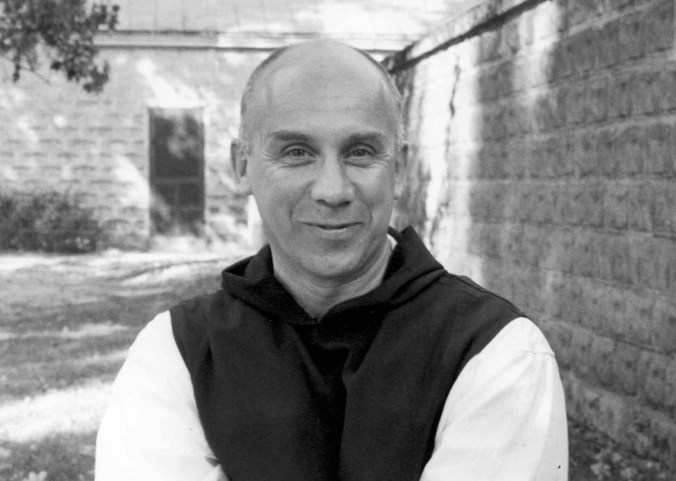
(1915-1968)
Faithful Conversations Updates
Join us for some free-flowing conversation about the Lectionary readings each Sunday. We meet from 10:45-11:30 in the church library each week, with some exceptions. No prior knowledge is necessary! ALL ARE WELCOME! And, let’s discuss the Gospel reading for Sunday (Luke 20: 27-38) alongside the Second Reading from 2 Thessalonians — why are they offered together in the RCL readings for Sunday?
And, one more thing: this offering from Pew Research regarding our religious landscape is worth your time. I found this analysis of young people and religious beliefs especially interesting.
THIS WEEK’S BIBLE 365
READING CHALLENGE:
Monday 3 November: Leviticus 19-20, Psalm 36
Tuesday 4 November: Leviticus 21-23, Psalm 37
Wednesday 5 November: Leviticus 24-25, Psalm 38
Thursday 6 November: Leviticus 26-27, Psalm 39
Friday 7 November: Numbers 1-4, Psalm 40
Saturday 8 November: Numbers 5-7, Psalm 41
Sunday 9 November: Numbers 8-10, Psalm 42
Here is a LINK to the full Bible 365 Plan!
The Bible 365 Challenge!
More than 60 members of our faith community have committed to the Bible 365 Challenge—a shared journey of reading through the entire Bible in one year. Each day, we engage with selected passages weaving together stories of faith, struggle, grace, and redemption. This challenge isn’t just about completing a task; it’s about deepening our spiritual roots, building community, and discovering how scripture speaks into our lives today.
