“Think for a moment how, across the world, someone’s life just changed – irrevocably and permanently – and everything that once was so steady, so reliable, must now find a new way of unfolding.” (John O’Donohue)**
Celtic mystic John O’Donohue’s opening quote reminded me that liminal moments forever fascinate me — those times when we are “here” but will soon be “there” — in a different space. Richard Rohr, Franciscan priest, defines those moments as “any hiatus between stages of life, faith, jobs, loves, or relationships. It is that graced time when we are not certain or in control, when something genuinely new can happen … it is the ultimate teachable space.” As I look back on over four decades of teaching and coaching, it is clear to me that has always been the hook — the opportunity to work with young people in a liminal moment when hope and exciting possibility are “unfolding.” What a great privilege that is.
The Gospel for Christ the King Sunday brings us into the ultimate liminal moment. At Golgotha, Jesus enters the remarkable threshold—suspended between heaven and earth, life and death. Time slows as eternity draws near. Between two criminals, one mocks while the other sees clearly and pleads, “Jesus, remember me.” In that moment, Jesus responds with grace: “Today you will be with me in paradise.”The cross becomes a doorway, not just to death, but to redemption. Here, God meets us in our suffering, not from above but within it, offering not just forgiveness, but presence. This liminal moment reveals the heart of the gospel—mercy at the edge of death, hope rising in the shadow of despair. It makes perfect sense to me that the authors of the Lectionary would choose this moment for the final Sunday in our church year.
The Liturgical Calendar
Thanks for your visit here again this week! As mentioned, we mark the end of the Lectionary cycle (Year C) during these late days of November. Christ the King Sunday was established by Pope Pius XI in 1925 as a response to the chaos of post–World War I Europe, where secularism, fascism, and communism were on the rise; the Pope’s encyclical Quas Primas proclaimed Christ’s reign as a source of peace, justice, and unity beyond political power — a timeless affirmation. Originally observed in October, Pope Paul VI moved the feast to the final Sunday of the liturgical year in 1969 to highlight Christ’s cosmic sovereignty (in line with changes brought by the Second Vatican Council). In the 1980s and 1990s, many Protestant churches—including the ELCA after its 1988 formation—adopted Christ the King Sunday through the Revised Common Lectionary, which placed it just before Advent. This shift marked a move toward greater ecumenical unity and theological emphasis on Christ’s reign as the culmination of the church’s annual journey. My reflections this week will focus on the Colossians passage, with a musical offering inspired by the Gospel, and a contemporary prayer of confession written for Christ the King Sunday.
** Note 1: Links to outside references are bolded and italicized and are meant for further reading or research on your part. While the text I am including in the blog is my own, I am pulling from a multitude of sites for ideas and connections. ** Note 2: In my increasing use of A.I. (Copilot), I will cite sourcing of how I am using the tool, if necessary. I don’t want that to be overly cumbersome, but I am gradually incorporating more tools. I am exploring the A.I. world this summer prior to my next teaching semester. As you can imagine, it is a great challenge right now and will forever change the face of education!
** Note 3: The images I include in the blog are drawn from Wikimedia Commons to the fullest extent possible.
My source for the Bible readings each week is the Bible Gateway website. I generally use the NRSVUE translation.
The readings for Christ the King Sunday proclaim a vision of divine kingship rooted in justice, mercy, and cosmic reconciliation. Jeremiah foretells a righteous king who will gather and shepherd the scattered, embodying wisdom and justice. Psalm 46 declares God as a steadfast refuge amid chaos, while Colossians exalts Christ as the cosmic center—through whom all things were created and reconciled. In Luke’s Gospel, Christ reigns paradoxically from the cross, offering forgiveness and welcoming the repentant thief into paradise, revealing a kingdom founded not on domination but on sacrificial love.
“Describe the common themes among the readings for Pentecost 23.” Copilot, 13 November 2025, Copilot website.
Lectio Divina is a quiet, thoughtful way of reading the Bible to connect with God. It grew out of early Christian traditions and was shaped by thinkers like Augustine, who believed Scripture speaks to the heart. Augustine didn’t invent the practice, but his ideas helped form its spirit—listening deeply and responding with love. Later, others gave it a clear structure, but its roots go back to that longing for God’s voice.
LUTHER’S METHOD OF BIBLE READING A Revision of the Lectio Divina (Augustinian)
Three Steps
Oratio (Prayer): This is the starting point, where one humbly prays for the Holy Spirit’s guidance to understand God’s Word. Luther emphasized that prayer prepares the heart and mind to receive divine wisdom.
Meditatio (Meditation): This involves deeply engaging with Scripture, not just reading it but reflecting on it repeatedly. Luther encouraged believers to “chew on” the Word, allowing its meaning to sink in and shape their thoughts and actions.
Tentatio (Struggle): Often translated as “trial” or “temptation,” this refers to the challenges and spiritual battles that arise as one seeks to live according to God’s Word. Luther saw these struggles as a way God refines faith, making it more resilient and authentic.
Focus Passage: Colossians 1: 11-20
11 May you be made strong with all the strength that comes from his glorious power, so that you may have all endurance and patience, joyfully 12 giving thanks to the Father, who has enabled you to share in the inheritance of the saints in the light.13 He has rescued us from the power of darkness and transferred us into the kingdom of his beloved Son, 14 in whom we have redemption, the forgiveness of sins.
15 He is the image of the invisible God, the firstborn of all creation, 16 for in him all things in heaven and on earth were created, things visible and invisible, whether thrones or dominions or rulers or powers—all things have been created through him and for him. 17 He himself is before all things, and in him all things hold together. 18 He is the head of the body, the church; he is the beginning, the firstborn from the dead, so that he might come to have first place in everything. 19 For in him all the fullness of God was pleased to dwell, 20 and through him God was pleased to reconcile to himself all things, whether on earth or in heaven, by making peace through the blood of his cross.
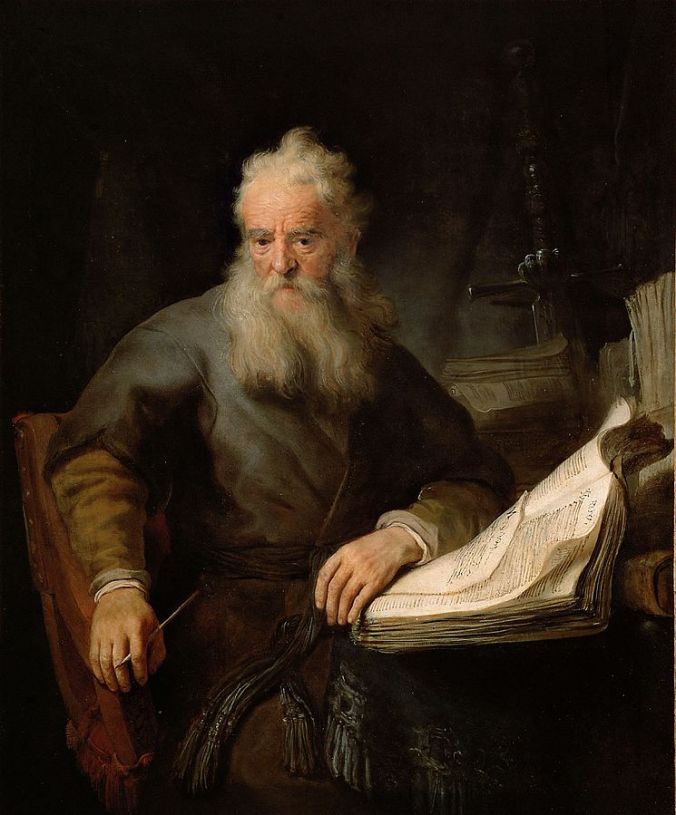
Saint Paul Rembrandt (1606-1669)
Check out this overview of Colossians from the Bible Project!
Reflection: “Christ in All: A Colossian Prelude to Advent”
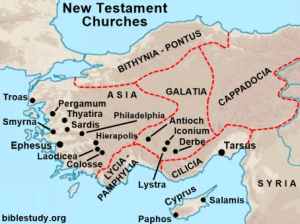
Ancient Turkey
A fascinating window into the world of the first-generation Christians, Colossians was written by the Apostle Paul (or a disciple of his) in c. 60–62 CE during his imprisonment in Rome, addressing a young church in Colossae facing theological confusion and turmoil.
Traders and travelers shaped Colossae — a small city in Asia Minor (modern-day Turkey) — into a diverse hub, blending pagan beliefs, Jewish legalism, and emerging mystical philosophies. Though Paul had not personally visited the Colossae Christians, he was responding to reports from Epaphras, a local leader and companion of Paul’s, who warned of false teachings — later termed the Colossian Heresy — that threatened the community’s understanding of Christ. (Sidebar: Epaphras is mentioned three times in the New Testament: Colossians 1:7-8, 4: 12-13, and Philemon 1:23 and is an intriguing character in his own right).
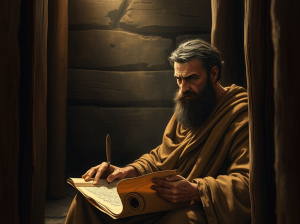
Paul writing from Prison (A.I. generated)
This week’s reading from the first portion of the letter is a remarkable passage that stopped me in my tracks — and is entirely fitting for Christ the King Sunday. In verses 11-14 Paul urges the Colossians to draw strength from God’s glorious power so they can endure with patience and joy. He calls them to live in gratitude, knowing God has qualified them to share in the inheritance of the saints. God has rescued them from the grip of darkness and placed them firmly in the kingdom of his beloved Son. In Christ, they don’t just find comfort—they receive full redemption and the radical forgiveness of sins. This truth anchors their identity and equips them to stand firm against every false teaching (the Colossian heresy). Good words for us to hear this week.
And then we arrive at this extraordinary piece of prose from the pen of Paul — verses 15-20. As noted by New Testament scholar Jennifer S. Wyant in her 2022 commentary on this passage, “These verses contain some of the highest Christology in the whole New Testament.” Think of Christology as the study of Christ’s divine and human nature, along with an exploration of how he reveals God, fulfills the role of Savior, and reconciles creation through his life, death and resurrection. Biblical scholars, in fact, assert that these verses contain an early creedal statement voiced by first-generation Christians, and provide a window into the evolution into their understanding of Christ’s identity. Can we possibly improve on it?
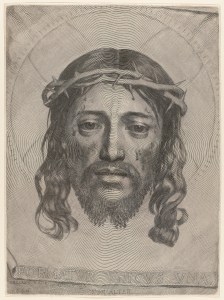
Face of Christ Claude Mellon, 1649
Finally, Wyant makes an important observation as to WHY these words from more than two thousand years ago instruct and inspire us in 2025 — that is, Paul’s near rhythmic use of the word ALL within the nine verses (I marked them in the passage above). This “creates a deep sense of confidence in who Christ is,” she says. “Nothing is outside of Christ. There is no situation that the Colossians might face that Christ is not already there . . . And so over and over again, we see Paul assure this congregation: Christ is in all. All has been forgiven. All will be well. Forever.” Sit with those words for a few minutes. What a beautiful close to our Lectionary readings for this church year — good words for us to carry into Advent! We have arrived at a liminal moment.
Soli Deo Gloria!
As noted above, I am indebted to Jennifer Wyant for her analysis of Colossians 1: 11-20. You may read that in full at here. Her commentary is among those found at the Working Preacher site sponsored by Luther Seminary in St. Paul, MN.
A Musical Connection: “Jesus Remember Me”
“Jesus, Remember Me” emerged from the Taizé Community in France, an ecumenical monastic movement founded by Brother Roger to promote reconciliation and peace. Composed by Jacques Berthier in 1978, the chant reflects Taizé’s commitment to simple, meditative prayer that transcends language and denomination. Its text—drawn from the words of the penitent thief in Luke 23:42 — embodies the community’s focus on mercy, humility, and hope. Designed for repetition, the chant invites worshippers into a shared contemplative silence, often sung in candlelit gatherings. As with many Taizé songs, it fosters unity through music that is both accessible and spiritually profound.
The chant “Jesus, Remember Me” by Jacques Berthier is known for its simplicity and meditative repetition. The lyrics are:
“Jesus, remember me when you come into your kingdom.”
This line is sung repeatedly, often in a Taizé-style prayer setting, allowing worshippers to enter a contemplative rhythm.
A Prayer of Confession for Christ the King Sunday
Jesus said, “My realm is not of this world.”
And yet, we confess, sometimes we still get seduced by the values of empire: wealth and power and glory.
Loving God, you see us as we are. You know our secret battles and all the ways in which we fail to live out your call upon our lives.
Never give up on us, God. Use us, even in our brokenness. Forgive us and renew us. Help us to enthrone you in our lives. Amen.
Source: Confession for Christ the King Sunday by Cara Heafy, an ordained Minister in the United Reformed Church, UK.
Jesus Statue in Świebodzin, Western Poland
Faithful Conversations Updates
Join us for some free-flowing conversation about the Lectionary readings each Sunday. We meet from 10:45-11:30 in the church library each week, with some exceptions. No prior knowledge is necessary! ALL ARE WELCOME!
QUESTIONS FOR DISCUSSION THIS WEEK (and anything else you care to discuss from the readings):
1. How does Paul’s repeated use of the word “all” in Colossians 1:11–20 shape our understanding of Christ’s cosmic role and presence in everyday life?
2. Why is a high Christology—emphasizing Christ’s divinity, creative power, and reconciling work—essential for grounding Christian identity, especially in times of transition like Advent?
3. In what ways does the cultural and religious diversity of Colossae mirror the complexities of our own communities today—and how might Paul’s message guide us through theological confusion or competing worldviews?
One more thing . . . .
Check out this story from the Lutheran World Federation regarding the Lutheran Church in Myanmar.
The Bible 365 Challenge! More than 60 members of our faith community have committed to the Bible 365 Challenge—a shared journey of reading through the entire Bible in one year. Each day, we engage with selected passages weaving together stories of faith, struggle, grace, and redemption. This challenge isn’t just about completing a task; it’s about deepening our spiritual roots, building community, and discovering how scripture speaks into our lives today.