“A thing may be incredible and still be true; sometimes it is incredible because it is true.” ~ Herman Melville
Herman Melville remains my favorite fiction writer, and the aphorism above from his 1849 novel Mardi names a hard truth: we often turn away from what is real simply because it unsettles us. That insight still lands with force. Scholars often cast Melville as a man locked in a fierce struggle with Christian faith — unable to claim it fully, yet unable to release it. Many of us know that tension. Melville read the King James Bible with care, and its rhythms pulse through his novels, essays, and poems. Once you start listening for them, those biblical echoes become part of the pleasure of reading him. His mix of honesty, restlessness, and reverence keeps drawing me back. He refuses to let us settle. He urges us to look again. As we move through the Christmas season — its beauty, its strangeness, its long and layered history — we meet stories that still stretch our imaginations: a virgin birth, the incarnation, angels breaking open the night, a star pulling foreign seekers across deserts. It’s no surprise that many outside the Christian story view these claims with skepticism. Yet these exciting mysteries invite us to consider how truth can rise beyond what we think possible.
Update: Our Lectionary Journey
In case you want to sing the familiar song!
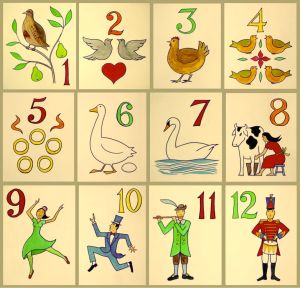
Since February of 2023, we have explored the church calendar, and I appreciate your ongoing interest in the Revised Common Lectionary (RCL)! One surprising discovery in preparing this post: the earliest Christians apparently didn’t celebrate Christmas. Their worship centered on Easter and the Resurrection, the heartbeat of their faith. The first observance of Jesus’ birth actually lived inside Epiphany — a single feast that once held his birth, the Magi’s visit, and his baptism together. Only in the fourth century, as Christianity gained legal standing in the Roman Empire, did Christmas emerge on December 25. Over time, shaped especially by German and northern European traditions, our modern holiday took on the form we now assume is ancient, though much of it isn’t. You can feel that older rhythm in the Twelve Days of Christmas, a pattern reaching back to the Council of Tours in 567 CE, when the church crafted a calendar to help believers linger with the mystery of Christ’s birth. These days carry us toward Epiphany, rooted in the Greek epiphaneia—appearance, manifestation, revelation. Historians might call it the moment when the hidden becomes visible; the church calls it a season when God’s presence breaks through in unexpected, life‑altering ways. From the Magi’s long journey to Jesus’ baptism in the Jordan, Epiphany invites us to revisit familiar stories and discover that they still have something new to reveal. I will explore that further in my reflections.
Finally, here’s a calendar consideration for this week. Across many Christian traditions, January 1 marks the commemoration of the Name of Jesus, historically tied to the eighth day after his birth, when—according to Luke—he was circumcised and formally given the name “Jesus.” This name, announced by the angel before his conception, means “Yahweh is salvation.” If inclined, here’s some further history on that commemoration.
A Simple Strategy for Reading
#1: What is something NEW you learned in the reading?
#2: What is something that caused you to REFLECT?
#3: What is something you can RELATE to prior knowledge?
#4: What is something you would like to further DISCUSS?
The four-question approach to reading (NRRD) is a good way to take on Bible passages.
The readings for the Second Sunday after Christmas share themes of divine restoration, incarnation, and grace. Jeremiah envisions God gathering and comforting a scattered people, promising joy even amid sorrow, while Psalm 147 celebrates God’s sustaining power in creation and providence. Ephesians lifts this vision higher, proclaiming that believers are chosen and blessed in Christ, redeemed and sealed by the Spirit as part of God’s eternal plan. John’s prologue crowns these themes, declaring that the Word became flesh, bringing light, truth, and grace into the world, so that all might receive adoption as children of God.
Co-Pilot Prompt: “Comment on the themes from the Revised Common Lectionary for 2 Christmas.” 26 December 2025.
Common Themes Among the Readings
The readings for the Epiphany of Our Lord reveal a God who draws all nations into the light of divine revelation. Isaiah and the psalm envision a world where kings and peoples are drawn to God’s radiance and justice, while Ephesians proclaims that this long‑hidden mystery — God’s inclusive grace — is now made known in Christ for all. Matthew’s story of the Magi embodies this universal invitation, showing that even those from distant lands recognize and honor the light that has come into the world.
Co-Pilot Prompt: “Comment on the themes from the Revised Common Lectionary for Epiphany.” 26 December 2025.
1 In the beginning was the Word, and the Word was with God, and the Word was God. 2 He was in the beginning with God. 3 All things came into being through him, and without him not one thing came into being. What has come into being 4 in him was life, and the life was the light of all people. 5 The light shines in the darkness, and the darkness did not overtake it. 6 There was a man sent from God whose name was John. 7 He came as a witness to testify to the light, so that all might believe through him. 8 He himself was not the light, but he came to testify to the light. 9 The true light, which enlightens everyone, was coming into the world. 10 He was in the world, and the world came into being through him, yet the world did not know him. 11 He came to what was his own, and his own people did not accept him. 12 But to all who received him, who believed in his name, he gave power to become children of God, 13 who were born, not of blood or of the will of the flesh or of the will of man, but of God. 14 And the Word became flesh and lived among us, and we have seen his glory, the glory as of a father’s only son, full of grace and truth. 15 (John testified to him and cried out, “This was he of whom I said, ‘He who comes after me ranks ahead of me because he was before me.’ ”) 16 From his fullness we have all received, grace upon grace. 17 The law indeed was given through Moses; grace and truth came through Jesus Christ. 18 No one has ever seen God. It is the only Son, himself God, who is close to the Father’s heart, who has made him known.
My source for the Biblical text is the Bible Gateway website, NRSVUE.
Questions for Discussion
1. John opens his Gospel with the same words that begin Genesis: “In the beginning…” How does this deliberate echo of the creation story shape your understanding of who Jesus is—and how might returning to these ancient texts, again and again, deepen your own spiritual practice or sense of identity?
2. John describes Christ as the “true light” that shines in the darkness, a light the darkness cannot overcome. How do you see that light breaking into the world today—both in large, public ways and in small, personal ones—and what does it mean for us to bear witness to that light as John did?
Reflection: “The God Who Pitches a Tent Among Us“
Our faith, like history, never stands still. As a historian, I’ve learned that the stories we inherit keep unfolding each time we return to them, shaped by the questions we carry and the lives we’ve lived since our last encounter. That’s why the historian’s craft has always felt so close to the work of the church for me: we revisit these texts, turn them in the light, and let them speak with fresh force. The Revised Common Lectionary gives us that rhythm. Its three‑year cycle brings familiar passages back until they feel like old friends — steady companions who still manage to surprise us. And Christmas, perhaps more than any season, reveals how layered those surprises can be. As Pastor Jen reminded us on Christmas Eve, joy and ache often sit side by side—memories that warm us, memories that unsettle us, nostalgia for a church that once felt different, or quiet questions about what we believe.
The Christmas story familiar to us derives from Matthew and Luke — Mark and John do not include it. John begins his Gospel not with a manger or a genealogy but with a prologue that feels like stepping into eternity. (Sidebar: I often find it helpful to read these passages aloud — and that is certainly the case with John’s prologue!). Before shepherds, before angels, before Bethlehem, John takes us to the beginning—“In the beginning was the Word, and the Word was with God, and the Word was God. He was in the beginning with God. All things came into being through him, and without him not one thing came into being. What has come into being in him was life, and the life was the light of all people.” Clearly, John is echoing the creation accounts from Genesis — note this language: “In the beginning when God created the heavens and the earth, the earth was a formless void and darkness covered the face of the deep, while a wind from God swept over the face of the waters. Then God said, ‘Let there be light’; and there was light.” I can almost hear the voice of Spock from Star Trek here — fascinating!
And then, in one breathtaking line, he brings that cosmic sweep down to earth: “And the Word became flesh and lived among us.” *The Greek verb translated “lived” is skenóō—literally, pitched his tent. John wants us to imagine God not as distant or abstract but as someone who moves into the neighborhood and chooses to dwell right in the middle of our ordinary, fragile lives. It’s an astonishing claim. The incarnation stretches our imaginations to the breaking point, yet our faith is grounded in it. Luther once said that if we actually saw the raw majesty of God, it would terrify us—crush us. That’s why Christ took on our humanity. God comes to us in a form we can bear, a presence we can approach, a face we can recognize. The tent is pitched not on some distant mountaintop but here, among us. And that makes John’s next observation all the more heartbreaking: “He came to his own, and his own did not accept him.” The NRSVue notes an alternate translation: “He came to his own home.” Christ came home — and home rejected him. Imagine the grief of that.
Mindy Misener
In her commentary on this text in The Christian Century, writer and Yale Divinity student Mindy Misener presses into this theme of rejection. She reminds us that the longing for home runs deep in Scripture and deep in human experience. Most of us, she writes, lose at least one home in our lifetime—sometimes gently, as time reshapes a place we once knew; sometimes violently, as homes are swept away by disaster, war, or the decisions of people far removed from the suffering they cause. Such losses, she notes, are nothing short of traumatic.
John tells us that Christ came home and was turned away. Yet that rejection did not stop him from making a home in this world, revealing God’s glory in the very place that resisted him. And many did receive him. John lingers on that word—receive—a physical verb before it becomes a theological one. The first disciples welcomed him not only with belief but with their lives, their tables, their presence. They said, in countless practical ways, welcome home. As Misener asserts, It’s tempting to let “home” drift into metaphor, but the child stumbling out of a bomb‑blasted city does not need a metaphor. She needs a home. And John’s prologue suggests that receiving Christ always pushes us toward making room for others—real people, real bodies, real dwellings.
So what lessons rise from this passage? Misener’s insight helps us see at least three, each one pressing into the heart of the Gospel. First, God knows the ache of homelessness—Christ himself steps into it. He enters a world that does not always make room for him, carrying in his own story the dislocation so many of us know. Second, God’s response to that ache is not abstraction but incarnation. The Word does not hover above human suffering; he pitches his tent among us, choosing proximity over distance, presence over detachment, solidarity over safety. And third, God invites us to embody that same nearness. To receive Christ is to create space where others can belong, to offer shelter where the world has offered none, to practice welcome in ways as concrete as the needs before us — meals shared, doors opened, dignity restored, homes rebuilt.
Soli deo Gloria!
* This reference is drawn from Pastor Elisabeth Johnson’s commentary on this text in Working Preacher from 2 January 2022. She does a beautiful job of explaining this text!
** I am indebted to Mindy Misener for this interpretation. Her article appears in the January 2026 issue of The Christian Century. She offers an interpretation of the Epiphany texts as well.
Musical Meditation: Of the Father’s Love Begotten
No hymn captures the opening sweep of John’s Gospel quite like Of the Father’s Love Begotten. Its roots reach all the way back to the 4th century, when the poet Prudentius wrote it as a way of expressing the same mystery John names in his prologue — the eternal Word through whom all things came to be. It’s a natural fit for this week’s Gospel reading — a companion to John’s vision, reminding us that the child in the manger is the One “begotten before all worlds.” In its simplicity and depth, the hymn invites us to stand with John in wonder as eternity steps into time. The version I’m sharing here offers its own distinctive interpretation of this old treasure. In the ELW, you’ll find it at #295. And, by the way, the poem originally had nine verses — the ones you see here are typically used in modern versions.
Of the Father’s love begotten, Ere the worlds began to be, He is Alpha and Omega, He the source, the ending He, Of the things that are, that have been, And that future years shall see, Evermore and evermore!
He is found in human fashion, Death and sorrow here to know, That the race of Adam’s children Doomed by law to endless woe, May not henceforth die and perish In the dreadful gulf below, Evermore and evermore!
O ye heights of heaven adore Him; Angel hosts, His praises sing; Powers, dominions, bow before Him, And extol our God and King! Let no tongue on earth be silent, Every voice in concert sing, Evermore and evermore!
Christ, to Thee with God the Father, And, O Holy Ghost, to Thee, Hymn and chant with high thanksgiving, And unwearied praises be: Honor, glory, and dominion, And eternal victory, Evermore and evermore!
ChurchFolk is a folk‑influenced worship collective that grew out of College Church in Wheaton, a historic congregation long intertwined with the Wheaton College community. Its members include musicians from the church’s staff and congregation.
Prayer Reflection: New Year’s Eve
Eternal God, you have placed us in a world of space and time, and through the events of our lives you bless us with your love. Grant that in the new year we may know your presence, see your love at work, and live in the light of the event that gives us joy forever — the coming of your Son, Jesus Christ our Lord, who lives and reigns with you and the Holy Spirit, one God, now and forever. Amen.
Source: ELW. Lesser Festivals, Commemorations, and Occasions (2006). page 63.
Faithful Conversation Updates
Join us for some free-flowing conversation about the Lectionary readings each Sunday. We meet from 10:45-11:30 in the church library each week, with some exceptions. No prior knowledge is necessary! ALL ARE WELCOME!
The Bible 365 Challenge! More than 60 members of our faith community have committed to the Bible 365 Challenge—a shared journey of reading through the entire Bible in one year. We cross over into 1 Kings this week and are just past 1/4 completion. We have also read 2/3 of the Psalms at this point.