“There are a few times in life when you leap up and the past that you’d been standing on falls away behind you, and the future you mean to land on is not yet in place…” (Ann Patchett)
This week’s Gospel and Second Reading prompt thinking about thresholds we cross in life. Most of us can recall those quiet or sudden shifts when the ground beneath us gives way, and only later do we realize how sharply life divided into a before and an after. Fiction writer Ann Patchett, in her 2019 novel The Dutch House, captures this with striking clarity — we often step into new terrain without recognizing its weight until much later. The vivid scenes in Matthew 3 and Acts 10 unfold in just this way. At the Jordan, Jesus enters the waters of baptism and rises into the fullness of his public calling as the Beloved Son. In Caesarea, the Roman centurion Cornelius receives a vision that will open the gospel to the Gentile world and redirect the early church. Both narratives remind us that God often meets us at these crossings. More on that in my reflections.
Important Update on the Blog!
With 5 Epiphany (8 February), we complete the three‑year Revised Common Lectionary cycle that began in 2023 as an offshoot of an Introduction to Bible Study course—an experiment that has grown into more than 150 posts. Thank you for reading and making this part of your weekly rhythm. Beginning with Transfiguration Sunday (15 February), the blog will turn the page. I will still be following the RCL, but with a cleaner, simpler look. Over the next month I’ll be experimenting with the layout and trying out a few ideas to make it easier to read and navigate. This shift reflects a renewed focus on digital ministry and more intentional use of online tools for learning and reflection. The blog can also serve as a hub for future Bible studies and adult education.
One key change: I will no longer use a mailing list. To keep receiving new posts, please subscribe directly to the blog (no cost). After you enter your email, WordPress will send a verification link; clicking it confirms your subscription and prevents spam sign‑ups. You will find a subscribe block at the bottom of the blog and a pop-up subscribe application in the lower right also. I encourage you to go ahead and do that now, if you wish to continue receiving the blog.
** If you are already a subscriber through WordPress, no need to redo that process!
A Simple Strategy for Reading
#1: What is something NEW you learned in the reading?
#2: What is something that caused you to REFLECT?
#3: What is something you can RELATE to prior knowledge?
#4: What is something you would like to further DISCUSS?
The four-question approach to reading (NRRD) is a good way to take on Bible passages.
The readings for the Baptism of Our Lord center on God’s chosen servant, empowered by the Spirit to bring justice, healing, and light to the nations. Psalm 29 echoes this by portraying the majestic voice of the Lord over the waters, revealing divine power that both shakes creation and blesses God’s people with peace. Acts 10 proclaims that Jesus’ ministry—launched at his baptism—reveals a God who shows no partiality, extending peace and liberation to all peoples through the Spirit’s anointing. In Matthew’s Gospel, Jesus’ baptism becomes the defining threshold moment where the heavens open, the Spirit descends, and the divine voice declares him the Beloved Son, marking the beginning of his mission.
Co-Pilot Prompt: “Comment on the themes from the Revised Common Lectionary for The Baptism of Our Lord.” 2 January 2026.
Focus Readings from Matthew and Acts
The Gospel 13 Then Jesus came from Galilee to John at the Jordan, to be baptized by him. 14 John would have prevented him, saying, “I need to be baptized by you, and do you come to me?” 15 But Jesus answered him, “Let it be so now, for it is proper for us in this way to fulfill all righteousness.” Then he consented. 16 And when Jesus had been baptized, just as he came up from the water, suddenly the heavens were opened to him and he saw God’s Spirit descending like a dove and alighting on him. 17 And a voice from the heavens said, “This is my Son, the Beloved, with whom I am well pleased.”
My source for the Biblical texts is the Bible Gateway website, NRSVUE.
Questions for Discussion
Where do you see signs that God may already be at work ahead of you — in a person, situation, or community you hadn’t expected — and what would it take for you to “cross the threshold” as Peter did?
Both Jesus at the Jordan and Peter in Caesarea step into moments that redraw the boundaries of who belongs. What inherited lines — personal, cultural, or congregational — might God be inviting us to re‑examine today?
The Second Reading 34 Then Peter began to speak to them: “I truly understand that God shows no partiality, 35 but in every people anyone who fears him and practices righteousness is acceptable to him. 36 You know the message he sent to the people of Israel, preaching peace by Jesus Christ—he is Lord of all. 37 That message spread throughout Judea, beginning in Galilee after the baptism that John announced: 38 how God anointed Jesus of Nazareth with the Holy Spirit and with power; how he went about doing good and healing all who were oppressed by the devil, for God was with him. 39 We are witnesses to all that he did both in Judea and in Jerusalem. They put him to death by hanging him on a tree, 40 but God raised him on the third day and allowed him to appear, 41 not to all the people but to us who were chosen by God as witnesses and who ate and drank with him after he rose from the dead. 42 He commanded us to preach to the people and to testify that he is the one ordained by God as judge of the living and the dead. 43 All the prophets testify about him that everyone who believes in him receives forgiveness of sins through his name.”
Reflection: “Where the River Meets the Doorway”
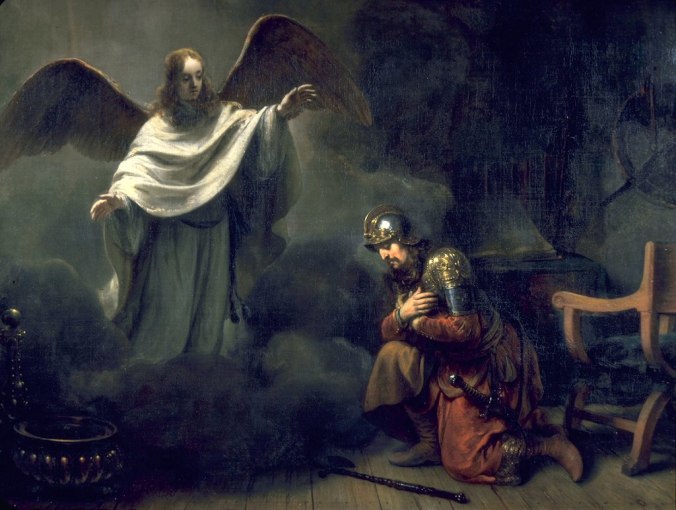
Vision of Corelius, the Roman Centurion by Gerbrand van den Eeckhout (Dutch, 1664)
Two stories, two encounters that change everything. This Sunday we stand at a threshold where Scripture shows God expanding what we imagine is possible. In Matthew 3, Jesus steps into the Jordan and receives his divine affirmation and calling. In Acts 10, Peter crosses the doorway of a Roman centurion’s home and discovers that the Spirit has already gone before him.These moments are separated by roughly a decade and by miles of geography — from the wilderness of Judea to the coastal city of Caesarea — yet they share the same disruptive grace. What began at the river now breaks open in the household of a Gentile officer, revealing a God who keeps pushing the early church beyond its inherited lines and into a wider, more surprising future.
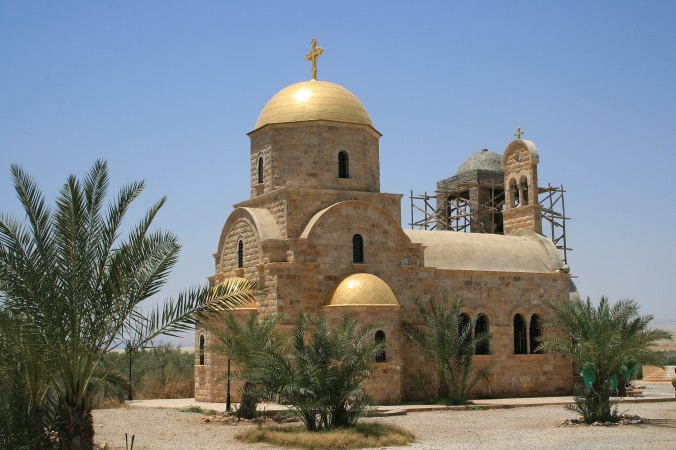
John the Baptist Church (Greek Orthodox), Jesus’ Baptismal Site, River Jordan
Jesus’ baptism happens around the year 28 or 29 CE at Bethany beyond the Jordan — Al‑Maghtas — the wilderness site where he steps into the water and into the public ministry that will reshape the world. By the time Peter stands in Caesarea, entering the home of Cornelius, we are roughly a decade later — early to mid‑40s CE — and the Jesus movement has spread north from Jerusalem into Judea, Samaria, and the coastal regions. Peter is no longer the fisherman from Galilee; he now leads a rapidly growing and increasingly diverse community of believers. Then Cornelius enters the story — a Roman officer, a Gentile, and a representative of the very empire that executed Jesus — already guided by a vision to send for Peter. His household becomes the unlikely setting for a major turning point in Christian history. Here Peter delivers one of the earliest and clearest summaries of the Gospel. And when he steps across that threshold and sees the Spirit poured out on Gentiles, the early church learns that God’s promise is not confined by ethnicity, purity codes, or inherited boundaries. This moment doesn’t just widen the circle; it redraws the map of who belongs.
These two moments — one at the river, one at a Roman household — offer lessons that still press on the church today. First, they remind us that God often begins new work long before we recognize it, inviting us to step into movements of grace already unfolding around us. Second, they challenge us to cross our own thresholds of fear, habit, or inherited boundary, trusting that the Spirit is at work in people and places we might never have expected. These are not just ancient stories; they are invitations to discern where God is calling us to move next!
Soli Deo Gloria!
Musical Meditation: The Only Son from Heaven
Elisabeth Cruciger (1500-1535)
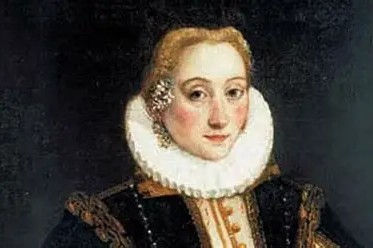
Elisabeth Cruciger (born von Meseritz) came from a Polish noble family. When persecution forced her parents to flee to Wittenberg, she settled there as well and married Caspar Cruciger in 1524. Caspar, the son of a Leipzig townsman, began studying in Wittenberg in 1522 and quickly became one of Martin Luther’s closest and most promising students—Luther even treated him like a son. Caspar later served as Rector of St. John’s School and preacher at St. Stephen’s Church in Magdeburg, and in 1528 he joined the Wittenberg faculty as a professor of theology at Luther’s urging.
Out of this same Wittenberg circle came Elisabeth’s hymn The Only Son from Heaven, the earliest known Lutheran hymn written by a woman. It appeared in 1524 in the Erfurt Enchiridion, one of the first evangelical hymnals, where it was the only hymn by a female author. After leaving her convent, Cruciger entered Luther’s household community, where close contact with the reformers shaped her theological voice. Sung to the tune HERR CHRIST, DER EINIG GOTTS SOHN, the hymn has endured for five centuries and remains in use across Christian traditions (ELW 309). The version I included is in German and replicates how the hymn may have originally sounded.
Note: This information was drawn from the Hymnary.Org website, 3 January 2026.
Lyrics (ELW)
1 The only Son from heaven, foretold by ancient seers, by God the Father given, in human form appears. No sphere His light confining, no star so brightly shining as He, our Morning Star.
2 O time of God appointed, O bright and holy morn! He comes, the King anointed, the Christ, the virgin-born; grim death to vanquish for us, to open heav’n before us, and bring us life again.
3 Awaken, Lord, our spirit to know and love You more, in faith, to stand unshaken in spirit, to adore; that we, through this world moving, each glimpse of heaven proving, may reap its fullness there.
4 O Father, here before You with God the Holy Ghost, and Jesus, we adore You, O pride of angel-host. Before You mortals lowly cry, “Holy, holy, holy, O blessed Trinity!”
This YouTube channelcreates electronic interpretations of Medieval, Renaissance, and Baroque music. The producer gathers MIDI files from various sources, edits them, and arranges them into virtual concerts, using digital tools to mimic the sound of early instruments like the shawm, crumhorn, viol, lute, and cornetto. The visuals draw on public‑domain artwork and manuscript images, and a voice‑simulation program supplies the sung texts. The creator continues to refine earlier uploads and occasionally adds new pieces inspired by pre‑1800 musical styles.
Prayer Reflection: Vision of the Future
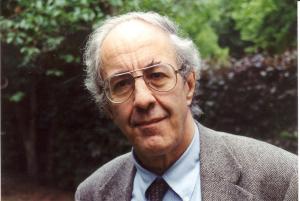
Dutch Theologian Henri Nouwen (1932-1996)
“Often it is the dark forest that makes us speak about the open field. Frequently prison makes us think about freedom, hunger helps us to appreciate food, and war gives us words for peace. Not seldom are our visions of the future born out of the sufferings of the present and our hope for others out of our own despair. Only few “happy endings” make us happy, but often someone’s careful and honest articulation of the ambiguities, uncertainties and painful conditions of life gives us new hope. The paradox is indeed that new life is born out of the pains of the old.” (Henri Nouwen)
Inspired Prayer: O God, who meets us in the dark forests of our lives, teach us to trust that the very places of hunger, longing, and uncertainty can open our eyes to freedom, peace, and new possibility. Give us the courage to speak honestly of our pain and the grace to discover, even there, the quiet beginnings of new life. Amen.
Join us for some free-flowing conversation about the Lectionary readings each Sunday. We meet from 10:45-11:30 in the church library each week, with some exceptions. No prior knowledge is necessary! ALL ARE WELCOME!
The Bible 365 Challenge! More than 60 members of our faith community have committed to the Bible 365 Challenge—a shared journey of reading through the entire Bible in one year. We cross over into 1 Kings this week and are just past 1/4 completion. We have also read 2/3 of the Psalms at this point.