“In Niebuhr’s view, we all worship something. A simple way to figure out what we worship is to ask: Where do we find our sense of meaning? That which gives our lives deeper meaning is that which we worship. If we do not worship God — if we do not seek and find our purpose in relationship with our Creator — we seek meaning in an endless array of other things. Political causes, charismatic people, or even one’s own ego could become an object of worship.”
(Jeremy L. Sabella, An American Conscience: The Reinhold Niebuhr Story).
Reinhold Niebuhr (1892-1971)
“What are you looking for?” Jesus’ question to Andrew and Peter in this week’s Gospel reading from John cuts straight through our defenses. It echoes Reinhold Niebuhr’s insight, as described by Jeremy L. Sabella, that human beings are inherently religious — not because we all gather in sanctuaries, but because we all hand our devotion to something. Whatever shapes our trust, fuels our desire, or anchors our identity becomes, in Niebuhr’s terms, the object of our worship.
I’ve suggested before that our spiritual malaise grows when we move our deepest trust away from a shared spiritual center and toward substitutes—our politics, our work, our purchases, our online personas, or the circles we join to feel like we belong. These forces don’t just compete for our attention; they form us, claim us, and often harden us. None of this is new, but in 2026 the pull feels unusually fierce, as if the very atmosphere is charged with rival altars calling for our loyalty.
Commemorations this Week
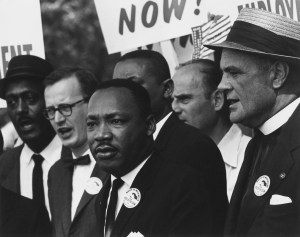
MLK and fellow clergy and the March on Washington, 1963
There are three commemorations on the ELCA calendar this week. Thursday 15 January: Martin Luther King, Jr., renewer of society and martyr; Saturday 17 January: Antony of Egypt (c. 356), renewer of the church; and Sunday 18 January, Confession of Peter (Apostolic Festival).
Sunday is also the beginning of the Week of Prayer for Christian Unity. Some quick history: The Week of Prayer for Christian Unity began in 1908, when Episcopal priest Fr. Paul Wattson proposed an eight‑day period of prayer from January 18–25, linking the Confession of St. Peter to the Conversion of St. Paul as a symbolic frame for Christian reconciliation. In the 1930s, Abbé Paul Couturier broadened the vision, encouraging Christians to pray not for unity on any one group’s terms but for “the unity Christ wills.” This more inclusive approach helped the observance spread across traditions. Since 1968, materials for the week have been prepared jointly by the World Council of Churches and the Vatican, marking a major step in global ecumenical cooperation. Today, communities around the world join in this annual rhythm of prayer, seeking healing and deeper unity in the Body of Christ.
Note: I include a few links within the blog — italicized, bolded, and underlined — for further information on various topics.
Update Regarding the Lectionary Blog!
With 5 Epiphany (8 February), we complete the three‑year Revised Common Lectionary cycle that began in 2023 as an offshoot of an Introduction to Bible Study course — an experiment that has grown to more than 150 posts. Beginning with Transfiguration Sunday (15 February), the blog will take on a cleaner, simpler look as I experiment with layout and design to make it easier to read and navigate — I’m also transitioning to a new name — Two Worlds. This refresh reflects a renewed focus on digital ministry and a more intentional use of online tools for learning, reflection, and future Bible studies.
And, a REMINDER on this change: I will no longer use a mailing list. To continue receiving new posts, please subscribe directly to the blog (at no cost). After entering your email, WordPress will send a verification link to confirm your subscription. You’ll find a subscribe block at the bottom of the blog, along with a pop‑up option in the lower right corner. If you already subscribe through WordPress, you’re all set—no need to sign up again.
Try Luther’s Approach to Reading
A Revision of the Lectio Divina (Augustinian)
Three Steps
Oratio (Prayer) The journey begins with humble prayer, asking the Holy Spirit to open one’s heart to Scripture. For Luther, prayer clears the ground so God’s wisdom can take root.
Meditatio (Meditation) Meditation means more than reading. It’s the slow, repeated turning of Scripture over in the mind — “chewing” on the Word until it shapes one’s imagination, habits, and decisions.
Tentatio (Struggle) Struggle is the crucible of faith. As believers try to live out God’s Word, they meet resistance — inner conflict, doubt, temptation, and suffering. Luther insisted that these trials are not signs of failure but the very means by which God deepens and strengthens faith.
Lectio Divina is a quiet, thoughtful way of reading the Bible to connect with God. It grew out of early Christian traditions and was shaped by thinkers like Augustine, who believed Scripture speaks to the heart. Augustine didn’t invent the practice, but his ideas helped form its spirit—listening deeply and responding with love. Later, others gave it a clear structure, but its roots go back to that longing for God’s voice.
The readings for the Second Sunday after Epiphany center on God’s initiative to call, reveal, and send. Isaiah speaks of a servant formed and summoned by God for a purpose larger than he imagined, a theme echoed in the psalmist’s testimony that God not only rescues but places a new song and vocation within the heart. Paul reminds the Corinthians that their identity and strength come from God’s faithfulness, who equips them with every gift needed for their calling. In John’s Gospel, Jesus is revealed as the Lamb of God, and those who encounter him are drawn into a new life of witness, showing that divine calling always leads outward into relationship, testimony, and mission.
Co-Pilot Prompt: “Comment on the themes from the Revised Common Lectionary for 2 Epiphany.” 7 January 2026.
Focus Reading from John 1 (Gospel)
29 The next day he saw Jesus coming toward him and declared, “Here is the Lamb of God who takes away the sin of the world! 30 This is he of whom I said, ‘After me comes a man who ranks ahead of me because he was before me.’ 31 I myself did not know him, but I came baptizing with water for this reason, that he might be revealed to Israel.” 32 And John testified, “I saw the Spirit descending from heaven like a dove, and it remained on him. 33 I myself did not know him, but the one who sent me to baptize with water said to me, ‘He on whom you see the Spirit descend and remain is the one who baptizes with the Holy Spirit.’ 34 And I myself have seen and have testified that this is the Chosen One.” 35 The next day John again was standing with two of his disciples, 36 and as he watched Jesus walk by he exclaimed, “Look, here is the Lamb of God!” 37 The two disciples heard him say this, and they followed Jesus. 38 When Jesus turned and saw them following, he said to them, “What are you looking for?” They said to him, “Rabbi” (which translated means Teacher), “where are you staying?”39 He said to them, “Come and see.” They came and saw where he was staying, and they remained with him that day. It was about four o’clock in the afternoon. 40 One of the two who heard John speak and followed him was Andrew, Simon Peter’s brother. 41 He first found his brother Simon and said to him, “We have found the Messiah” (which is translated Anointed). 42 He brought Simon to Jesus, who looked at him and said, “You are Simon son of John. You are to be called Cephas” (which is translated Peter).
My source for the Biblical texts is the Bible Gateway website, NRSVUE.
Questions for Discussion
1. When Jesus asks, “What are you seeking,” what rises to the surface for you right now—personally, spiritually, or in your daily life?
2. The disciples respond by asking, “Where are you staying?” What does it look like for you—or for a community—to “stay” with Jesus in a restless world?
Reflection: Jesus’ First Question
The Gospel reading this week brings us into the early days of Jesus’ ministry, but John’s Gospel asks us to see those days through a different lens.(Sidebar: Several people I have talked to recently indicate to me that John is their favorite of the four Gospels, and I concur). Unlike Matthew, Mark, and Luke — written earlier and shaped by communities still close to the first generation of believers — John’s Gospel comes from a later moment in the church’s life. Most scholars place it near the end of the first century. By then, the Christian movement had weathered decades of tension with local synagogue communities, the destruction of the Jerusalem Temple, and the growing challenge of defining its identity in a changing world. John reads less like a straightforward narrative and more like a deep meditation. Its purpose is not simply to recount events but to reveal who Jesus is and what his presence means. It invites readers to see with new eyes, to enter a relationship rather than memorize a timeline.
Before reaching this week’s passage, John has already laid a rich foundation. The Gospel opens with that sweeping prologue: “In the beginning was the Word…” Jesus is placed at the center of creation itself. Then John the Baptist appears — not as the Messiah, but as a witness. His whole mission is to point beyond himself. Religious leaders question him, but he stays focused: prepare the way. By the time we reach verse 29, the anticipation is rising. The true Light has stepped into the world, and John is ready to direct others toward him.
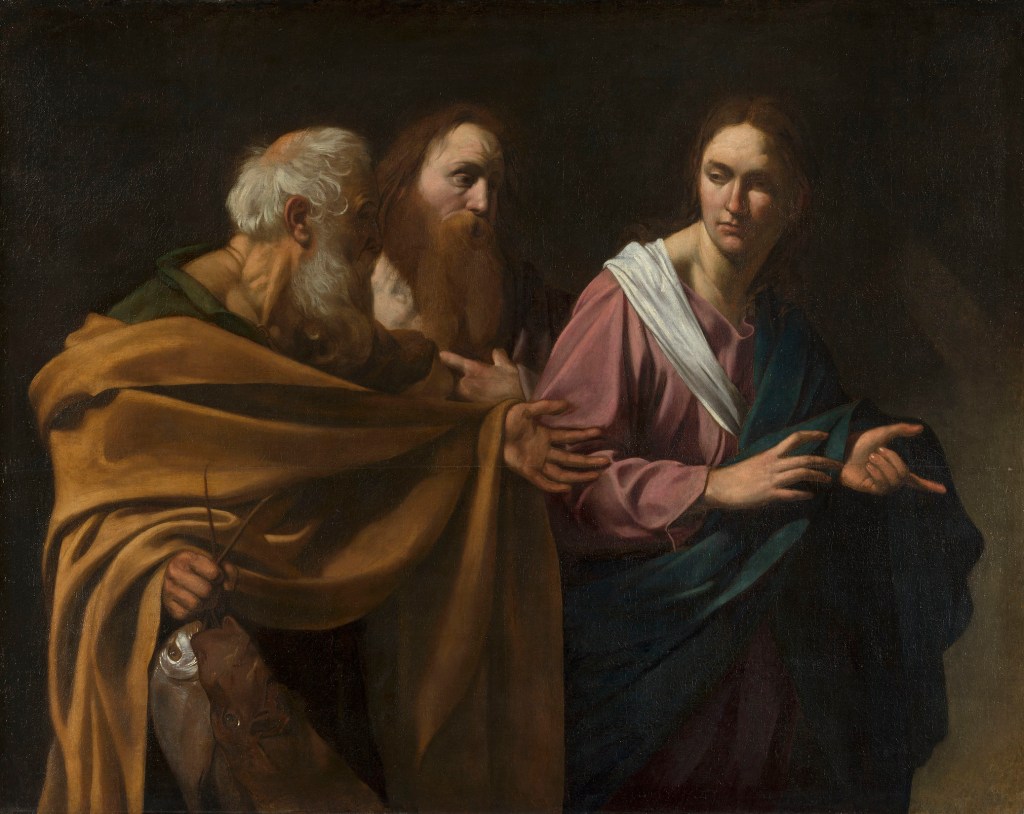
The Calling of Saints Peter and Andrew by Caravaggio, c. 1603-1606.
Today’s reading moves with purpose. Those of you that have been consistent blog readers know that I’m fascinated with “moments” from scripture, especially turning points — add this one to the list. (Sidebar: The painting included here depicts the moment Jesus calls Andrew and Peter, from Matthew’s Gospel, but I’m including it here because it depicts the three main characters). John sees Jesus and names him “the Lamb of God.” Two of John’s disciples (Andrew and Peter) hear this and begin to follow Jesus. Then Jesus turns, and we hear his first words in this Gospel: “What are you looking for?” In Greek, the question is even sharper: “What are you seeking?” It’s a simple question, but profoundly important. Jesus doesn’t begin with a command or a teaching. He begins with desire. He asks them to name what they long for. That question still reaches us. In this season after Epiphany—a season of light, clarity, and revelation — it feels especially urgent. What are we seeking as individuals? What are we seeking as communities? What do we need as a nation? What does our world hunger for right now?
The two disciples don’t offer a polished answer. They don’t ask for a miracle or a lesson. They simply say, “Where are you staying?” On the surface, it sounds like a practical question. But underneath it lies a deeper longing: Where can we remain with you? Where can we dwell in God’s presence? They want to stay close enough to see who Jesus truly is. Jesus responds with an invitation: “Come and see.” Discipleship begins there—not with certainty, but with movement. Not with perfect understanding, but with a willingness to stay close.
So Jesus’ question returns to us: What am I seeking? Do I seek peace? Healing? Purpose? Belonging? Do I seek a way of living that feels honest and hopeful? Do I seek a place where God feels near? In this Time After Epiphany, we are reminded that God’s light still breaks in. Jesus’ question helps us name our longing. And his invitation — “Come and see”—opens the path forward. Good words for a cold December day.
Soli Deo Gloria!
Note: I am indebted to Audry West, distinguished associate professor of New Testament at Lutheran School of Theology at Chicago, and project administrator of Moravian Clergy Connections, for her interpretation of this passage. Accessed from Working Preacher at Luther Seminary in St. Paul, MN. 11 January 2026.
Musical Meditation: “Blackbird” (Paul McCartney)
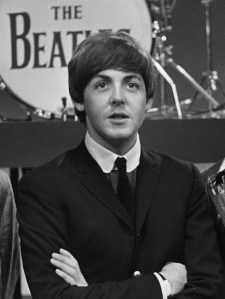
Paul McCartney (born 1942)
How many of you recall the Beatles coming to America in 1964 and appearing on the Ed Sullivan Show? (an early memory for me!). Released in November of 1968, Paul McCartney has said that Blackbird was his quiet response to the assassination of Martin Luther King Jr. (the prior April) and the wider civil‑rights struggle unfolding in the United States in 1968 (including the Little Rock Nine episode). The image of a blackbird learning to “fly” became his way of encouraging Black Americans — especially Black women — who were facing discrimination and violence. He wrote the song as a message of hope in a moment of national grief, wanting to offer comfort after King’s death and to affirm the courage of those continuing the fight for justice. The song has been covered by multiple artists. The one I’m sharing here is from a concert by the Harvard Opportunes in December of 2025, and is a remarkable rendition! Enjoy!
Lyrics Blackbird singing in the dead of night Take these broken wings and learn to fly All your life You were only waiting for this moment to arise
Blackbird singing in the dead of night Take these sunken eyes and learn to see All your life You were only waiting for this moment to be free
Blackbird fly Blackbird fly Into the light of a dark, black night
Blackbird fly Blackbird fly Into the light of a dark, black night
Blackbird singing in the dead of night Take these broken wings and learn to fly All your life You were only waiting for this moment to arise
You were only waiting for this moment to arise You were only waiting for this moment to arise
The Harvard Opportunes are Harvard University’s oldest contemporary a cappella group, founded in 1980 and known for bold arrangements and an easy stage presence. They perform an eclectic mix of pop, R&B, and contemporary music, all arranged by students who lean into rich harmonies and strong solo work. The group tours, records, and produces polished videos, earning recognition for both musicality and creativity. Their blend of tradition and experimentation gives them a distinctive voice in the collegiate a cappella world.
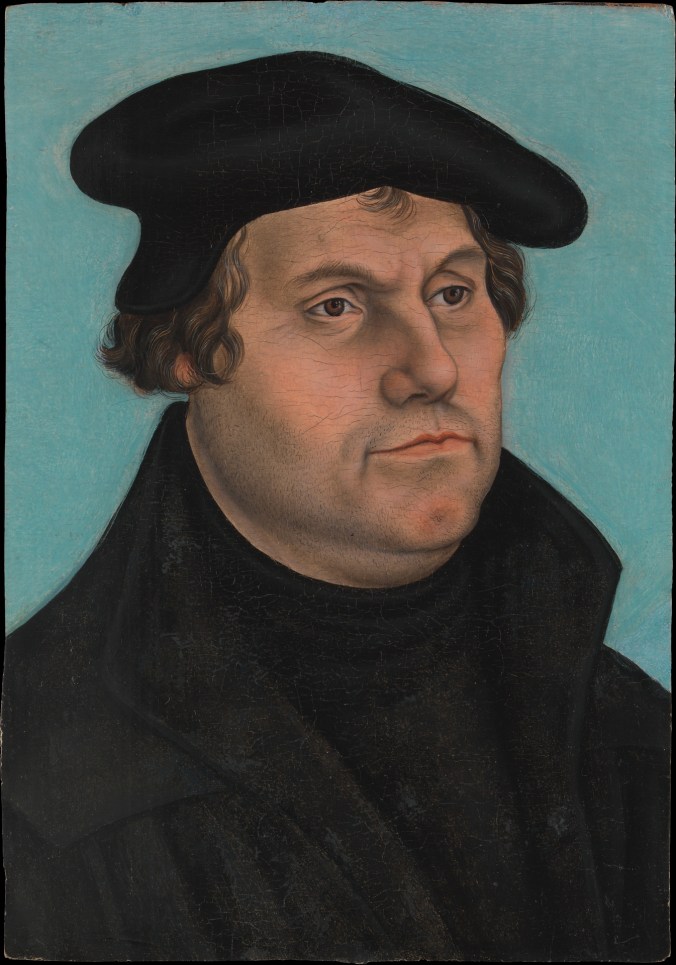
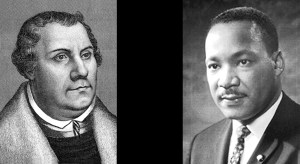
Have you ever wondered about the connection between MLK and Martin Luther? Here’s the backstory. Martin Luther King Jr.’s spiritual life was rooted in the Black Baptist tradition he inherited from his father, yet it grew into a global moral vision shaped by scripture, nonviolence, and a profound sense of divine calling. Born Michael King Jr., he received the name Martin Luther after his father — deeply moved by a 1934 trip to Germany and the legacy of the Reformation — changed both their names, a shift that symbolically linked the young preacher to a long line of reformers who challenged injustice. MLK’s official name change occurred in on 23 July 1957. The general prayers for renewers of the church prayer are found on page 60 of the ELW.
Let us pray: Holy and righteous God, you created us in your image. Grant us grace to contend fearlessly against evil and to make no peace with oppression. Help us, like your servant Martin Luther King, Jr., to work for justice among people and nations, to the glory of your name, through Jesus Christ our Savior and Lord, who lives and reigns with You and the Holy Spirit, one God, now and forever. Amen.
Two Sources: Taylor Branch. Parting the Waters: America in the King Years 1954-63. The National Museum of African-American History, Washington, D.C.
Faithful Conversation Updates
Join us for some free-flowing conversation about the Lectionary readings each Sunday. We meet from 10:45-11:30 in the church library each week, with some exceptions. No prior knowledge is necessary! ALL ARE WELCOME!
Read ELCA Bishop Curry’s statement in response to recent events in Minneapolis and the death of Renee Good on 7 January.
The Bible 365 Challenge! More than 60 members of our faith community have committed to the Bible 365 Challenge—a shared journey of reading through the entire Bible in one year.