“Imagination is hearing the silence because we have heard some of the sounds . . . Our imagination to see the past as it actually was has to return to the past in its own present, with all the possibilities of its future still in it, with all its uncertainties . . .” (Greg Dening)
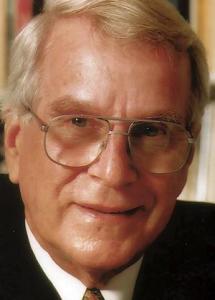
Historian Greg Dening (1931-2008)
The call of those first disciples has always pulled at my imagination. Matthew gives us only a few spare words — “Follow me” — and leaves the rest in silence, offering no glimpse of what these fishermen thought or said as their lives abruptly tilted in a new direction. What conversations rose in those homes and workplaces as they tried to make sense of such a sudden call? In a 1996 keynote address titled Empowering Imaginations, Greg Dening argued that such silences for historians are never empty; they open a doorway into a world not our own. Matthew wrote for readers who already understood the force of Jesus’ call, the grind of daily labor, and the deep hunger for something more. When we attend to these silences, we begin to see the disciples as real people stepping into an uncertain future, not characters locked into a script. Their quick response becomes a moment charged with courage and possibility — an invitation to listen for the unspoken depths in our own stories of calling. More on both the Isaiah and Matthew passages in my reflections below.
Commemorations this Week
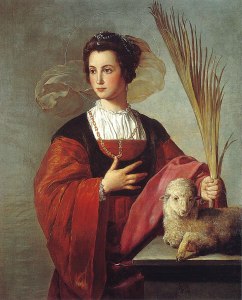
Saint Agnes (c. 291-304)
Thanks for visiting this space again this week and for your continuted interest in exploring the Lectionary! Three commemorations shape the ELCA calendar this week: Henry of Uppsala on January 19, Agnes of Rome on January 21, and the Conversion of Paul on January 25. St. Agnes’s story strikes with particular force. A young Christian of noble birth, she faced the brutal persecutions of Emperor Diocletian around 304, refusing powerful suitors and standing firm in her faith even when it meant death. Her unwavering witness as a virgin martyr lifted her into the heart of Christian memory, where communities across the world still honor her each January 21.
Note: I include a few links within the blog — italicized and bolded — for further information on various topics.
Also, Dr. Dening’s speech, Empowering Imaginations, was offered at the eleventh Pacific History Association conference at Hilo, Hawaii, 12 July 1996. I accessed this through Scholar Space.
Upcoming Changes With the Lectionary Blog!
Beginning with Transfiguration Sunday (15 February), the blog will have a cleaner, simpler design and a new name—Two Worlds—as part of a renewed commitment to digital ministry and more intentional use of online tools for learning, reflection, and future offerings. Because I am discontinuing the mailing list, you will need to subscribe directly through WordPress to keep receiving new posts (no cost): simply enter your email in the subscription box, confirm the email message WordPress sends, and you will receive updates each time I post. If you do not receive the Confirmation Email, check your spam folder. Also, you can manage your subscription anytime through the “Manage Subscription” link at the bottom right.
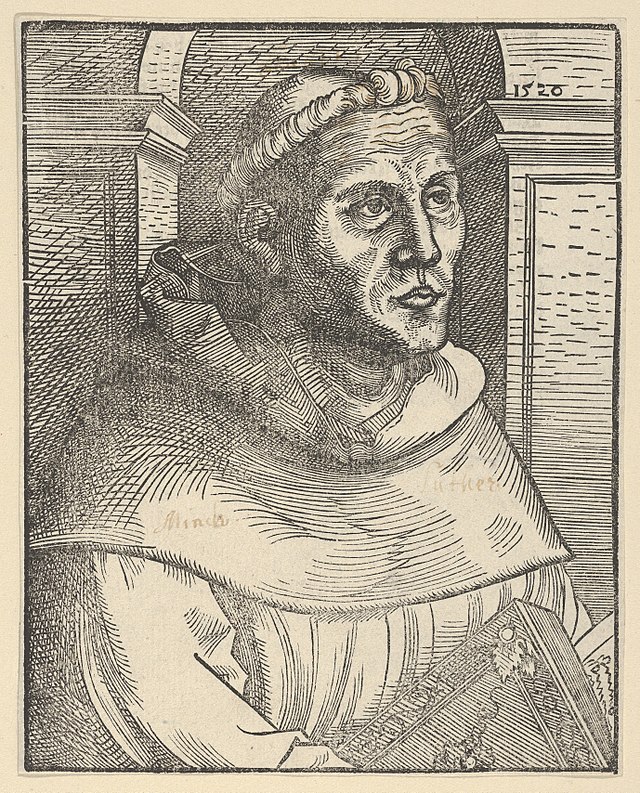
Try Luther’s Approach to Reading
A Revision of the Lectio Divina (Augustinian)
Three Steps
Oratio (Prayer) The journey begins with humble prayer, asking the Holy Spirit to open one’s heart to Scripture. For Luther, prayer clears the ground so God’s wisdom can take root.
Meditatio (Meditation) Meditation means more than reading. It’s the slow, repeated turning of Scripture over in the mind — “chewing” on the Word until it shapes one’s imagination, habits, and decisions.
Tentatio (Struggle) Struggle is the crucible of faith. As believers try to live out God’s Word, they meet resistance — inner conflict, doubt, temptation, and suffering. Luther insisted that these trials are not signs of failure but the very means by which God deepens and strengthens faith.
Lectio Divina is a quiet, thoughtful way of reading the Bible to connect with God. It grew out of early Christian traditions and was shaped by thinkers like Augustine, who believed Scripture speaks to the heart. Augustine didn’t invent the practice, but his ideas helped form its spirit—listening deeply and responding with love. Later, others gave it a clear structure, but its roots go back to that longing for God’s voice.
The readings for the Third Sunday after Epiphany share a movement from darkness toward light, revealing a God who breaks through fear, division, and despair with steadfast presence and purpose. Isaiah announces light dawning on people who have known deep shadow, while the psalmist names the Lord as a refuge whose beauty and guidance steady the heart. Paul urges a fractured community to reclaim unity in Christ rather than cling to competing loyalties, reminding them that God’s power often appears in forms the world considers weak or foolish. In Matthew, Jesus embodies this same light as he calls ordinary people into a new way of life, inviting them to follow him into healing, proclamation, and the work of gathering a renewed community.
Co-Pilot Prompt: “Comment on the themes from the Revised Common Lectionary for 3 Epiphany.” 14 January 2026.
Focus Reading: Matthew 4: 12-23
The First Reading
Nevertheless, there will be no more gloom for those who were in distress. In the past he humbled the land of Zebulun and the land of Naphtali, but in the future he will honor Galilee of the nations, by the Way of the Sea, beyond the Jordan –
2 The people walking in darkness have seen a great light; on those living in the land of deep darkness a light has dawned. 3 You have enlarged the nation and increased their joy; they rejoice before you as people rejoice at the harvest, as warriors rejoice when dividing the plunder. 4 For as in the day of Midian’s defeat, you have shattered the yoke that burdens them, the bar across their shoulders, the rod of their oppressor.
Mosaic of the prophet Isaiah in the Dome of Immanuel in St Mark’s Basilica (Venice)
Questions for Discussion
How does reading Jesus’ early ministry through Isaiah’s vision — especially the contrast between light and imperial darkness — shape the way we understand his actions in Galilee and his call to the first disciples?
In what ways does remembering painful history, as both Isaiah and Matthew insist we do, help us see the present more clearly and discern how Christ calls us to act on behalf of those who bear the heaviest burdens today?
The Gospel
12 Now when Jesus heard that John had been arrested, he withdrew to Galilee. 13 He left Nazareth and made his home in Capernaum by the sea, in the territory of Zebulun and Naphtali, 14 so that what had been spoken through the prophet Isaiah might be fulfilled:
15 “Land of Zebulun, land of Naphtali, on the road by the sea, across the Jordan, Galilee of the gentiles— 16 the people who sat in darkness have seen a great light, and for those who sat in the region and shadow of death light has dawned.”
17 From that time Jesus began to proclaim, “Repent, for the kingdom of heaven has come near.” 18 As he walked by the Sea of Galilee, he saw two brothers, Simon, who is called Peter, and Andrew his brother, casting a net into the sea—for they were fishers. 19 And he said to them, “Follow me, and I will make you fishers of people.” 20 Immediately they left their nets and followed him. 21 As he went from there, he saw two other brothers, James son of Zebedee and his brother John, in the boat with their father Zebedee, mending their nets, and he called them. 22 Immediately they left the boat and their father and followed him.
23 Jesus went throughout all Galilee, teaching in their synagogues and proclaiming the good news of the kingdom and curing every disease and every sickness among the people.
My source for the Biblical texts is the Bible Gateway website, NRSVUE.
Reflection: “Trusting the Light: Jesus in the Borderlands“
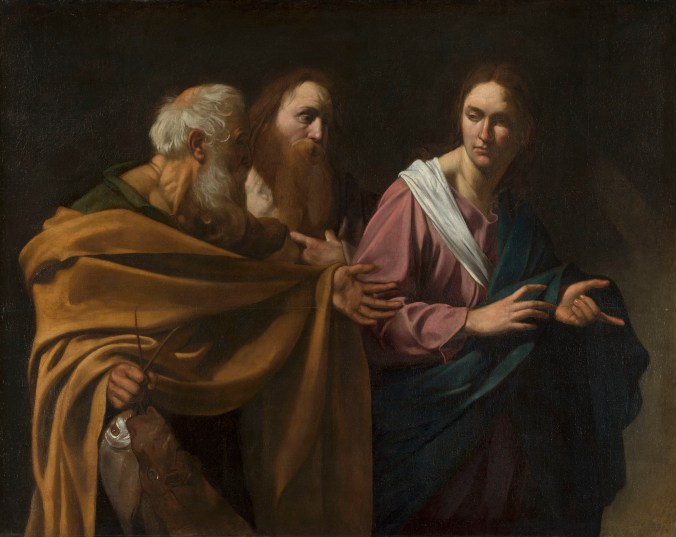
The Calling of Saints Peter and Andrew (Caravaggio, c. 1603-1606)
Reading the Bible is always humbling and this week’s passages from Isaiah and Matthew remind me of that old adage — “the more I learn, the more I realize how much I don’t know!”Here’s a framework to help us better understand these texts. Matthew anchors Jesus’ early ministry in Israel’s long memory, drawing directly on Isaiah to speak to a community shaped by loss and empire. Writing after 70 CE, with Rome’s destruction of the Second Temple still fresh, he invokes the Assyrian crisis of Isaiah’s time and places it directly alongside Rome’s rule — a parallel his audience would have grasped immediately. He places Jesus in Zebulun and Naphtali — the same borderlands Isaiah once named — now again under foreign rule, and marks Jesus’ move there after John’s death as the moment his public ministry begins. In that charged landscape, ordinary workers drop their nets at his call, stepping into a future defined not by fear but by trust. Matthew insists we read Christ’s move into these covenant‑rich lands through Isaiah’s vision. By citing Isaiah 9, he locates Jesus within the same story in which God’s light breaks into Assyrian darkness (echoing Isaiah 9:2). He casts Rome as a new Assyria and presents Jesus as the one who fulfills Isaiah’s promise that God’s saving light will cut through imperial shadow. Every act Jesus performs in Galilee embodies Isaiah’s hope for deliverance breaking into a land long held down by foreign power.
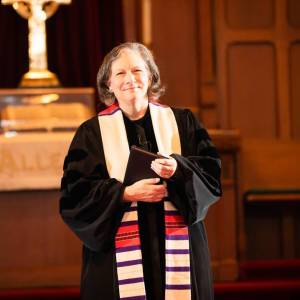
Christine Chakoian Westwood Presbyterian Church (Los Angeles)
In her compelling commentary on these texts, Pastor Christine Chakoian offers this reflection on history: “It is faithful to live in the present, ‘in the day that the Lord has made’ (Psalm 118:24). But that does not mean forgetting the past. Remembering it provides for a more faithful life now — even when the past is painful to recall.”Yes, humanity’s history is filled with pain, and it is tempting to forget, to deny, to sanitize. We do that at our own peril, however. As Christians, we need clear vision and clear thinking, something our faith provides — we need perspective. Again, quoting from Pastor Chakoian, “What would it look like for our generation to learn from the past? What would it tell us about the present? Even more, how would it lead us to change the trajectory of the future, looking to the kingdom of heaven — the template of God’s will? Maybe it starts where Jesus did: recognizing the lowest ranking in society, both for the value they bring and the burden they carry.” Wise words to ponder on a cold winter day, my friends.
Soli Deo Gloria!
Note: I drew from two sources for this reflection and am indebted to these theologians for prompting my thinking:
Warren Carter’s 2017 commentary on Matthew accessed through Working Preacher (Luther Seminary). Carter is a New Testament professor in Tulsa, Oklahoma. And Christine Chakoian’s analysis of both the Isaiah and Matthew passages from January edition of The Christian Century. Chakoian is pastor of Westwood Presbyterian Church in Los Angeles.
Musical Meditation: “Sure on This Shining Night” (Lauridsen)
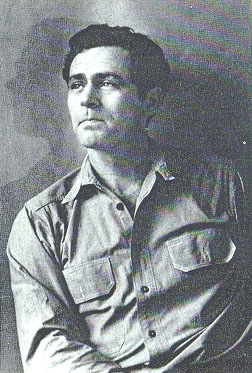
James Agee (1909-1955)
James Agee’s 1934 poem Sure on This Shining Night, especially in the remarkable musical setting by Morten Lauridsen (b. 1943), resonates deeply with the Epiphany season. Epiphany is the church’s meditation on light revealed in the midst of human need, and Agee’s poem holds that same tension between shadow and radiant light. Its plea for kindness and healing mirrors the Gospel stories of Jesus’ early ministry, where divine presence becomes visible in acts of compassion. This interpretation by the Nordic Choir of Luther College is from 2015 — enjoy a few peaceful moments this week with their amazing rendition!
Agee’s Poem: Sure on This Shining Night
Sure on this shining night Of star made shadows round, Kindness must watch for me This side the ground. The late year lies down the north. All is healed, all is health. High summer holds the earth. Hearts all whole. Sure on this shining night I weep for wonder wand’ring far alone Of shadows on the stars.
Nordic Choir, founded in 1946, enjoys national and international stature as one of the premier collegiate choral ensembles in the United States. Acclaimed for the way it honors the Lutheran choral tradition while also featuring new and innovative choral works, the choir showcases versatility, artistry, and technical mastery across many genres of music. Nordic Choir is Luther College’s principal choral ensemble.
Prayer for the Children of Ukraine
Ukrainian Children Refugees
The Russo-Ukrainian War began in February of 2022, nearly four years ago! To put that in perspective, the war has now been raging longer than US involvement in World War II! Among other things, Russia’s invasion has included a systematic effort to remove Ukrainian children from their families, communities, and cultural identity. Investigations by the Yale Humanitarian Research Lab and other international bodies document that more than 19,000 children have been forcibly taken to Russia or Russian‑controlled territories, where many are placed in “re‑education” programs, adoption pipelines, or facilities designed to sever their connection to Ukrainian language and heritage (the number may be much higher than that). We offer this prayer on their behalf this week.
God of justice and mercy, we cry out for the children of Ukraine, whose lives have been torn apart by war and by those who seek to erase their identity. Stand between them and every force that threatens their safety, their heritage, and their hope. Break the grip of those who have taken them, and strengthen all who work to protect, shelter, and reunite them. Surround these children with people who act with courage and tenderness, and let Your light cut through every shadow that tries to claim them. Hold them fast in the truth that they are not forgotten by their families, by the world, or by You. Amen.
Faithful Conversation Updates
Join us for some free-flowing conversation about the Lectionary readings each Sunday. We meet from 10:45-11:30 in the church library each week, with some exceptions. No prior knowledge is necessary! ALL ARE WELCOME!
In Other News . . .
Greenland is home to roughly 56,000 people, the vast majority of whom are Indigenous and of Inuit or mixed Inuit-Danish heritage. The Bishops of the ELC in Canada, Denmark, and the United States issued this Joint Statement on 16 January regarding recent geo-political developments.
The Bible 365 Challenge! More than 60 members of our faith community have committed to the Bible 365 Challenge—a shared journey of reading through the entire Bible in one year.