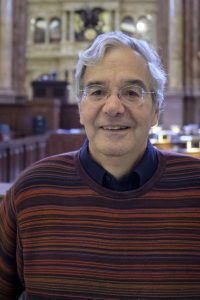
“Influenced by the intellectuals of the Enlightenment, Jefferson scoffed at biblical stories of miracles but believed that the study of nature proves the existence of God. He thought deeply about religion all his life, and although his views sometimes shifted, one opinion never changed: He believed that no government had the right to impose any religion on any individual. He wrote Virginia’s statute on religious freedom and famously coined the phrase ‘wall of separation between church and state.’” (Historian Peter Carlson)
Introductory Reflection
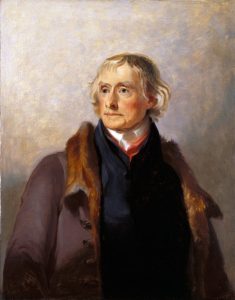
As the opening quote from historian Peter Carlson indicates, our third President, brilliant and deeply educated, remains a complex figure when it comes to religious faith. At age 33, young Jefferson penned the Declaration of Independence, something we are highlighting this year as part of a 250th anniversary commemoration. If he had done nothing else beyond that moment, he would remain famous in the annals of history. Nevertheless, the man who wrote “all men are created equal” enslaved hundreds of people during his lifetime — an unsettling contradiction. He also pursued destructive policies toward Indigenous people, something that is well documented. His religious views were tangled as well, something his political opponents liked to highlight (he was often accused of being an atheist, but that does not line up with his writings). Raised Anglican, he believed in God but rejected the divinity of Jesus and every miracle in scripture. He literally cut those passages from the New Testament to create what we now call the “Jefferson Bible.” While admiring Jesus as a moral exemplar, Jefferson’s rational mind simply could not move past his doubts regarding the miracles that sit at the center of our faith. It’s difficult to easily summarize Jefferson’s religious views, but you will find good information here if you want to go further!
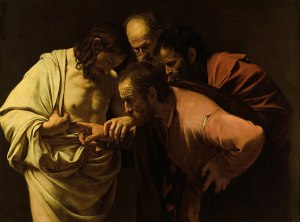
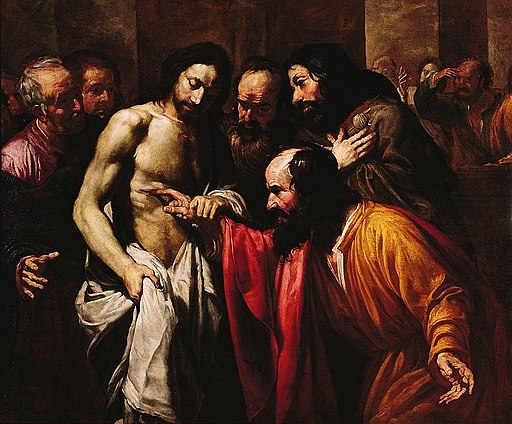
Sunday’s Gospel brings us face‑to‑face with another story of doubt. It’s still Easter evening. The disciples hide behind locked doors, afraid for their lives, when Jesus suddenly stands among them. He shows them his wounds and breathes his Spirit into them, giving them the power to forgive. Imagine the shock in that room. Then we meet Thomas, who missed that first gathering. When the others tell him they’ve seen the risen Christ, he can’t accept it. He wants evidence — wounds he can see and touch. One week later, Jesus appears again and meets Thomas right at the point of his doubt — the Caravaggio painting captures the moment (also note the Serodine painting described below).Thomas responds with the clearest confession in John’s Gospel: “My Lord and my God.” Curiously, this story appears only in John, and it’s there for a reason. Jesus doesn’t shame Thomas; he simply names a deeper truth: those who have not seen and yet believe are blessed. That’s us. And 1 Peter echoes the same promise today: though we have not seen Christ, we love him; though we do not see him now, we trust him and rejoice with a joy beyond words, receiving the salvation of our souls. Good words to ponder on this Second Sunday of the Easter season.
Soli Deo Gloria!
Reminders: Blog Purpose and Format
Two Worlds is a digital space for ministry. Each week, I post the Revised Common Lectionary readings for the upcoming Sunday and link them for easy access (NRSVU edition). Along the way, I also offer an introductory reflection — usually with a historical bent — and explore how music, visual art, and other creative expressions deepen our understanding of faith. Because of my interest in history, I also include the ELCA’s weekly commemorations. You’ll find links to thoughtful resources for anyone who wants to dig further (italicized and bolded). And because this is meant to be a tool, not a script, feel free to use the Table of Contents to jump to whatever sections speak most directly to you. My sourcing is eclectic. Nearly all images are drawn from Wikimedia Commons and I am utilizing Co-Pilot as an assist for some of the writing and research. I welcome any feedback here or via email (pstrykken@gmail.com).
Navigate the Blog Here
- Introductory Reflection
- Reminders: Blog Purpose and Format
- The Readings and Connecting Themes
- ELCA Commemorations This Week
- Symbolism and the Cross
- Reflective Music and Prayer
- Going Beyond: Digital and In-Person Ministry
TRY LUTHER’S METHOD OF READING
A Revision of the Lectio Divina (Augustinian)
Three Steps
Oratio (Prayer): This is the starting point, where one humbly prays for the Holy Spirit’s guidance to understand God’s Word. Luther emphasized that prayer prepares the heart and mind to receive divine wisdom.
Meditatio (Meditation): This involves deeply engaging with Scripture, not just reading it but reflecting on it repeatedly. Luther encouraged believers to “chew on” the Word, allowing its meaning to sink in and shape their thoughts and actions.
Tentatio (Struggle): Often translated as “trial” or “temptation,” this refers to the challenges and spiritual battles that arise as one seeks to live according to God’s Word. Luther saw these struggles as a way God refines faith, making it more resilient and authentic.
(1600 –1630)
Eugène Burnand’s 1898 painting The Disciples Peter and John Running to the Sepulchre on the Morning of the Resurrection captures the dramatic moment from John 20 when the two apostles race toward the empty tomb after hearing Mary Magdalene’s news. Burnand, a Swiss realist painter known for his deep Christian faith, exhibited the work at the Paris Salon, where it was immediately acclaimed and later acquired by the French state for the Musée d’Orsay. The painting is celebrated for its vivid emotional realism: Peter’s anxious, weathered face and John’s youthful, hope‑filled expression reveal the turmoil and dawning faith of that first Easter morning.
The Readings and Connecting Themes
12 April: 2 Easter
Acts 2: 14a, 22-32
Psalm 16
1 Peter 1: 3-9
John 20: 19-31
Together, these readings proclaim that the resurrection is God’s decisive act of life‑giving power, witnessed in Jesus and extended to us. Peter’s sermon in Acts and the confidence of Psalm 16 both testify that God does not abandon the faithful to death but brings them into new life. First Peter echoes this hope, describing believers as reborn into a living future even as they navigate trials. And in John’s story of the risen Christ meeting the disciples—and Thomas—fear is replaced with peace, doubt with trust, and the community is sent out as witnesses to the life God now makes possible.
Note: I utilize the Bible Gateway website for the readings (NRSVUE) and also receive as assist from Co-Pilot (A.I.) for summarizing the themes each week.
ELCA Commemorations This Week
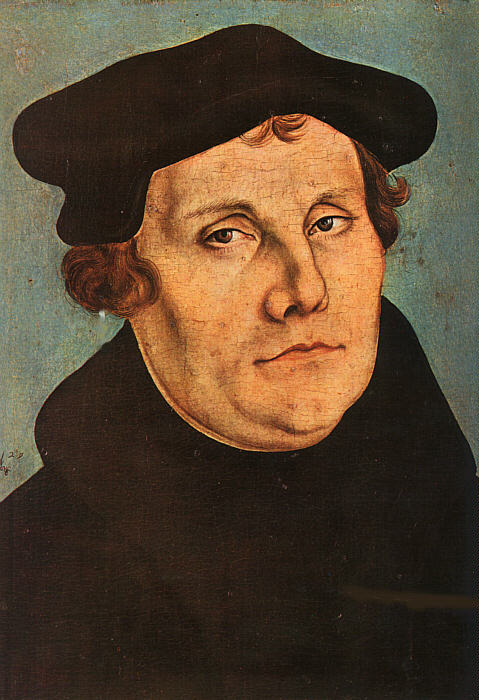
Monday 6 April
Albrecht Durer (d. 1528), Matthias Grunewald (d. 1529), and Lucas Cranach (d. 1553), Artists
Thursday 9 April
Dietrich Bonhoeffer, Theologian (d. 1945 )
Friday 10 April
Mikael Agricola, Bishop of Turku (d. 1557)
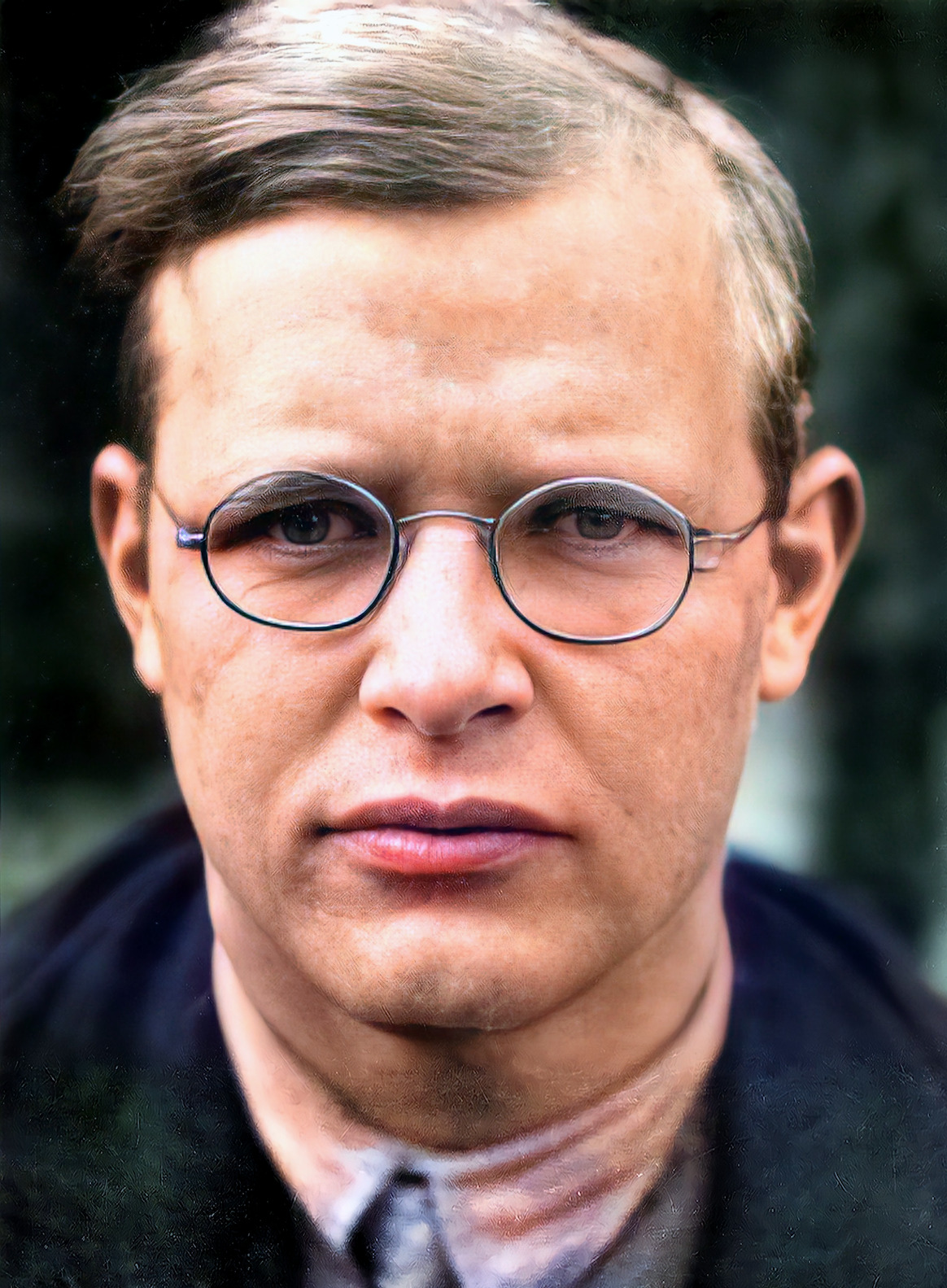
(1906-1945)
Symbolism and the Cross
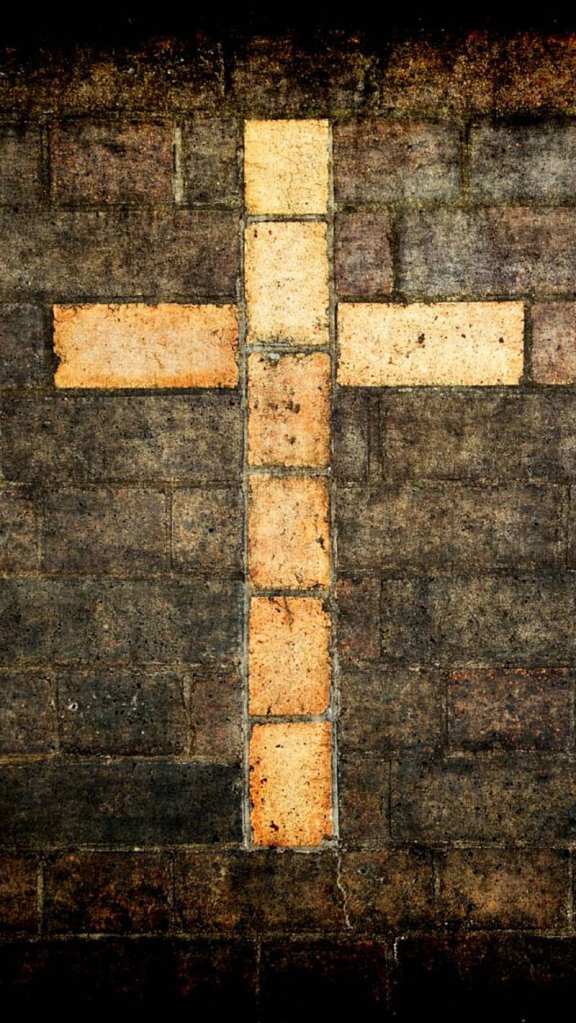
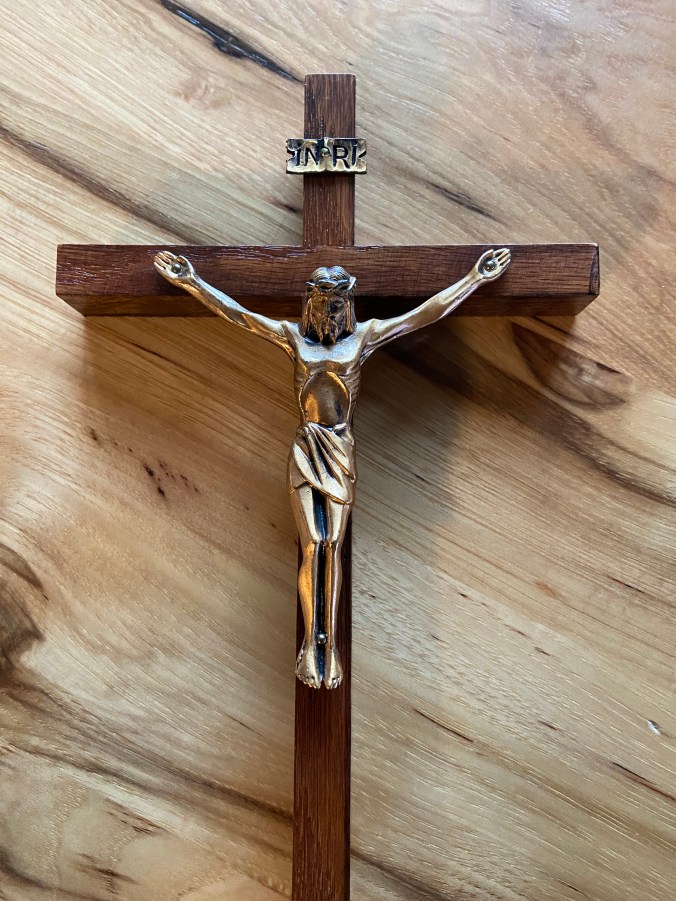
A reminder why Protestant Churches, like the ELCA, primarily display the empty cross, while Roman Catholic Churches primarily display the Crucifix. Here is an explanation I appreciated reading from The Compass, a publication of the Catholic Diocese of Green Bay: Displaying the corpus of Jesus on the cross is a stark visual aid that helps us to more easily focus on the very real sacrifice Jesus offered for us for our salvation . . . Our brothers and sisters of mainline Protestant and non-denominational traditions typically display an empty cross in recognition that Jesus died once and for all for us and is now risen from the dead. The cross, like the tomb, is empty. We should see these not as opposing viewpoints, but as complimentary emphasis.
Reflective Music and Prayer
My early childhood memory of hymns includes All Creatures of our God and King. In our current hymnal (2006 ELW), you will find that hymn on 835 and called, All Creatures, Worship God Most High. The hymn has a great origin story going back to St. Francis of Assisi’s 13th century poem, Canticle of the Sun (also called Canticle of the Creatures (Read the full poem here). Celebrating God through the voices of creation, it eventually made its way into the hymnal through a much later English paraphrase. In the early 1900s, William H. Draper took Francis’s Italian text and reshaped it into metered English verses that a congregation could actually sing. His version kept the heart of Francis’s idea — that all of creation joins in praise — while giving it a structure that fit a familiar hymn tune. When Draper’s text was paired with the lively 1623 melody Lasst Uns Erfreuen, complete with its joyful “Alleluia” refrains, the hymn took on the form we know today.
Though not an Easter hymn, the message of Francis’ poem is universal, and speaks to our time! Deanna Witkowski’s jazz interpretation of the hymn is offered here. Hear it in a new way and enjoy!
Lyrics (one variation)
All creatures, worship God most high!
Sound every voice in earth and sky:
Alleluia! Alleluia!
Sing, brother sun, in splendor bright,
sing, sister moon and stars of night:
Alleluia, alleluia, alleluia, alleluia, alleluia!
Sing, brother fire, so mirthful, strong;
drive far the shadows, join the throng:
Alleluia! Alleluia!
Dear mother earth, so rich in care,
praise God in colors bright and rare:
Alleluia, alleluia, alleluia, alleluia, alleluia!
O sisters, brothers, take your part,
and worship God with humble heart:
Alleluia! Alleluia!
All creatures, bless the Father, Son,
and Holy Spirit Three in One:
Alleluia, alleluia, alleluia, alleluia, alleluia!
Deanna Witkowski is an award‑winning jazz pianist, composer, and scholar whose music blends jazz, Brazilian rhythms, and sacred traditions with clarity and rhythmic lift. A past winner of the Great American Jazz Piano Competition and a leading interpreter of Mary Lou Williams, she earned national acclaim for her biography Mary Lou Williams: Music for the Soul. Shaped by a lifelong engagement with Christian liturgical music, Witkowski brings a reflective spiritual depth to her work.
Visit her website for more information!
Going Beyond: Digital and In-Person Ministry
Join Us for Worship and Study
Evangelical Lutheran Church in Black River Falls, Wisconsin, and is part of the Northwest Synod of Wisconsin (ELCA). We stream our Sunday worship at 9:30 each week. Please feel free to join us!
Access our YouTube Channel here.
Have you explored the revamped ELCA website? User friendly and many great resources! Check it out by clicking on the logo.
FOR THOSE INVOLVED . . . .
Our in-person Lectionary discussion will gather again this Sunday. Join us in the ELC library for discussion of this week’s readings! All are welcome!
