
“Purpose sends you back to that sense of awe in front of something greater than yourself. It gives you focus. Purpose grounds, inspires, and energizes. It lets you appreciate your own effort and the effort of others. Purpose connects you with those around you: It will lead you to other people, movements, and institutions, histories and futures that you can participate in. ‘Faith, hope, and love remain,’ writes Paul, ‘and the greatest of these is love’ (1 Corinthians 13:13). Not all is lost when hope is lost. And even hope regenerates when we allow faith and love to sow purpose and meaning.” (Hanna Reichel, Princeton Theological Seminary)
Introduction: The Emmaus Moment

Regular readers of this blog know how much I value artistic interpretations of Scripture. Today’s Gospel — the encounter between Cleopas, an unnamed disciple, and Jesus on the seven‑mile walk from Jerusalem to Emmaus — has long been one of my favorite post‑resurrection moments. Part of that affection traces back to an 1877 painting by Swiss artist Robert Zünd, a work that hung in one of the parishes my father served during his fifty years of ministry at Faith Lutheran in West Fargo, North Dakota (note the description below). Scripture records eight appearances of the risen Christ in the forty days after Easter — eight moments of conversation, recognition, and shared meals. This week we join two disciples on the road, heavy with grief and confusion (v. 21). It is Sunday evening, three days after the crucifixion. They leave Jerusalem for Emmaus, trying to make sense of what they have witnessed. Steeped in Jewish hope for a different kind of Messiah, they cannot reconcile Jesus’ death with the rumors of resurrection. They feel lost. Jesus steps into their sorrow and walks with them, unrecognized. They’re startled that this “stranger” seems unaware of the week’s upheaval. He listens first. Then he opens the scriptures with authority, tracing the promises of the Messiah through the prophets (vv. 25–27). Still, they do not see him for who he is. At Emmaus, they urge him to stay as night falls. And in one of the most luminous scenes in the post‑resurrection narratives, Jesus breaks bread — and vanishes. Recognition floods in at once (v. 31). Joy propels them back the seven miles to Jerusalem to tell the eleven what they have seen. I imagine them excitedly running that seven miles. If purpose anchors and renews us — as Hanna Reichel reminds us — then Emmaus becomes a lesson in how purpose catches up to us, providing hope — perhaps when we least expect it! Two disciples leave Jerusalem hollowed out, and everything shifts when Christ joins them on the road. Good words for us to hear in April of 2026!
Soli Deo Gloria!
The introductory quote is drawn from For Such A Time As This: An Emergency Devotional (William B. Eerdmans Publishing Company, Grand Rapids, Michigan, 2025). The author, Hanna Reichel, is the Charles Hodge Professor of Systematic Theology at Princeton Theological Seminary.
Reminders: Blog Purpose and Format
Thanks for visiting this space again this week! Two Worlds is a digital space for ministry where I post the Revised Common Lectionary readings each week (NRSVU) and offer a brief, historically grounded reflection alongside music, visual art, and other creative expressions that deepen our understanding of faith. I include the ELCA’s weekly commemorations and link to thoughtful resources for readers who want to explore further, with a Table of Contents that lets you pick and choose a bit. Most images come from Wikimedia Commons, and I use Copilot to support some of the writing and research.
Where are we? Right now, the lectionary places us in the heart of the Easter season in Year A, hearing resurrection through Matthew’s bold storytelling while Acts traces the early church’s emergence and 1 Peter steadies communities learning to live as people shaped by new life. In the weeks ahead, the Gospel readings shift from resurrection appearances to Jesus’ farewell teachings in John, leading us toward Ascension and the Spirit’s dramatic arrival at Pentecost—a moment that launches the church’s public mission and opens the long season of discipleship that follows.
I welcome feedback at pstrykken@gmail.com.
Navigate the Blog Here
- Introduction: The Emmaus Moment
- Reminders: Blog Purpose and Format
- The Readings and Connecting Themes
- ELCA Commemorations This Week
- Reflective Music: An American Tune (1973)
- Going Beyond: Digital Ministry and Religion in the News
TRY LUTHER’S METHOD OF READING
A Revision of the Lectio Divina (Augustinian)
Three Steps
Oratio (Prayer): This is the starting point, where one humbly prays for the Holy Spirit’s guidance to understand God’s Word. Luther emphasized that prayer prepares the heart and mind to receive divine wisdom.
Meditatio (Meditation): This involves deeply engaging with Scripture, not just reading it but reflecting on it repeatedly. Luther encouraged believers to “chew on” the Word, allowing its meaning to sink in and shape their thoughts and actions.
Tentatio (Struggle): Often translated as “trial” or “temptation,” this refers to the challenges and spiritual battles that arise as one seeks to live according to God’s Word. Luther saw these struggles as a way God refines faith, making it more resilient and authentic.
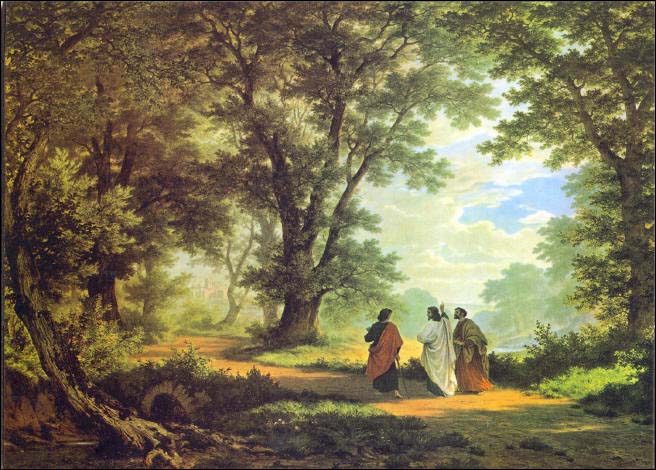
Robert Zünd’s The Road to Emmaus (1877) places Luke’s resurrection story not in first‑century Judea but in the rolling, pastoral landscape of his own Austrian world, and that choice reshapes how we experience the moment. The towering trees, the filtered sunlight, and the gentle rise and fall of the countryside create a setting that feels familiar and lived‑in—an everyday place where revelation could quietly unfold. Against this backdrop, the three figures walk in unhurried conversation, their gestures understated, as if the mystery of the risen Christ is something that dawns slowly rather than breaks open all at once. By rooting the scene in an Austrian landscape, Zünd suggests that Emmaus is not a distant event but a recurring human experience — grace meeting us on the roads we actually travel, in the places we know by heart.
The Readings and Connecting Themes
19 April: 3 Easter
Acts 2: 14a, 36-41
Psalm 116: 1-4, 12-19
1 Peter 1: 17-23
Luke 24: 13-35
The readings for 3 Easter trace a movement from bewilderment to renewed life, showing how God meets people in their confusion and calls them into transformation. Acts and the psalm highlight a God who hears, rescues, and draws people into a new way of living marked by gratitude and trust. First Peter presses that transformation further, urging believers to embody holiness and sincere love as the fruit of their new birth in Christ. Luke’s Emmaus story gathers these threads, revealing the risen Jesus as the one who opens eyes, rekindles hope, and sends disciples back into the world with burning hearts and a renewed sense of purpose.
Note: I utilize the Bible Gateway website for the readings (NRSVUE) and also receive as assist from Co-Pilot (A.I.) for summarizing the themes each week.
ELCA Commemorations This Week
Sunday 19 April
Olavus Petri, Priest (d. 1552); Laurentius Petri, Bishop of Uppsala (d. 1573); renewers of the church
Olavus Petri and his brother Laurentius helped steer the Swedish Reformation in ways that still shape the church today. Olavus, fresh from studying with Luther and Melanchthon, brought Reformation ideas home through bold preaching, accessible teaching tools, a Swedish New Testament, and the first Swedish hymnal—always pushing for worship people could actually understand. Laurentius, calmer in style but equally influential, became the first Lutheran Archbishop of Uppsala and defended the episcopate—the church’s order of bishops responsible for teaching, oversight, and continuity of pastoral leadership—when the crown tried to eliminate it. He oversaw the 1541 Swedish Bible and wrote the 1571 church order that grounded Swedish worship and governance for generations, making the Petri brothers the architects of a national church rooted in Scripture, the vernacular, and steady pastoral care.
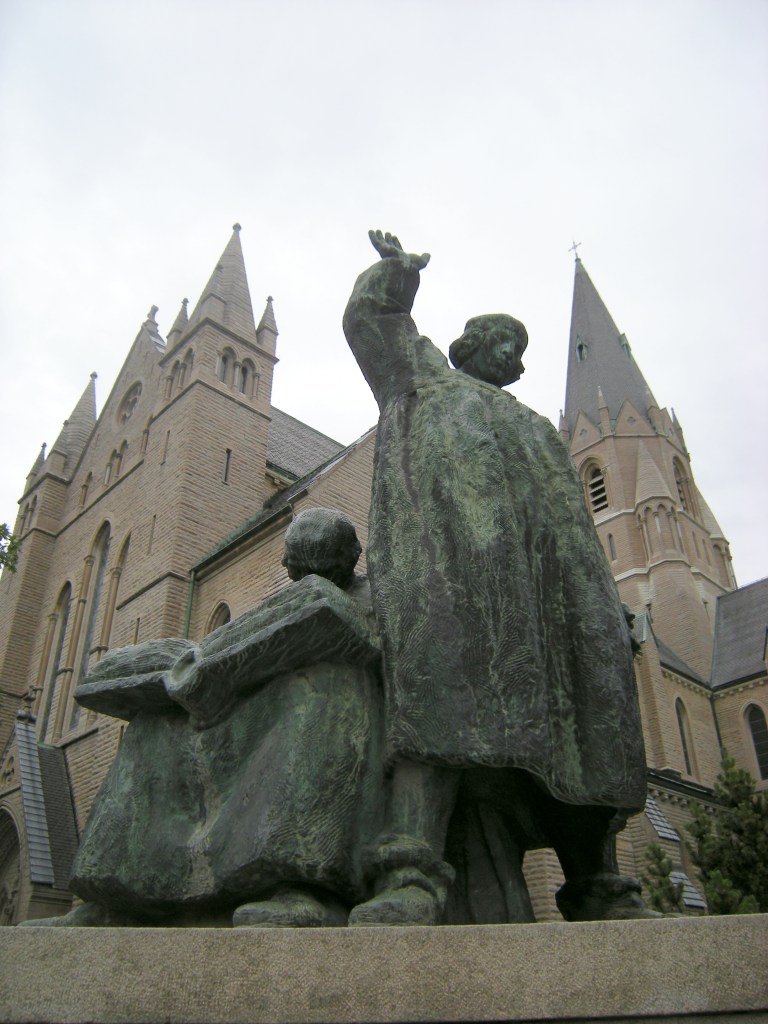
Örebro, Sweden
Reflective Music: An American Tune (1973)
In my quest to explore music through the prism of the Christian journey, An American Tune feels like the right companion for this week’s Gospel. A favorite of mine, I first heard it as a junior in high school when the country felt unsteady — Vietnam still raw, Watergate beginning to seep into the headlines, adults around me carrying a quiet confusion I didn’t yet have words for. Paul Simon did. His honesty — “mistaken, confused, and forsaken” — sounded like the world I was watching. Hearing it this week triggered memories (and nostalgia).
Luke’s Emmaus story lives in that same emotional landscape. Two travelers walk the road naming their disappointment with the most honest words in Scripture: we had hoped. They try to make sense of what just happened, not sure what to believe next. Simon’s song turns into a modern Emmaus when you set them side by side — a people bruised by history, still walking, still talking, still waiting for meaning to reassemble itself. Both texts remind us that resurrection rarely begins with certainty; it begins with honest sorrow, shared bread, and the slow recognition that hope has been walking beside us all along. Only later did I learn that Simon built the melody on O Sacred Head, Now Wounded—a Passion tune hiding inside a 1970s lament. That ancient line, braided into a modern ache, makes the song’s quiet hope feel even more like Emmaus.
This performance comes from the Concordia Choir’s 2026 Northeast Tour, recorded at the National Presbyterian Church in Washington, D.C. Matthew Culloton, the choir’s director, created the arrangement — a beautiful rendering of the piece. The version I’m sharing, sung on that tour, carries the song’s quiet hope with real grace. I hope you enjoy it (especially good with headphones).
Lyrics: An American Tune
Many’s the time I’ve been mistaken
And many times confused
Yes, and I’ve often felt forsaken
And certainly misused
Oh, but I’m alright, I’m alright
I’m just weary to my bones
Still, you don’t expect to be bright and bon vivant
So far away from home, so far away from home
I don’t know a soul who’s not been battered
I don’t have a friend who feels at ease
I don’t know a dream that’s not been shattered
Or driven to its knees
Oh, but it’s alright, it’s alright
For we lived so well so long
Still, when I think of the road we’re traveling on
I wonder what’s gone wrong
I can’t help it, I wonder what’s gone wrong
And I dreamed I was dying
I dreamed that my soul rose unexpectedly
And looking back down at me
Smiled reassuringly
And I dreamed I was flying
And high up above my eyes could clearly see
The Statue of Liberty
Sailing away to sea
And I dreamed I was flying
And we come on the ship they call The Mayflower
We come on the ship that sailed the moon
We come in the age’s most uncertain hours
And sing an American tune
Oh, and it’s alright, it’s alright, it’s alright
You can’t be forever blessed
Still, tomorrow’s gonna be another working day
And I’m trying to get some rest
That’s all I’m trying to get some rest
The Concordia Choir of Moorhead, Minnesota stands as one of the nation’s premier collegiate a cappella ensembles, known for its luminous blend and disciplined artistry. Founded in 1920, the choir’s identity has been shaped by a century of influential leadership, most notably Paul J. Christiansen, René Clausen, and current conductor Dr. Michael Culloton. Its national and international tours showcase a repertoire that spans sacred masterworks, global choral traditions, and newly commissioned works. The choir’s signature Christmas Concerts—broadcast and celebrated across the country—embody its mission of musical excellence, spiritual depth, and community connection.
Going Beyond: Digital Ministry and Religion in the News
Join Us for Worship and Study
Evangelical Lutheran Church in Black River Falls, Wisconsin, and is part of the Northwest Synod of Wisconsin (ELCA). We stream our Sunday worship at 9:30 each week. Please feel free to join us!
Access our YouTube Channel here.
FOR THOSE INVOLVED . . . .
Our in-person Lectionary discussion will gather again this Sunday. Join us in the ELC library for discussion of this week’s readings! All are welcome!
The Challenging World We Are Experiencing . . .
History is filled with examples of the intersection of war and religion. As I am writing this, we are 42+ days into the 2026 Iran War. This article gives a helpful big‑picture look at how some in the U.S., Israel, and Iran are using religious language to frame the current conflict. It sticks to public statements and constitutional structures, which keeps things grounded instead of speculative. I also appreciate that it names the internal disagreements within each tradition, so it’s not just “religion vs. religion” but a look at how political leaders selectively use religious themes. Overall, it’s a solid starting point for understanding how faith gets pulled into the rhetoric of war, even if it doesn’t dive deeply into any one tradition’s theology.