“Character building begins in our infancy and continues until death.” – Eleanor Roosevelt
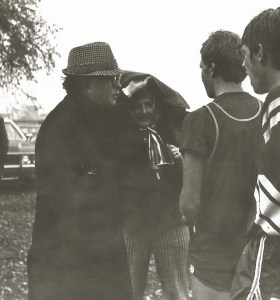
Character has been on my mind this week, stirred by Paul’s words in Romans for Trinity Sunday. The word immediately brings my mother, Cathy, to mind. Let me explain. For 60 years, I have immersed myself in athletics, either as a competitor or a coach. This particular photo—one of the few I have from my athletic days—captures a moment in 1974. My parents stood on the sidelines, enduring brutal weather to watch me compete in a Cross Country race during my senior year at West Fargo High School. Cathy never missed a chance to cheer me on, but beneath her unwavering support ran a fierce competitive streak. If she sensed I wasn’t pushing hard enough or thought I had slipped into self-pity, she wasted no time in setting me straight — she pushed me to persevere. My coaches appreciated her enthusiasm, I have no doubt! She would have wholeheartedly agreed with Eleanor Roosevelt, as she prepared me to face a challenging world. And, incidentally, wisdom often appears in Scripture as a personified woman—this week’s passage from Proverbs is an example. That image, much like the concept of character itself, reminds me of my mother. As part of my reflections this week, I’ll delve into how Paul frames character and how this applies to our lives as Christians.
As always, thanks for your continued interest in exploring the scriptures! And, a shout-out this week to all the fathers or father-figures in our lives. Thanks for everything that you do! We are now beyond the half-year of seasons (Advent, Christmas, Epiphany, Lent, and Easter) and are on the front end of the long season of Pentecost with this question guiding our reading: What does it mean to live out Jesus’ teachings in our chaotic and turmoil-filled world? The blog this week includes some thoughts on the Holy Trinity, Luther’s Trinitarian Prayer, and a joyful organ selection of a Trinity-inspired hymn. And one note: I sprinkle in a few hyperlinks throughout the blog if you care to do further reading — there are italicized and bolded.
The readings for Holy Trinity Sunday emphasize God’s wisdom, majesty, and relational nature. Proverbs 8 presents wisdom as an eternal presence with God, rejoicing in creation and calling humanity to understanding. Psalm 8 marvels at God’s grandeur, questioning humanity’s place in the cosmos while affirming human dignity as stewards of creation. Romans 5 highlights the transformative power of faith, where suffering leads to hope through the love of God poured out by the Holy Spirit. John 16 reveals the Spirit’s role in guiding believers into truth, glorifying Christ, and deepening the connection between the Father, Son, and Holy Spirit.
Romans 5: 1-5 5 Therefore, since we have been justified through faith, we have peace with God through our Lord Jesus Christ, 2 through whom we have gained access by faith into this grace in which we now stand. And we boast in the hope of the glory of God. 3 Not only so, but we also glory in our sufferings, because we know that suffering produces perseverance; 4 perseverance, character; and character, hope.5 And hope does not put us to shame, because God’s love has been poured out into our hearts through the Holy Spirit, who has been given to us.
Check out this introductory segment on Romans for background on this week’s passage. This comes from our friends at the Bible Project. There is a segment on Romans 5-16 as well, if you’re interested. You can find that here, along with many other guides.
TRY LUTHER’S METHOD OF BIBLE READING
A Revision of the Lectio Divina, a method he learned in his Augustinian training (Three Steps)
Oratio (Prayer): This is the starting point, where one humbly prays for the Holy Spirit’s guidance to understand God’s Word. Luther emphasized that prayer prepares the heart and mind to receive divine wisdom.
Meditatio (Meditation): This involves deeply engaging with Scripture, not just reading it but reflecting on it repeatedly. Luther encouraged believers to “chew on” the Word, allowing its meaning to sink in and shape their thoughts and actions.
Tentatio (Struggle): Often translated as “trial” or “temptation,” this refers to the challenges and spiritual battles that arise as one seeks to live according to God’s Word. Luther saw these struggles as a way God refines faith, making it more resilient and authentic.
Luther’s Seal
Reflections (Part 1): “The Holy Trinity”
Almighty Creator and ever-living God: we worship your glory, eternal Three-in-One, and we praise your power, majestic One-in-Three. Keep us steadfast in this faith, defend us in all adversity, and bring us at last into your presence, where you live in endless joy and love, Father, Son, and Holy Spirit, one God, now and forever. Amen.
Here are a few things to think about this week regarding the Holy Trinity. Many Christian traditions follow a structured liturgy, shaping worship through prayers and rituals passed down over generations. Some parts of the liturgy, known as Propers, change based on the calendar, aligning with the Revised Common Lectionary and marking special observances like Epiphany or Pentecost. The Prayer of the Day for Holy Trinity Sunday (above), found on page 37 of the ELW(Evangelical Lutheran Worship hymnal), continues a tradition that traces back to the 16th-century Book of Common Prayer. I included this prayer to encourage reflection on the Holy Trinity, often called “the central mystery of the Christian faith and life.”
Martin Marty (1928-2025)
Many volumes explore the Trinity, but words alone struggle to capture its full meaning. Still, as theologian Martin Marty suggests, the Trinity teaches us about relationship—not just between God and humanity, but in how we interact with each other. He writes: “The Trinity is the model of the relational life, and invoking the Trinity draws us into thinking and experiencing divine-human relations that we can then carry into human-to-human relations . . . God. Father. Creator. Son. Redeemer. Savior. Spirit. Advocate. Comforter . . . the Trinity opens the door of imagination and the focusing power of prayer to much more than if we do not invoke the Trinity” (Lutheran Questions, Lutheran Answers, p. 42).
The discussion around the Trinity isn’t just a relic of history. I learned this week, for example, that The Lutheran World Federation (LWF), which includes our church, continues theological dialogues with Roman Catholic and Orthodox traditions, working toward greater understanding and unity. Decades of conversation with the Catholic Church led to the Joint Declaration on the Doctrine of Justification, a major step in bridging doctrinal differences. Likewise, dialogues with Orthodox churches have addressed topics such as the Holy Spirit, the nature of the Church, and historical disputes like the Filioque controversy. These ongoing conversations remind us that the doctrine of the Trinity remains deeply relevant in shaping faith today. Check out this joint statement from June 2025.
Reflections (Part 2): “Character Forged in Faith”
Like many passages in Romans, this week’s second reading packs a punch. Paul proclaims a bold truth: through faith, we stand justified and reconciled with God. Christ grants us access to grace, and we rejoice in the hope of His glory. But our confidence is not limited to moments of triumph—we find glory even in suffering, knowing it refines us. Hardships build endurance, endurance shapes character, and character fuels unwavering hope. This hope never fails us because God has poured His love into our hearts through the Holy Spirit, His gift to us. We are strengthened, sustained, and assured by the power of divine love.
Seminary Professor Chrystal Halloffers a compelling interpretation of this passage, highlighting how Paul grapples with integrating vastly different peoples—Gentiles and Jews—into the church despite their cultural, legal, and religious differences. Even in 2025, unity remains a challenge for the Christian community. Hall also emphasizes the Trinity’s presence in this passage, showing how its three Persons intertwine in relationship. Followers of the Anointed One experience God’s peace through Jesus and receive God’s love through the Holy Spirit, who pours that love into their hearts. This interdependence reflects our own relationship with one another and with God—a model suggested by Martin Marty (note Part 1 of my Reflections).
Finally, as alluded to in my blog introduction this week, I’ve always been struck by the language in verses 3-4: “suffering produces perseverance; perseverance, character; and character, hope.” The Greek word for “endurance” conveys resilient perseverance, while “character” implies steadfast reliability, especially in God’s eyes. These words resonate deeply in 2025, reminding us to remain strong as we navigate a challenging world. May the Holy Spirit inscribe them on our hearts!
Soli Deo Gloria!
Prayer Reflection: “Trinitarian Prayer and Blessing” (Martin Luther)
O God the Father, graciously give us all that we need for body and soul.
O Son of God, deliver us from sin, be gracious to us, and give us your Spirit.
O God, Holy Spirit, heal, comfort and strengthen us against the devil, and give us endless victory and resurrection from death. Amen.
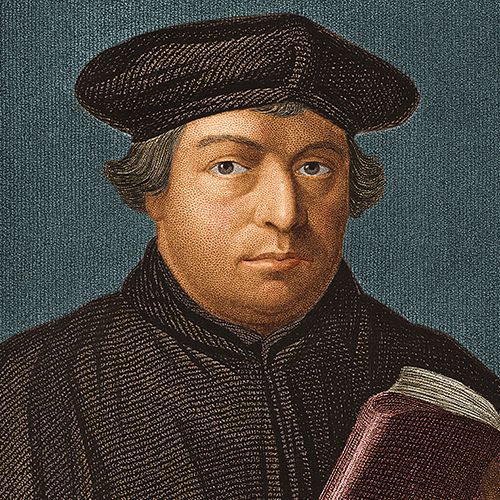
Martin Luther (1483-1546)
A Musical Offering: “Come, Join the Dance of Trinity” (412, ELW)
Come, Join the Dance of Trinity
Come, join the dance of Trinity, before all worlds begun– the interweaving of the Three, the Father, Spirit, Son. The universe of space and time did not arise by chance, but as the Three, in love and hope, made room within their dance.
Come, see the face of Trinity, newborn in Bethlehem; then bloodied by a crown of thorns outside Jerusalem. The dance of Trinity is meant for human flesh and bone; when fear confines the dance in death, God rolls away the stone.
Come, speak aloud of Trinity, as wind and tongues of flame set people free at Pentecost to tell the Savior’s name. We know the yoke of sin and death, our necks have worn it smooth; go tell the world of weight and woe that we are free to move!
Within the dance of Trinity, before all worlds begun, we sing the praises of the Three, the Father, Spirit, Son. Let voices rise and interweave, by love and hope set free, to shape in song this joy, this life: the dance of Trinity.
“Come, Join the Dance of Trinity” is a hymn written by Richard Leach, known for his ability to craft texts that are both biblically grounded and theologically rich. The hymn draws on the ancient concept of perichoresis, an early theological term describing the interrelationship of the Father, Son, and Holy Spirit—often likened to a divine dance. The hymn’s four stanzas explore the Trinity’s role in creation, redemption, and the Spirit’s ongoing work, culminating in an invitation for believers to join in the dance of faith. It is commonly set to the KINGSFOLD tune, a melody with medieval roots that has been adapted for various hymns. The organist you’re hearing is Jeffrey Dexter of Zion Lutheran Church in Ohio. The visuals are interesting throughout the song.
Zion is a congregation of the Evangelical Lutheran Church in America (ELCA), part of the Northeastern Ohio Synod of the ELCA, founded in 1840 and located in downtown Wooster.
Update on “Faithful Conversations”
Our regular gatherings for discussing the weekly lectionary are on a pause. Summer worship at ELC is at 8:30 in town and 10:15 at Hatfield by the lake. The 8:30 service will be streamed. Please stay in touch!
Recent News Regarding the Lutheran Study Bible!
This is something you may be interested to know. In 2009, the Lutheran Study Bible was published by Augsburg Fortress. It featured the New Revised Standard Version (NRSV) translation and included introductions, notes, and articles written by ELCA Lutheran pastors and theologians. It provided historical and cultural context, theological insights, and faith reflection prompts to help readers engage deeply with Scripture. I have used if for a number of years. A second edition, featuring the NRSV Updated Edition (NRSVue), is set to release in July 2025, expanding on the original with contributions from over seventy Lutheran scholars. If you’re looking for a Bible that connects well with the ELCA, check it out.
Augsburg Fortress is the publishing branch of the Evangelical Lutheran Church in America (ELCA). It creates resources for worship, music, faith education, and church life, including hymnals, theological books, and study materials. It also runs Fortress Press, which publishes academic and theological works for pastors, educators, and general readers. Over the years, Augsburg Fortress has shaped Lutheran teaching and provided essential materials for churches.
Congratulations Paul on getting through the AP US History Exam!
We enjoyed the photo of your parents and you at your Senior track meet!
I often prayed that the suffering of my dear friend Pam would lead her to hope in eternal life through the love of our dear God. She passed away into eternal life with our Savior in May 2024. She is dearly missed.





Congratulations Paul on getting through the AP US History Exam!
We enjoyed the photo of your parents and you at your Senior track meet!
I often prayed that the suffering of my dear friend Pam would lead her to hope in eternal life through the love of our dear God. She passed away into eternal life with our Savior in May 2024. She is dearly missed.
LikeLike