Navigate the Blog Here
Two Worlds is a digital ministry space that shares the RCL readings, a brief homily, and supporting images, music, and ELCA commemorations. The blog is authored by Paul Rykken in consultation with Pastor Jen Hatleli of Evangelical Lutheran Church in Black River Falls, Wisconsin (ELCA). The blog lands more naturally on a larger screen. Also, hyperlinks are included for further information — they are bolded and italicized.
Bishop Curry on the Death Penalty
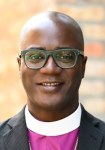
ELCA Bishop Curry issued a statement opposing the recent proposal to livestream a U.S. execution, calling it a dangerous distortion of justice that turns human suffering into spectacle. He reaffirms the ELCA’s long-standing opposition to the death penalty, arguing that it deepens cycles of violence, denies the possibility of repentance and restoration, and fails to provide true safety or healing. Rooted in the church’s ministry of reconciliation, he urges congregations to engage in faithful dialogue, study the ELCA’s social statements, and advocate for abolition.
Read his full statement here.
Reformation Sunday Readings
Luther on Bible Reading
“In truth you cannot read too much in Scripture; and what you read you cannot read too carefully, and what you read carefully you cannot understand too well, and what you understand well you cannot teach too well, and what you teach well you cannot live too well.”
Jeremiah 31: 31-34
Psalm 46
Romans 3: 19-28
John 8: 31-36
Readings are Linked

(1483-1546)
Common Themes/ Connections
The readings for Reformation Sunday converge on God’s decisive act to create a new covenant grounded not in human achievement but in God’s own faithfulness and mercy. Jeremiah promises a future in which God’s law is written on the heart, while Psalm 46 anchors that promise in the assurance that God alone is our refuge amid every upheaval. Paul’s argument in Romans intensifies this theme by insisting that righteousness comes apart from the law, as a gift of grace received through faith in Christ. In John’s Gospel, Jesus completes the arc by declaring that true freedom is found in abiding in his word, a liberation rooted not in human effort but in the truth he embodies.
Note: Next Sunday provides an example of how the ELCA and other churches that trace their heritage to the Protestant Reformation utilize different texts than those prescribed by the Revised Common Lectionary. Recall that the RCL is a guideline for churches, not a mandate, as such. For example, there is also something called the “Narrative Lectionary” and various preaching series that offer alternative texts (sidebar: the same can be said of the various liturgies available to us in the ELW).
Image of the Week
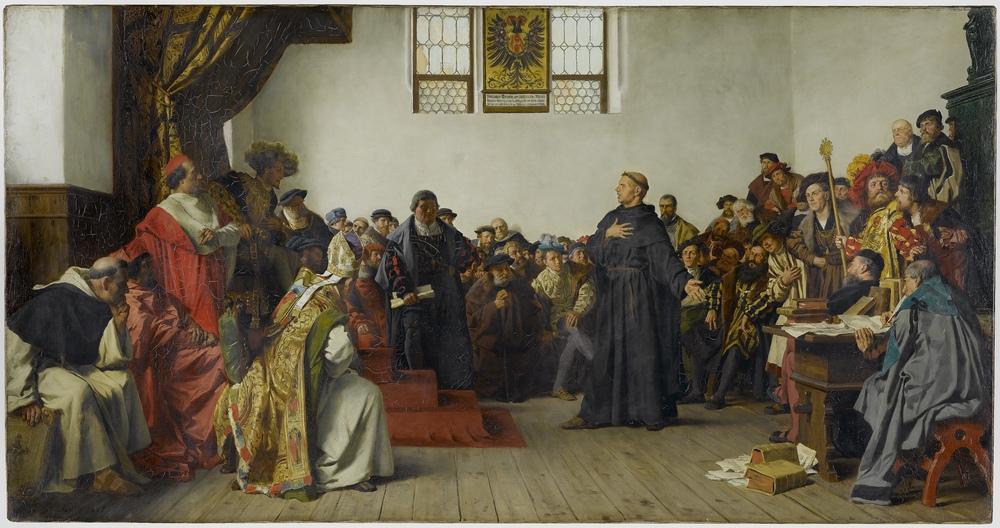
Anton von Werner’s Luther Before the Diet of Worms (1877) presents Luther standing firm before imperial authorities, captured in a clear, dramatic moment of conviction. Werner, a leading German history painter of the late 19th century, was known for precise detail and works that shaped national identity in the newly unified German Empire. His rendering of Luther—calm, upright, and resolute—reflects both his academic training and his belief that historical art should teach civic courage. The painting distills the scene into a simple visual message: conscience grounded in the Word stands its ground.
Four-Minute Homily: Reformation Sunday
Title: “The Psalm That Held Luther Together”
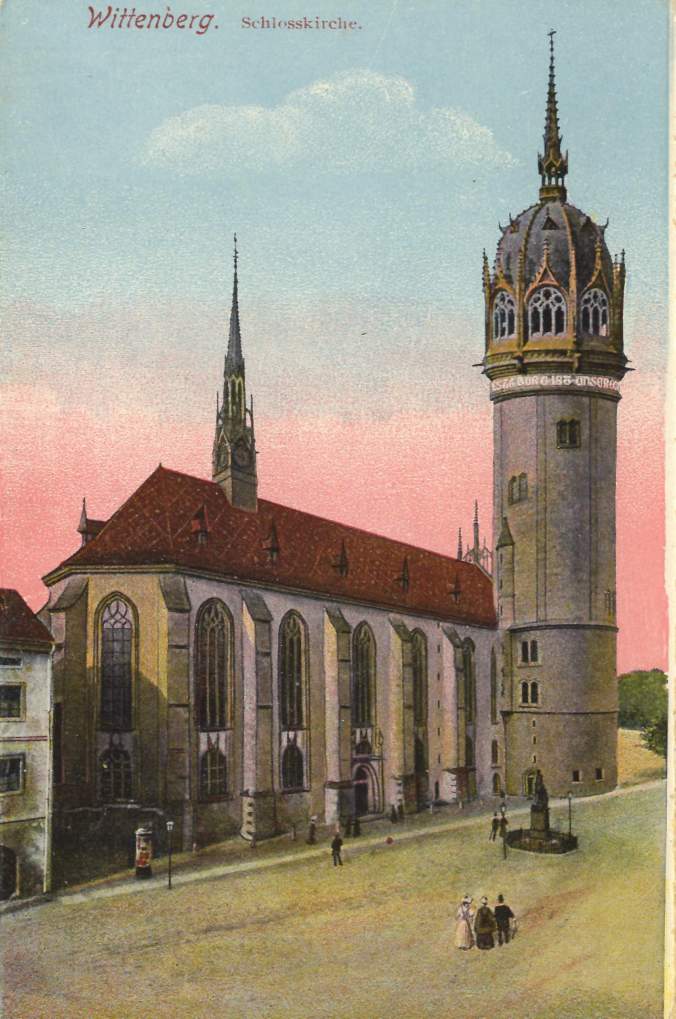
509 years ago this month, in October 1517, the Augustinian monk Martin Luther posted his Ninety‑Five Theses on the door of the Castle Church in Wittenberg, sparking debates that eventually reshaped Western Christianity and set the Protestant Reformation in motion. Brilliant and complicated, Luther translated the Bible into German, wrote tracts and commentaries that fill volumes, and crafted both a Large and Small Catechism to teach the faith to clergy and everyday believers. A gifted musician, he also composed hymns — thirty‑six are attributed to him — including the best known, Ein feste Burg ist unser Gott (“A Mighty Fortress Is Our God”), likely written between 1527 and 1529. Hymnologist John Julian famously called it “The Battle Hymn of the Reformation.”
Luther drew deep strength from the Psalms, which he called the “Bible in miniature.” Psalm 46 became especially dear to him during the harrowing year of 1527, when plague swept through Europe and his own household faced severe strain, including the near death of his son. Reflecting on the psalm’s fierce trust, Luther wrote: “We sing this psalm to the praise of God, because He is with us and powerfully and miraculously preserves and defends His church and His word against all fanatical spirits, against the gates of hell, against the implacable hatred of the devil, and against all the assaults of the world, the flesh, and sin.”
There are many excellent recordings of A Mighty Fortress out there (including a rock version, yes), but the Pacific Lutheran University Choir of the West offers a particularly stirring rendition — fitting, given PLU’s long history as one of the 26 colleges and universities affiliated with the Evangelical Lutheran Church in America. These schools were founded to unite rigorous learning with Lutheran theological identity, and PLU’s musical tradition reflects that heritage with depth and beauty. Listening to their performance while reading Psalm 46 alongside Luther’s hymn creates a vivid sense of how this text shaped his imagination and fortified his faith.
Musical Reflection: A Mighty Fortress is our God
Lyrics
A mighty fortress is our God, a bulwark never failing;
Our helper He, amid the flood of mortal ills prevailing:
For still our ancient foe doth seek to work us woe;
His craft and pow’r are great, and, armed with cruel hate,
On earth is not his equal.
Did we in our own strength confide, our striving would be losing,
Were not the right Man on our side, the Man of God’s own choosing:
Dost ask who that may be? Christ Jesus, it is He;
Lord Sabaoth, His Name, from age to age the same,
And He must win the battle.
And though this world, with devils filled, should threaten to undo us,
We will not fear, for God hath willed His truth to triumph through us;
The Prince of Darkness grim, we tremble not for him;
His rage we can endure, for lo, his doom is sure,
One little word shall fell him.
That word above all earthly pow’rs, no thanks to them, abideth;
The Spirit and the gifts are ours through Him Who with us sideth;
Let goods and kindred go, this mortal life also;
The body they may kill: God’s truth abideth still,
His kingdom is forever.
“We sing this psalm to the praise of God, because He is with us and powerfully and miraculously preserves and defends His church and His Word against all fanatical spirits, against the gates of hell, against the implacable hatred of the devil, and against all the assaults of the world, the flesh, and sin.”
Martin Luther Reflecting on Psalm 46
The 46th Psalm
1 God is our refuge and strength,
a very present help in trouble.
2 Therefore we will not fear,
though the earth should change,
though the mountains shake in the heart of the sea,
3 though its waters roar and foam,
though the mountains tremble with its tumult. Selah
4 There is a river whose streams make glad the city of God,
the holy habitation of the Most High.
5 God is in the midst of the city; it shall not be moved;
God will help it when the morning dawns.
6 The nations are in an uproar; the kingdoms totter;
he utters his voice; the earth melts.
7 The Lord of hosts is with us;
the God of Jacob is our refuge. Selah
8 Come, behold the works of the Lord;
see what desolations he has brought on the earth.
9 He makes wars cease to the end of the earth;
he breaks the bow and shatters the spear;
he burns the shields with fire.
10 “Be still, and know that I am God!
I am exalted among the nations;
I am exalted in the earth.”
11 The Lord of hosts is with us;
the God of Jacob is our refuge. Selah
Who Are We Commemorating This Week?
Note: The ELCA commemorates a wide range of Christians throughout the year as a way of remembering that God has worked through ordinary people in every age. These commemorations — drawn from Scripture, the early church, the Reformation, and more recent history — invite us to see faith lived out in many different vocations and cultures. They aren’t about elevating “heroes,” but about widening our sense of the communion of saints and letting their witness encourage our own. In marking these days, the church pauses to give thanks, to learn, and to be reminded that the Holy Spirit continues to shape faithful lives in every generation.
We have one commemoration this week. You will find the full listing of them in the front of the ELW.
Week of 19 October
Friday 23 October
James of Jerusalem, martyr (d. 62)
James of Jerusalem — called James the Just — rose as the early church’s steady center of gravity in Jerusalem, known in the New Testament as “the Lord’s brother,” whether by blood, step‑relation, or kinship. After a post‑resurrection encounter with Jesus, he stepped into leadership with conviction, becoming one of the movement’s “pillars” and guiding the Jerusalem community through its most defining moment: the Council of Jerusalem, where he argued that Gentile believers need not be circumcised while Jewish believers could continue observing the Law. His strict piety, ascetic habits, and deep devotion to Jewish tradition earned him broad respect across Christian and Jewish circles. His martyrdom around 62 CE sealed his legacy as Jerusalem’s first bishop and the crucial bridge between Jesus’ Jewish world and the emerging Christian faith.
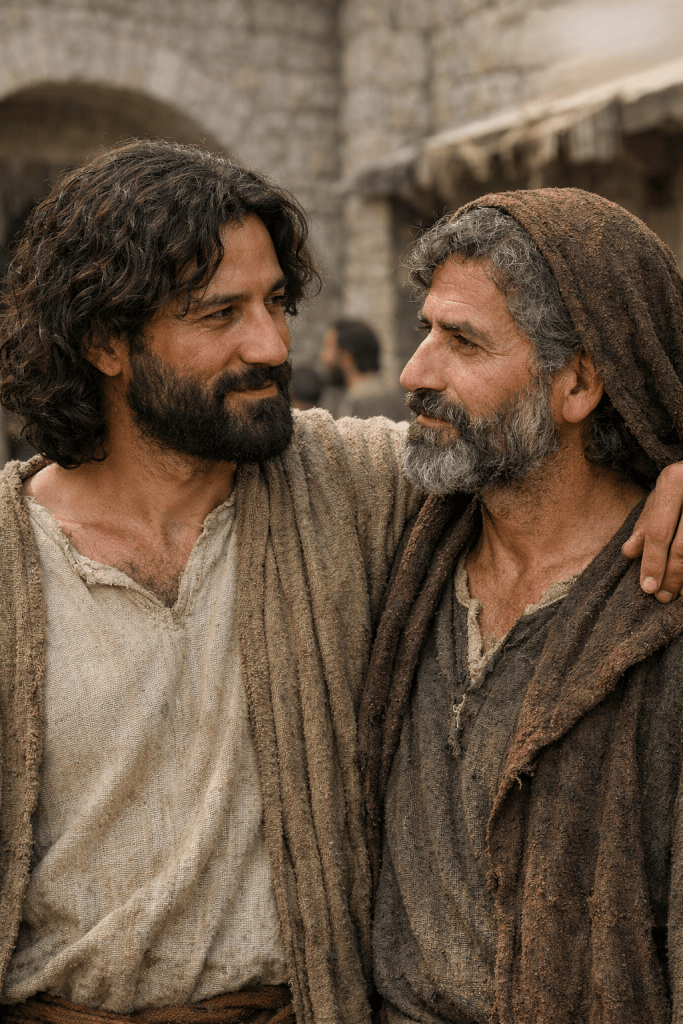
(A.I. generated)
Going Beyond
Thomsas Merton on Technology
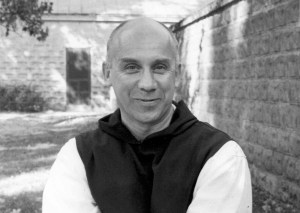
As artificial intelligence becomes woven into daily life — often without our awareness — we face a spiritual challenge as much as a technological one. I stumbled upon an excellent article recently that explores how Trappist Monk Thomas Merton reflected on the impact of technology in our lives back in the 1960s. Merton warned that modern tools can dull our perception, blunt our sensibilities, and distract us from the deeper currents of the Spirit. Pope Leo echoes this today, reminding us that innovation without justice widens the gap between rich and poor and risks eroding human dignity. Technology can help us, even save lives, but it can also pull us away from the slow, embodied encounters where God speaks: the neighbor in need, the friend in grief, the fragile work of repairing relationships. When machines take over more of our attention, we risk losing touch with the “angelic” — the divine presence that moves between human beings. Good stewardship of AI begins not with fear or fascination but with love: protecting our neighbors, tending our earth, and strengthening the connections made of flesh and dirt. As Merton wrote, we need “angels” to teach us how to live with our machines. Perhaps those guardians are simply us — showing up with integrity, humility, and care.
Faithful Conversations
We’ve spent the past year at ELC discerning how best to offer adult study in a way that’s both flexible and consistent, and that work has led to a simple rhythm: Faithful Conversations, our weekly gathering on Sundays from 11:00 to 11:45 a.m. This space offers a rotating mix of lectionary discussion, Lutheran theology, spiritual disciplines, and congregational history—open to anyone, with no prior knowledge needed and no pressure to read or share.
We are currently doing a book study of Michael Foss’s Real Faith for Real Life. Our final session on this book is on 25 October at 11:00 a.m. in the church sanctuary, continuing our exploration of practical Christian discipleship. Whether you have been there or not . . . .
ALL ARE WELCOME!
