Introduction: “Many Mansions”
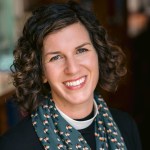
“When you look back on your life, what are the pivotal moments when you perceived the grace of an invitation to a different way of being, a way closer to God? How does it change your understanding of such moments if you think of them as the Lord at work, trying to ‘take you to myself, so that where I am, there you may be also’ — in other words, into deeper fullness of life and truth and communion with the Creator? Hearing anew this promise of Jesus as a way-maker to abundant life, not just once and for all through his death and resurrection but even and especially through the intimate details of your life, can be electrifying.” (Laurel Mathewson)
As I sat with this week’s readings — and especially John 14 — I kept returning to a recent article by Reverand Laurel Mathewson that reframed Jesus’ promise about “many dwelling places” (or “many mansions” in the King James version). As she suggests, we typically hear that line at funerals, but the author pushed me to hear it as a present invitation: the soul as an “interior castle,” full of rooms where Christ meets us now in the day to day of our earthly lives.
That image helped me rethink Jesus’ words, “I will take you to myself,” not as a distant hope but as something unfolding now in the daily rhythm of our lives. And when I set that beside Stephen’s story and Jesus’ exchange with Thomas and Philip — “I am the way, the truth, and the life” — the connection sharpened. Those first Christians were called “People of the Way” for a reason. Our gaze stays fixed on Christ because he is the one who draws us inward, builds us into a spiritual house, and leads us toward the Father.
In a world fractured by division and despair, this is the message we carry: a God who stands with us, restores us, and fills us with hope — not someday, but today. Later in this week’s blog, I am offering a hymn that follows the more traditional view of John 14. Consider both interpretations as you explore the readings this week!
Soli Deo Gloria!
My introduction this week was inspired by Laurel Mathewson’s May 3rd “In the Lectionary” commentary on John’s Gospel from The Christian Century magazine (May 2026 edition). Reverand Mathewson is co-vicar at St. Luke’s Episcopal Church in San Diego and the author several books. Here is further information on St. Luke’s Episcopal, if interested.
TRY LUTHER’S METHOD OF READING
A Revision of the Lectio Divina (Augustinian)
Three Steps
Oratio (Prayer): This is the starting point, where one humbly prays for the Holy Spirit’s guidance to understand God’s Word. Luther emphasized that prayer prepares the heart and mind to receive divine wisdom.
Meditatio (Meditation): This involves deeply engaging with Scripture, not just reading it but reflecting on it repeatedly. Luther encouraged believers to “chew on” the Word, allowing its meaning to sink in and shape their thoughts and actions.
Tentatio (Struggle): Often translated as “trial” or “temptation,” this refers to the challenges and spiritual battles that arise as one seeks to live according to God’s Word. Luther saw these struggles as a way God refines faith, making it more resilient and authentic.
Image of the Week: The Stoning of Stephen
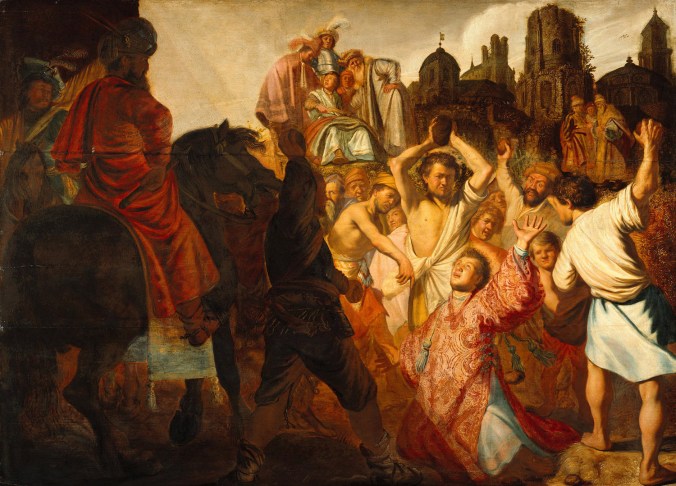

There is a lot going on in Rembrandt’s 1625 painting! The scene is derived from this week’s first reading (Acts 7: 55-60) — a Biblical passage that is deeply personal to me because of my name. Unk — my father — told me later in life that he chose Paul Stephen because he wanted me to grow up knowing the power of conversion (such is the life of a PK). As I studied the piece more closely, a few details jumped out. Rembrandt gives Stephen and Saul the same face. Saul sits in the upper center of the painting, holding the cloaks of the executioners, just as Acts describes. Once I noticed the shared features, it felt intentional –almost like Rembrandt was hinting at the transformation that will unfold in Acts 9. Violence and grace sit in the same frame. And then there’s Rembrandt himself. He slips into the crowd, peeking out from behind the man about to strike Stephen. His expression looks pained, almost conflicted. I read that as a quiet admission of our human tendency to stand by when injustice erupts around us. But the detail that keeps pulling me back is Stephen’s gaze. He doesn’t look at the men with stones in their hands. He looks up. Scripture says he sees Jesus standing at the right hand of God — a posture one commentator described as Christ choosing to stand with us rather than sit in judgment. Rembrandt paints that truth into Stephen’s face. It’s calm, illuminated, anchored somewhere beyond the chaos. That upward gaze still challenges me. It asks where I’m looking when pressure closes in—and whether I trust the God who stands with us.
Easter 4 Readings and Connecting Themes
The readings for 5 Easter unite around the call to entrust our lives to Christ, who forms us into a people grounded in God’s steadfast care and drawn into the life of the Father through him. Stephen’s martyrdom in Acts 7:55–60 shows a disciple who entrusts himself fully to the risen Christ, even in the face of violence, and whose final words echo Jesus’ own mercy. Psalm 31 reinforces this posture of trust, declaring that our times rest securely in God’s hands. 1 Peter 2:2–10 expands the vision by naming believers as “living stones” built into a spiritual house, chosen and called to reflect God’s light in the world. In John 14:2–14, Jesus promises that he prepares a place for his followers and reveals himself as the way to the Father, inviting them into a life shaped by faith, intimacy, and purposeful action. Together, these texts emphasize that God forms a people who rely on Christ’s presence, embody his mercy, and live with confidence in the future he secures.
Note: I utilize the Bible Gateway website for the readings (NRSVUE) and also receive as assist from Co-Pilot (A.I.) for summarizing the themes each week.
ELCA Commemorations This Week
The ELCA’s Lesser Festivals and Commemorations grow from an old Christian practice—shared with Roman Catholicism—of remembering saints as fellow believers. Early Christians honored martyrs, apostles, and teachers whose lives made the gospel visible. Lutherans kept the practice but shifted the focus: we remember these people to point to the God who worked through them. Today, these commemorations root us in the church’s broad story and remind us that the same Spirit who inspired earlier believers is still shaping our witness. They appear on pages 15–17 of the ELW.
Explore Catherine’s Story Here
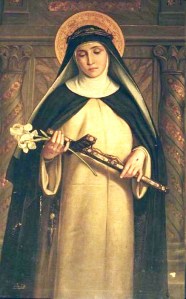
(1347-1380)
Wednesday 29 April
Catherine of Siena, theologian (d. 1380)
Friday 1 May
Philip and James, APOSTLES
Saturday 2 May
Athanasius, Bishop of Alexandria (c. 373)
Music and Meditation: Mansions of the Lord
“Mansions of the Lord,” written by Randall Wallace and Nick Glennie‑Smith for the 2002 film We Were Soldiers, takes its title directly from Jesus’ promise in John 14:2 (KJV): “In my Father’s house are many mansions.” The hymn embraces the traditional, future‑tense reading of that passage—Christ preparing a place of rest, peace, and welcome beyond death. Its language of “no more weeping, no more fear” naturally resonates in military contexts, honoring those who have fallen in battle. Yet the imagery also extends to anyone who has “fought the good fight” of faith, offering comfort to all who long for God’s promised home. This stands in contrast to Laurel Mathewson’s reading in The Christian Century, where she shifts the focus from a future heavenly dwelling to the present, interior rooms where Christ meets us now. If Mathewson invites us to explore the soul’s inner chambers in this life, “Mansions of the Lord” points us toward the home Christ prepares in the next.
The West Point Glee Club’s interpretation of the song is offered here — they are accompanied by the West Point band. It raises some nostalgia for me due to our son’s experience at USMA in the early 2000s — we visited there a half dozen times and it is a remarkable school.
The West Point Glee Club is the premier choral ensemble of the U.S. Military Academy, known for its clear, disciplined sound and its role as a musical ambassador for West Point. The group performs at major national events, memorial services, and public ceremonies, often singing music that honors service and sacrifice—including their well‑known rendition of “Mansions of the Lord.” Their repertoire ranges from patriotic pieces to classical and contemporary works, all shaped by the Academy’s values of duty, honor, and country.
To learn more, you can visit the official West Point Glee Club page on the U.S. Military Academy’s website.
Lyrics
To fallen soldiers, let us sing
Where no rockets fly, nor bullets ring
Our broken brothers, let us bring
To the mansions of the lord.
No more bleeding, no more fight
No prayers pleading through the night
Justfied embrace, eternal light
In the mansions of the lord
Where no fathers cry, and no children weep
We will stand and guard o’er the angels sleepw
All through the ages, safely keep
The mansions of the lord
Going Beyond: Digital Ministry: The Bible Project
If you’re not familiar with The Bible Project, I heartily recommend this incredible resource to you. This devotional (below) is an example of the kind of work they are doing in helping millions of people explore scriptures more richly!
Explore their Website Here!
The Lectionary Study Group will meet Sunday (5.3) at 10:45 in the library. All are welcome!
Are You Looking for a Church Home?
Evangelical Lutheran Church in Black River Falls, is part of the Northwest Synod of Wisconsin (ELCA). We stream our Sunday worship at 9:30 each week. Please feel free to join us!
Access our YouTube Channel here.
Reminder: Blog Purpose and Format
Thanks for stopping by again this week. Two Worlds is a digital ministry space where I post the weekly Revised Common Lectionary readings (NRSVU) and offer a brief, historically grounded reflection with music, visual art, and other creative resources. I also include the ELCA’s weekly commemorations and link to additional materials, with a Table of Contents that lets you jump to what you need. Most images come from Wikimedia Commons, and Copilot supports some of the writing and research. Among other things, the blog grows out of ongoing conversation with Pastor Jen Hatleli of ELC in Black River Falls.
I welcome any feedback. Comment on the blog, or email me: pstrykken@gmail.com
