Welcome to Two Worlds!
Two Worlds is a digital ministry space where I share the weekly Revised Common Lectionary readings and a brief homily with supporting images and music. As a nod to our history, I also include the ELCA’s commemorations for the week. Most images come from Wikimedia Commons, and I utilize Copilot for some aspects of the research and writing.
The project grows out of ongoing conversation with Pastor Jen Hatleli of ELC in Black River Falls — a dialogue first sparked by a 2023 Bible Study that set this whole thing in motion.
Feel free to offer your comments on the blog. And I welcome any feedback: pstrykken@gmail.com
Navigate the Blog Here
Thanks for Visiting This Space!
The 6 Easter Readings (Linked)
Common Themes
The readings for 6 Easter hold together around the promise that God draws near, sustains, and empowers a people who witness with courage and hope. In Athens, Paul announces a God who is not distant but the One in whom “we live and move and have our being,” calling all people toward life in the risen Christ. Psalm 66 echoes that nearness with thanksgiving for a God who hears, delivers, and refuses to abandon those who cry out. First Peter urges believers to embody that same hope with gentleness and endurance, trusting that Christ has already gone ahead of them through suffering into new life. And in John 14, Jesus seals the promise with the gift of the Advocate, assuring the disciples that love, obedience, and the Spirit’s presence will bind them to him even after his departure. Together, the texts paint a picture of a God who refuses distance—choosing instead to dwell with, strengthen, and send a people shaped by resurrection.
Three-Minute Homily: “God in Us”
Think for a moment about the most enthusiastic person you know. A number of people come to mind for me — people who change the room with their presence. They remind me that enthusiasm comes from the Greek entheos, “God in us,” which is exactly what Jesus promises in this week’s Gospel. In John 14:15–21, Jesus is preparing the disciples for life after his departure. He promises “another Advocate” (v. 16), someone who will stand beside them and dwell within them—the Spirit of Truth the world can’t quite grasp (v. 17). He assures them they won’t be left orphaned (v. 18), and in verse 20 he gives a remarkable glimpse into the life of the Trinity. It’s worth lingering over that line.
And when we do, we realize the Church has been lingering over it for centuries. Every time we confess the faith in our three ecumenical creeds, we echo what Jesus is saying here. The Apostles’ Creed names Father, Son, and Holy Spirit with a kind of elegant simplicity. The Nicene Creed widens that frame, reminding us that the Son is “of one being with the Father” and the Spirit is “the Lord, the giver of life” — language that mirrors the unity Jesus describes in verse 20. And the Athanasian Creed, with its careful insistence on “one God in Trinity and Trinity in Unity,” underscores that this isn’t abstract theology. It’s the very life of God — shared, relational, overflowing. Which means that when Jesus promises the Advocate, he’s not offering a spiritual accessory. He’s drawing us into that divine life itself. That is the heart of entheos — “God in us.”
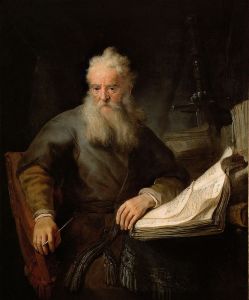
by Rembrandt (1606-1669)
That same theme —“God in us” — runs straight into the reading from Acts. Paul’s conversion took place around 34 CE, and roughly twelve years later he launched the first of several missionary journeys. Between 46–60 CE, he traveled more than 10,000 miles across the Mediterranean world, most of it on foot. In Acts 17, we meet him on his second journey (around 51 CE), standing on the Areios Pagos in Athens after being chased out of Thessalonica and Berea. Picture Paul surrounded by a mix of philosophers, poets, civic leaders, skeptics, and people who are simply curious about this “new teaching” he’s bringing to town. Athens was a city that loved ideas, so Paul meets them on their own ground. He begins with something familiar—their altar “to an unknown god”—and uses it as a bridge to proclaim the God “who gives to all mortals life and breath” (v. 25). Then he goes a step further. To show he’s not attacking their culture but building on it, he quotes two of their own poets, Epimenides and Aratus, to affirm that “we too are his offspring” (v. 28). It’s a brilliant move: he honors their intellectual world while gently redirecting it toward the God revealed in Christ. And as Acts tells us, the response is mixed. Some laugh him off, but others—like Dionysius the Areopagite and a woman named Damaris—lean in and become part of the early Christian movement (vv. 32–34).
So what do we take from these readings? First, God’s love and the gift of the Spirit are not limited to insiders. They reach everyone — an unsettling truth in a world that thrives on division. Second, the Spirit doesn’t let us stay insulated. If we only talk to people who think like we do, we shrink. We freeze. We lose the story we’ve been given to share. The Spirit pushes us outward — into conversations, into community, into the messy, beautiful work of living what we proclaim. That’s where “God in us” becomes more than a word study. It becomes a way of life.
Soli Deo Gloria!
Images of the Week
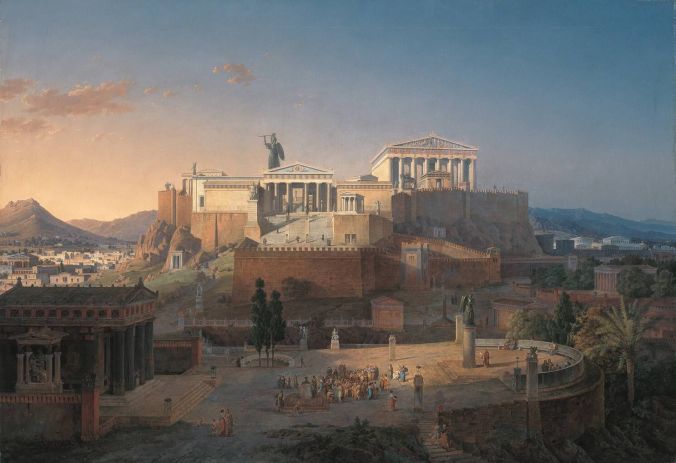
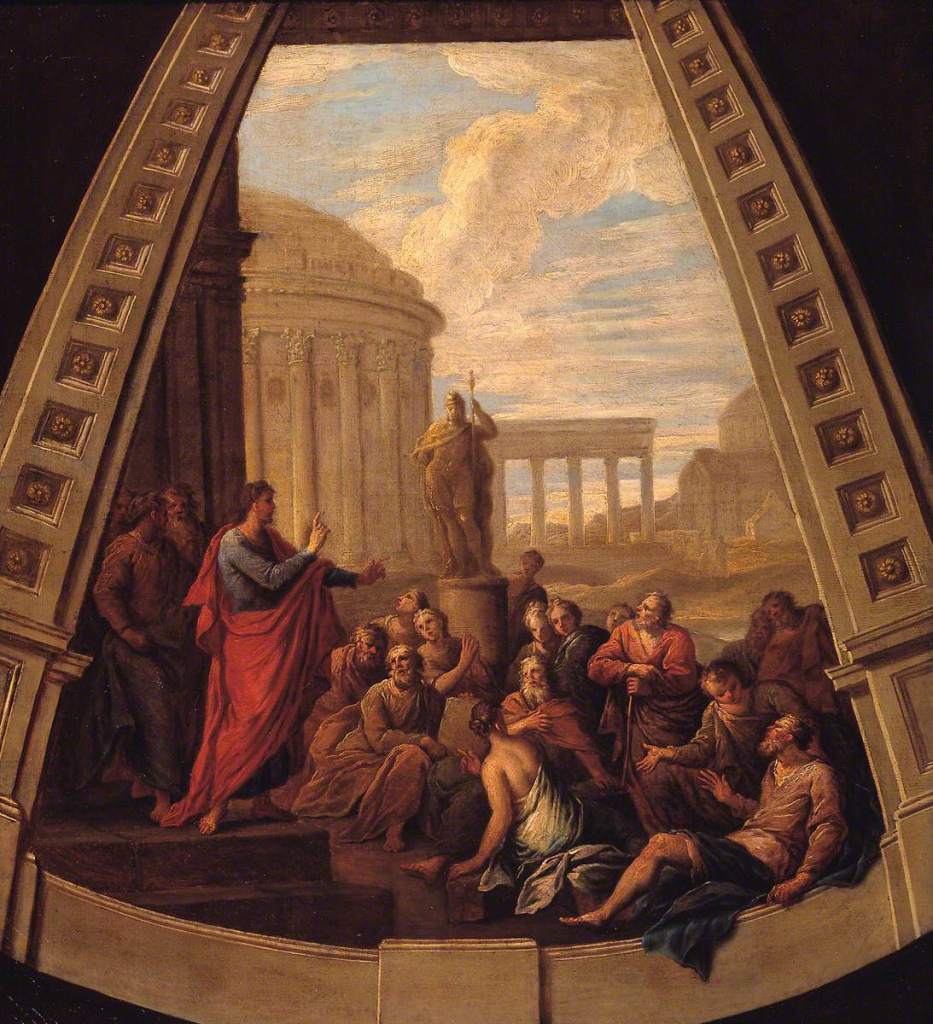
Leo von Klenze’s (1784-1864) painting (left) imagines the Acropolis and the Areios Pagos the way 19th‑century Europe wished classical Athens had looked—bright, orderly, and perfectly composed. Klenze wasn’t just guessing; he was one of the leading Neoclassical architects of his day and a major voice in the early archaeological debates about how ancient Greek buildings were actually painted and decorated. In this 1846 work, he gives us a sun‑washed Acropolis with temples and statues restored to their ideal form, while everyday Athenians gather on the Areios Pagos below. It’s less a literal reconstruction and more a love letter to the classical world — a blend of scholarship, imagination, and Klenze’s own vision for what a reborn Athens could be. Let’s imagine the Apostle Paul preaching there. James Thornhill’s (1675-1734) 1710 painting (right) captures that moment.
Musical Meditation: Mary Chapin Carpenter
In John 14:15–21, Jesus promises that we are not left orphaned — that the Spirit will come alongside us, lifting us into a life shaped by love. Though her music is not explicitly spiritual, Mary Chapin Carpenter’s “Why Walk When You Can Fly?” carries that same invitation. Her song urges us to rise above fear and step into the freedom already given to us. Both the Gospel and the song remind us that courage is not self-generated; it comes from knowing we are accompanied. When we trust that presence, we discover that walking is no longer enough. We were made to fly. Enjoy this artist!
In this world, there’s a whole lot of trouble, baby
In this world, there’s a whole lot of pain
In this world, there’s as whole lot of trouble but
A whole lot of ground to gain
Why take when you could be giving?
Why watch as the world goes by?
It’s a hard enough life to be living
Why walk when you can fly?
In this world, there’s a whole lot of sorrow
In this world, there’s a whole lot of shame
In this world, there’s a whole lot of sorrow
And a whole lot of ground to gain
When you spend your whole life wishing
Wanting and wondering why
It’s a long enough life to be living
Why walk when you can fly?
And in this world, there’s a whole lot of golden
In this world, there’s a whole lot of plain
In this world, you’ve a soul for a compass
And a heart for a pair of wings
There’s a star on the far horizon
Rising bright in an azure sky
For the rest of the time that you’re given
Why walk when you can fly high?
Mary Chapin Carpenter (b. 1958) is an American singer‑songwriter whose warm voice and thoughtful, poetic writing blend folk, country, and Americana into songs that explore love, loss, resilience, and the quiet spiritual textures of everyday life.

ELCA Commemorations This Week
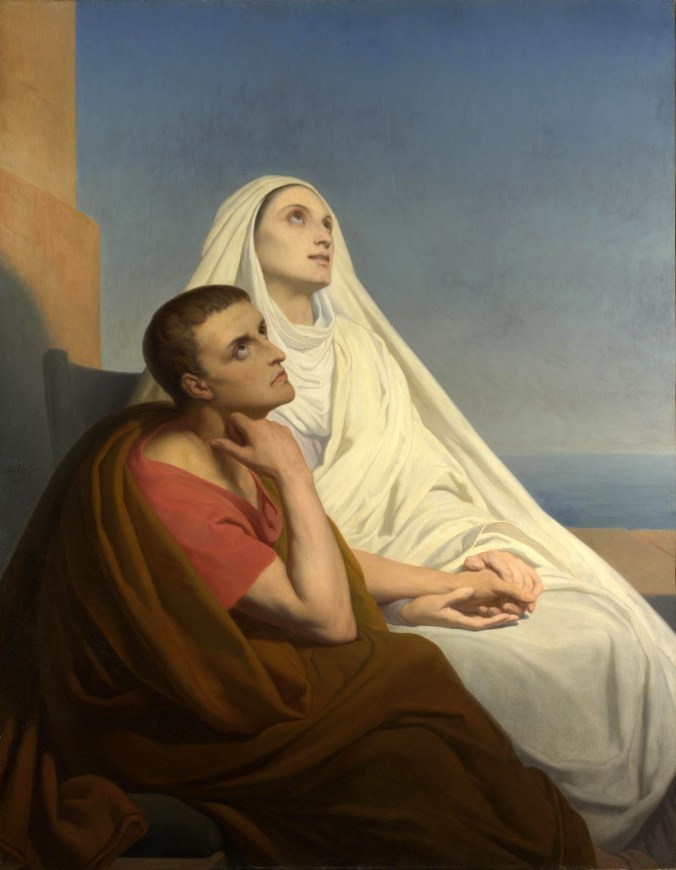
Monday 4 May
Monica, Mother of Augustine (d. 387)
Friday 8 May
Julian of Norwich, church renewer (d. 1416)
Saturday 9 May
Nicolaus Ludwig von Zinzendorf
church renewer and hymnwriter (d. 1760)
(Information on each is linked)
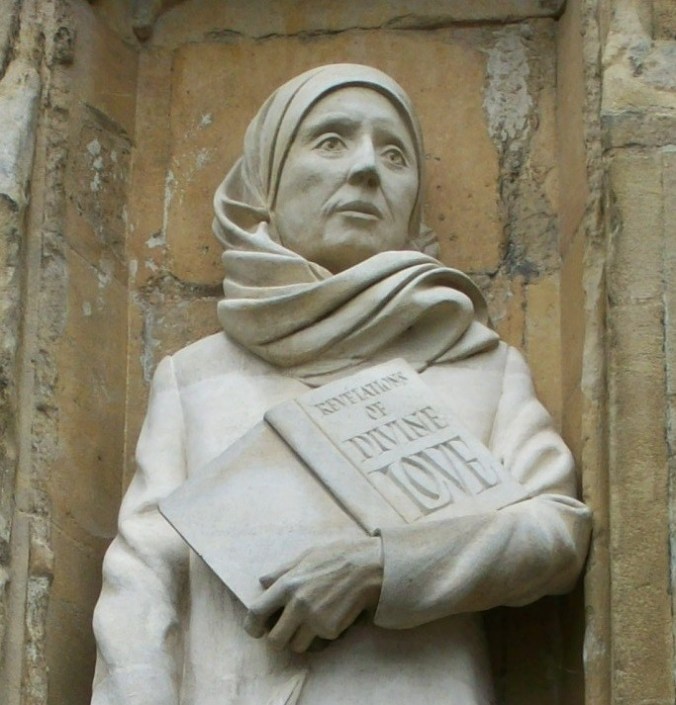
Norwich, England
Going Beyond: Digital Ministry
A Spiritual Profile
Pew’s 2025 report (linked below) shows that American religious life has stopped its long slide and settled into a period of stability. After decades of steady decline, rates of religious identity, prayer, and worship attendance have basically held their ground since 2020.
Some observers have talked about a spiritual comeback among young adults, especially young men, but the data doesn’t support a broad revival. Younger Americans are still far less religious than older generations, and most of their current engagement simply mirrors the habits of their parents. Instead of a rebound, Pew describes a pause — a moment when the religious landscape isn’t shrinking the way it once did, but isn’t growing either, giving us a clearer picture of where American spirituality now stands.
Check Out the Polling Results Here!
The Lectionary Study Group will meet Sunday (5.10) at 10:45 in the library. All are welcome!
Are You Looking for a Church Home?
Evangelical Lutheran Church in Black River Falls, is part of the Northwest Synod of Wisconsin (ELCA). We stream our Sunday worship at 9:30 each week. Please feel free to join us!
All are welcome!
Access our YouTube Channel here.

Note in Psalm 66 how many times–I counted 14– the psalmist says he speaks or praises God OUT LOUD and some are shouted! I think it IS powerful to speak praises, Scripture or prayers out loud since first it holds my mind so no “shiny objects” can distract me and second, it feeds my soul/faith and lastly, God’s spiritual opponents hear where I stand. I affectionately say when I pray or praise out loud, I “hold the floor”, so to speak, on behalf of God. : ) Kris H
LikeLiked by 1 person