Where Are We in the Lectionary Calendar?
Even though the Lectionary highlights Ascension Day, it often slips by quietly. We’re deep into Eastertide now — the fifty days between Easter and Pentecost — that keep drawing us back to resurrection, renewal, and the church’s first steps into mission. As Thursday approaches, the Ascension stands before us as that hinge moment when Jesus, after forty days with his followers, entrusts his work to the church and returns to the Father. Luke and Acts hold this mystery with both clarity and awe. Christians have honored this day since the earliest centuries; by the fourth century it was widely observed in the East, and by the sixth it was firmly rooted in the Western church. Traditionally kept forty days after Easter, Ascension Day has become a feast of prayer and worship, proclaiming Christ’s exalted reign and the hope of his coming again.
Thanks for your visit!
Two Worlds is a digital ministry space where I share the weekly Revised Common Lectionary readings and a brief homily with supporting images and music. As a nod to our history, I also include the ELCA’s commemorations for the week. Most images come from Wikimedia Commons, and I utilize Copilot for some aspects of the research and writing.
The project grows out of ongoing conversation with Pastor Jen Hatleli of ELC in Black River Falls — a dialogue first sparked by a 2023 Bible Study that set this whole thing in motion.
This Week’s Readings (Linked) and Themes
The Ascension of Our Lord (Thursday)
Acts 1: 1-11
Psalm 47
Ephesians 1: 15-23
Luke 24: 44-53
The Ascension readings hold together around the conviction that Christ’s exaltation reshapes the mission and hope of his people. Acts and Luke present the Ascension not as Jesus’ departure but as the moment he entrusts his witnesses with Spirit‑empowered purpose, sending them into the world with opened minds and burning joy. Psalm 47 lifts this event into cosmic scale, celebrating the risen Christ as the enthroned King whose reign calls all nations to praise. Ephesians then draws the lens even wider, proclaiming that the ascended Christ now fills all things with resurrection power, ruling over every authority for the sake of the Church, his body. Together, the readings declare that Christ’s reign is already active, his presence is not diminished but transformed, and his people now live between promise and commission—anchored in hope, empowered for witness, and lifted into the life of the risen Lord.
7 Easter (Sunday)
Acts 1: 6-14
Psalm 68: 1-10, 32-35
1 Peter 4: 12-14; 5: 6-11
John 17: 1-11
The readings for 7 Easter gather around the tension and promise of a community learning to live in the space between Christ’s Ascension and Pentecost. Acts shows the disciples waiting in obedient hope, trusting Jesus’ promise even as they cannot yet see its fulfillment. Psalm 68 lifts that waiting into a vision of God as the victorious, mountain‑riding defender who scatters enemies, shelters the vulnerable, and reigns with unmatched strength. 1 Peter speaks directly into this in‑between time, urging believers to endure trials with humility and courage, confident that God will restore and strengthen them. In John 17, Jesus’ prayer anchors all of this: he entrusts his followers to the Father, asking that they be protected, unified, and sustained in the world. Together, the readings portray a people held by God’s power, shaped by Christ’s intercession, and prepared for the Spirit’s coming as they wait with trust, humility, and expectant hope.
Five-Minute Homily: He Opened Their Minds

(1939-2025)
Ho‑Chunk elder Gordon Thunder visited my classroom many times during my years at BRFHS. On his first visit in the 1990s, he said something that lodged itself in me and never left: “Education is much more a matter of the heart than of the head.” As he spoke, he tapped his chest and told a story from his childhood. He remembered walking in the woods with his Cooka—his grandfather—who would stop along the trail to teach him things. Nothing formal. Nothing scripted. Just a grandfather, a child, and the quiet wisdom of the woods. That memory still reminds me that real learning begins with inspiration, not information. Gordon’s words came back to me again this week as I sat with the readings from Ephesians and Luke. In Ephesians, Paul prays that believers receive a spirit of wisdom and that “the eyes of their heart” be enlightened. I love that phrase. One commentator suggests that the heart, in Paul’s world, meant the core of who we are — mind, will, emotions, maybe even what we would call the soul. So when Paul prays for the eyes of our heart to open, he’s asking God to help us see fully, to perceive truth in a way that goes deeper than intellect. It strikes me that this is a prayer worth whispering every time we open scripture. Jesus gives what Paul prays for. After the resurrection — after the Emmaus conversation and the breaking of bread — Jesus appears again to the disciples in Jerusalem. He reminds them that everything written about him in the Law, the Prophets, and the Psalms has come to life in him. Then Luke offers that luminous line: “He opened their minds to understand the scriptures.” It mirrors the Emmaus moment when their eyes were opened at the table. Jesus is doing for them what Paul later longs for in the church: awakening the heart, clearing the fog, helping them see. From there, Jesus gives them a kind of summary of the Christian story — his suffering, his rising, the forgiveness he brings, and the mission they will carry into the world. He names them as witnesses. He promises the Holy Spirit. And then Luke gives us that dramatic scene of the ascension—so striking that he repeats it again at the start of Acts. None of the other Gospel writers tell it quite this way.

John Singleton Copley, 1775
How do we make sense of that moment? Artists like John Singleton Copley and Albertino Piazza (below) tried to capture it on canvas, but even the best paintings can only gesture toward mystery. As one thoughtful Christian philosopher has suggested, the ascension is not about Jesus rocketing through the sky to some far‑off “heaven.” It is not a change of location at all, but a change of state — Jesus stepping from the realm of time into the realm of eternity. That way of seeing it rings true. The disciples weren’t watching a departure; they were witnessing a transformation. Something real happened — something beyond their categories — something that told them Jesus was not gone but glorified, not absent but now present in a new and deeper way.
And here we are, two thousand years later, still trying to see with the eyes of our hearts. We remain in that “between time” — still trying to understand scripture. Still trying to follow the risen Christ into a world that aches for hope. Like those first disciples, we are witnesses in our own time and place. Guided by the Spirit, we carry light into the corners around us. And yes — the world still desperately needs the message of Jesus Christ. May God open our hearts to see it, and our lives to live it.
Soli Deo Gloria!
Image of the Week: The Ascension of Christ
Albertino Piazza’s Ascension of Christ presents the apostles gathered around the empty tomb, their faces lifted in awe as Christ rises beyond the frame. The composition centers on the circle of disciples, each rendered with distinct gestures that convey wonder, confusion, and devotion. Piazza uses warm earth tones and soft modeling to ground the scene in human emotion while hinting at the divine action unfolding above. The empty tomb anchors the lower half of the painting, symbolizing both the Resurrection completed and the mission about to begin. The overall effect is a quiet but powerful meditation on the moment when earthly followers look upward toward a heavenly Christ.
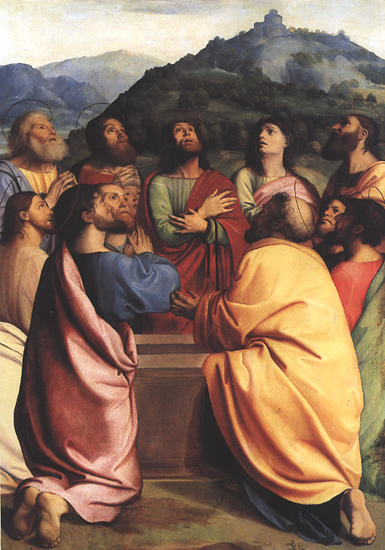
Albertino Piazza
(1490–1528)
Musical Meditation: Lord, You Give the Great Commission
In Luke–Acts, the Ascension and the church’s mission flow together as one moment. Jesus opens the Scriptures, promises the Spirit, names the disciples as His witnesses, and then ascends — handing the mission to them as He goes. That same sense of calling runs through “Lord, You Give the Great Commission,” which Jeffery Rowthorn wrote in 1978 for Yale and Berkeley Divinity School students who wanted a hymn that spoke honestly about ministry. Each verse lifts a direct saying of Jesus and turns it into a clear picture of the church’s work—teaching, healing, forgiving, serving, and staying hopeful—always grounded in the Spirit’s power rather than our own. Paired with Cyril Taylor’s confident tune ABBOT’S LEIGH, the hymn has become a favorite for ordinations, mission Sundays, and any moment when the church sends people out with purpose and heart.
This powerful version of the hymn is offered by the combined choirs of two Episcopal churches: Christ Church, Cambridge and Church of the Redeemer, Chestnut Hill (Massachusetts).
Note: The ELCA shares full communion with six U.S. church bodies: the Presbyterian Church (U.S.A.), the Reformed Church in America, and the United Church of Christ (all since 1997); the Moravian Church in America and The Episcopal Church (both since 1999); and the United Methodist Church (since 2009).
Lyrics
Verse 1
Lord, you give the great commission:
“Heal the sick and preach the word.”
Lest the church neglect its mission
and the gospel go unheard,
help us witness to your purpose
with renewed integrity:
With the Spirit’s gifts empower
us for the work of ministry.
Verse 2
Lord, you call us to your service:
“In my name baptize and teach.”
That the world may trust your promise,
life abundant meant for each,
give us all new fervor, draw us
closer in community:
With the Spirit’s gifts empower
us for the work of ministry.
Verse 3
Lord, you make the common holy:
“This my body, this my blood.”
Let us all, for earth’s true glory,
daily lift life heavenward,
asking that the world around us
share your children’s liberty:
With the Spirit’s gifts empower
us for the work of ministry.
Verse 4
Lord, you show us love’s true measure:
“Father, what they do, forgive.”
Yet we hoard as private treasure
all that you so freely give.
May your care and mercy lead us
to a just society:
With the Spirit’s gifts empower
us for the work of ministry.
Verse 5
Lord, you bless with words assuring:
“I am with you to the end.”
Faith and hope and love restoring,
may we serve as you intend,
and, amid the cares that claim us,
hold in mind eternity:
With the Spirit’s gifts empower
us for the work of ministry.
ELCA Commemoration This Week
Thursday 14 May: Matthias, Apostle
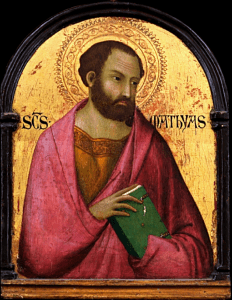
Matthias is the man chosen to replace Judas after Judas’ betrayal and death, and his story shows up only in Acts 1. The early believers wanted to restore the symbolic number of twelve apostles, so Peter laid out the criteria: the replacement had to be someone who had been with Jesus from the beginning and had witnessed the resurrection. Two men fit the bill — Joseph Barsabbas (called Justus) and Matthias. The community prayed, cast lots, and the lot fell to Matthias, which they understood as God’s choice. After that moment, Scripture doesn’t mention him again, and most of what people say about his later ministry comes from much later traditions, not the Bible itself. Matthias wasn’t a random pick; he was a long‑time follower of Jesus whose quiet faithfulness made him a natural fit. His story highlights how the early church trusted God’s guidance, valued faithful witness, and sought to continue Jesus’ mission even in a moment of uncertainty.
Source: GotQuestions.org, a website devoted to exploring questions regarding the Bible and Christianity.
Going Beyond: Digital Ministry
The Lectionary Study Group will meet Sunday (5.17) at 10:45 in the library. All are welcome!
Note: We will be taking a pause from Memorial Day through Labor Day. Look for further adult education announcements throughout the summer.
Are You Looking for a Church Home?
Evangelical Lutheran Church in Black River Falls, is part of the Northwest Synod of Wisconsin (ELCA). We stream our Sunday worship at 9:30 each week. Please feel free to join us!
All are welcome!
Access our YouTube Channel here.
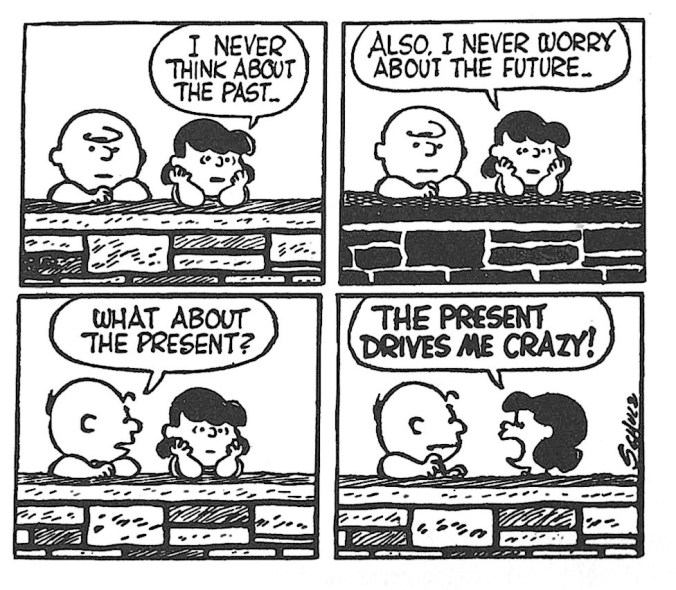
This cartoon from the pen of Charles Schulz is drawn from Robert L. Short’s 1968 classic, The Parables of Peanuts. As a history teacher, it reminded me of how tricky it can be to navigate the three time dimensions in our lives! As with many of Schulz’s cartoons, the message is timeless!