Velkommen!
Two Worlds began in February 2023 as an extension of an Intro to Bible Study class and a desire to better understand the Revised Common Lectionary. It has since become an anchor for Adult Study in our parish, offering a steady rhythm of scripture, reflection, and resources across the church year. Today, Two Worlds serves as a digital ministry space featuring the weekly RCL readings and a brief homily, supported by images, music, and the ELCA’s weekly commemorations.
The blog is authored by Paul Rykken in consultation with Pastor Jen Hatleli of Evangelical Lutheran Church in Black River Falls, Wisconsin.
The full three‑year cycle of the Lectionary is available on the Two Worlds Home Page.
Note: Images and lay-out tend to land better on a bigger screen.

The Pentecost 11 Readings
1 Kings 19: 9-18
Psalm 85: 8-13
Romans 10: 5-15
Matthew 14: 22-33
Readings are Linked
Approaching the Readings
The readings for Pentecost 11 trace a movement from fear and uncertainty toward renewed trust in God’s saving presence. Elijah’s encounter with God in the “sound of sheer silence” and the psalmist’s promise that steadfast love and faithfulness will meet both highlight how God comes with quiet mercy rather than spectacle. Paul’s teaching in Romans underscores that this mercy is meant to be proclaimed so others may call on the Lord and be saved. In Matthew, Jesus meets the disciples amid the storm, revealing that divine grace reaches people precisely when they are overwhelmed and invites them to step forward in faith.
Image of the Week
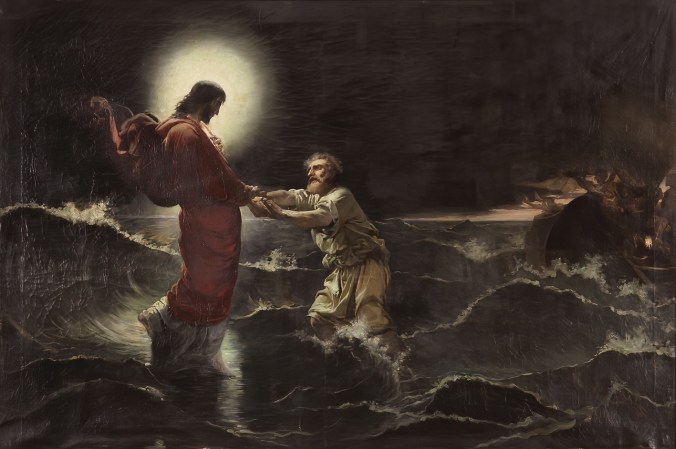
Virgilio Mattoni, a Sevillian painter active in the late 19th and early 20th centuries, was known for combining academic technique with a dramatic, almost theatrical sense of religious storytelling. In Christ Walking on the Waters at Iglesia de San Pedro, he heightens the miracle’s emotional tension by contrasting the turbulent, slate‑colored sea with Christ’s calm, illuminated figure, creating a visual theology of serenity confronting chaos. The disciples’ gestures—fear, astonishment, and desperate reaching—anchor the scene in human vulnerability, a hallmark of Mattoni’s narrative style. The composition ultimately emphasizes Christ’s stabilizing presence, using light, posture, and spatial depth to convey divine authority breaking into a world overwhelmed by uncertainty.
Five-Minute Homily
Listen to this week’s homily here.
Walking in Two Worlds
We are nearing the halfway point of the Season of Pentecost — the longest stretch in the church year — and Matthew has been guiding us through a series of miracle stories these past weeks. Diana Butler Bass, historian and theologian, reminds us that miracle stories always provoke questions. Were they real? Are they metaphors? Are miracles even possible? What makes a miracle a miracle? Those questions hover over every text we read in this season, including this week’s Gospel.
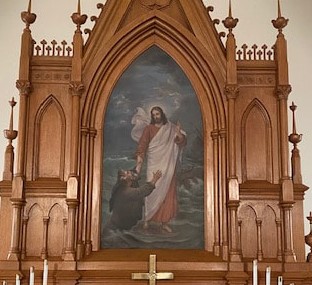
Matthew 14 invites us into one of the most vivid miracle scenes in Scripture — not only Jesus walking on the water (also found in Mark 6:45–52 and John 6:16–21), but Peter’s daring attempt to join him, a detail only Matthew preserves. Before we enter that moment, I find myself returning to a childhood memory. I still remember standing in a small country church as a child, staring at an altar painting of this week’s Gospel scene. It was not the church pictured here, but that is the image. Jesus walking on the storm‑tossed water captured my imagination long before I understood its depth.
The setting matters. After feeding the five thousand (Matthew 14:13–21), Jesus withdraws to pray (14:23) while the disciples sail across the Sea of Galilee. By nightfall, a brutal storm engulfs them (14:24). At dawn, with the wind still raging, they see a figure striding toward them on the waves. Terrified, they assume it’s a ghost (14:26). Jesus answers with that unforgettable reassurance: Take heart, it is I; do not be afraid (14:27). Biblical scholars note that some version of “do not be afraid” is the most repeated command in Scripture. Sit with that for a moment or two.
Then Peter steps forward. True to form, he wants proof. Lord, if it is you, command me to come to you on the water, he says (14:28), and he climbs out of the boat. For a moment, he walks. Then fear overtakes him, the waves rise, and he sinks (14:30). Jesus pulls him up, gently rebukes his doubt (14:31), and climbs into the boat. The storm stops. The disciples, stunned by what they have witnessed, proclaim him “Son of God” — the first time his followers use that title (14:33). What do we make of this whirlwind of a story? Let me offer two reflections.
First, Christians live in two worlds at once — the world we inhabit daily and the Kingdom that already claims us. Fear thrives in the earthly one. We fear danger, illness, change, failure, success, difference, loss, death, and the future itself. Fear traps us. Like Peter, we want to step out of the boat with confidence, trusting God to steady us. Yet our courage falters, distractions rise, and the waves swallow us. In those moments, our prayer becomes Peter’s cry: “Lord, save me!” Second, even when we falter, Jesus keeps moving toward us. He does not wait for us to master our fears or perfect our faith. He walks toward us in steadfast love, reminding us that we already belong to his Kingdom. That promise — sealed in baptism — strengthens us to face our fears with courage rooted not in bravado but in God’s presence. “Take heart, it is I. Do not be afraid.” That is a message worth carrying into the world, especially for those who most need to hear it.
Soli Deo Gloria.
Musical Reflection
This week’s Gospel reading from Matthew 14 immediately brought a beloved hymn to mind — Eternal Father, Strong to Save (you’ll find it in the ELW on page 756). The connection feels almost instinctive because the hymn was born out of real fear and real rescue at sea. William Whiting wrote the text in 1860 after surviving a violent storm; he wanted to comfort a student who dreaded ocean travel. His words lean heavily on biblical scenes where God shows mastery over chaotic waters, and John Bacchus Dykes’ tune Melita gave the hymn its solemn, maritime character. When you hear Whiting’s plea — “for those in peril on the sea” — it’s hard not to picture the disciples straining at the oars in Matthew 14, battered by wind and waves, or Peter stepping out of the boat only to sink beneath the storm. The hymn’s heartbeat is the same as that moment in the Gospel: human fear meeting divine presence. Just as Jesus reaches out to Peter with a steady hand, the hymn trusts that God still hears, still comes near, and still brings calm where chaos once ruled.
Lyrics
1 Eternal Father, strong to save,
Whose arm does bind the restless wave,
Who bids the mighty ocean deep
Its own appointed limits keep;
O hear us when we cry to Thee
For those in peril on the sea.
2 O Savior, whose almighty word
The winds and waves submissive heard,
Who walked upon the foaming deep,
And calm amid the rage did sleep;
O hear us when we cry to Thee
For those in peril on the sea.
3 O Holy Spirit, who did brood
Upon the waters dark and rude,
And bid their angry tumult cease,
And give for wild confusion peace;
O hear us when we cry to Thee
For those in peril on the sea.
4 O Trinity of love and pow’r,
Your children shield in danger’s hour;
From rock and tempest, fire, and foe,
Protect them where-so-e’er they go;
Thus, evermore shall rise to Thee
Glad hymns of praise from land and sea.
At President Jimmy Carter’s funeral on January 9, 2025, the hymn Eternal Father, Strong to Save was sung with a quiet, reverent weight that fit both the moment and the man. Carter had begun his adult life as a Navy submariner, and the hymn’s deep roots in naval tradition made it an especially fitting tribute. Its plea for God’s protection “for those in peril on the sea” echoed Carter’s own blend of humility, courage, and service that carried him from the military to the presidency and into decades of humanitarian work. In that setting, the hymn became more than music — it was a graceful acknowledgment of the faith and vocation that shaped his long public life.
ELCA Commemorations
Note: The ELCA commemorates a wide range of Christians throughout the year as a way of remembering that God has worked through ordinary people in every age. These commemorations — drawn from Scripture, the early church, the Reformation, and more recent history — invite us to see faith lived out in many different vocations and cultures. They aren’t about elevating “heroes,” but about widening our sense of the communion of saints and letting their witness encourage our own. In marking these days, the church pauses to give thanks, to learn, and to be reminded that the Holy Spirit continues to shape faithful lives in every generation.
You will find the full listing of them in the front of the ELW. Explore this week’s commemorations via the links provided under the dates.
Commemorations for the Week of 3 August
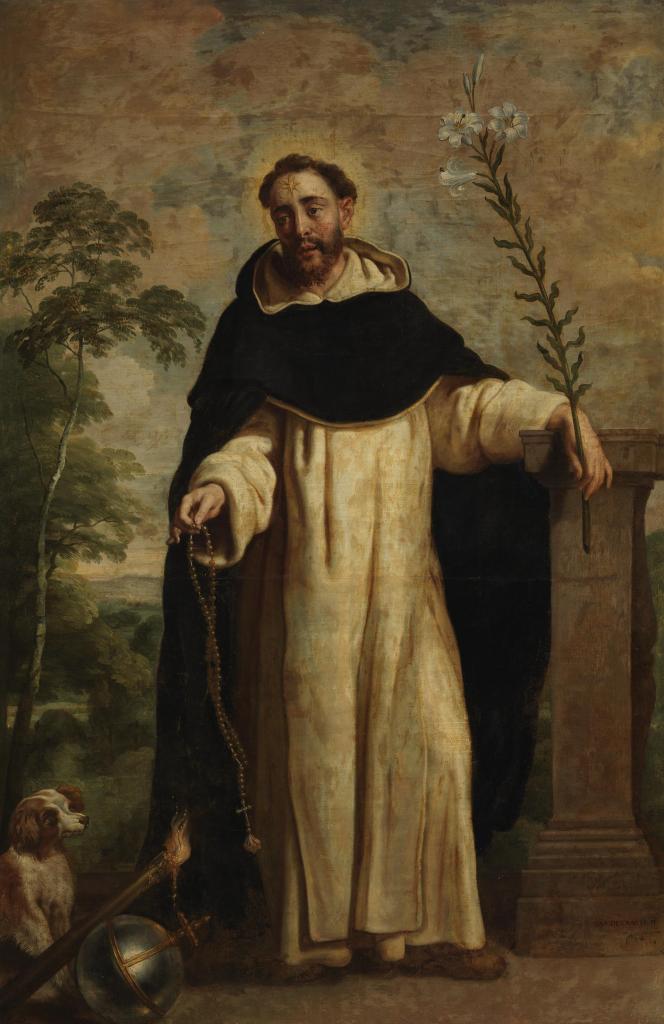
Dominic, Founder of the Order of Preachers (Dominicans) d. 8 August 1221
St. Dominic (1170–1221) was a Spanish priest whose compassion for people caught in spiritual confusion led him to found the Order of Preachers, better known as the Dominicans. He believed that preaching grounded in study, humility, and poverty was essential for renewing the church, especially in regions troubled by the Albigensian Movement. Dominic traveled constantly, teaching, debating, and forming communities devoted to learning and proclaiming the Gospel with clarity and joy. By the time of his death in Bologna, his order had already begun to spread across Europe, shaping Christian theology and education for centuries.
Visit the Dominican Friars Website Here!
The Congregation of the Most Holy Rosary of the Order of Preachers, also known as the Dominican Sisters of Sinsinawa, are derived from the Dominican Order and their Motherhouse is located in Sinsinawa, Wisconsin (southwestern corner).
Learn about them here!
Digital Ministry and News
We’re living in a moment when the tools of ministry have expanded far beyond the walls of any building. Digital platforms now allow Scripture, teaching, and community to reach people wherever they are. What once required physical presence can now be shared through video, messaging, and collaborative online study. This new landscape invites congregations to imagine ministry with a wider reach and a deeper sense of connection!
Explore Living Lutheran
Living Lutheran is the flagship magazine of the Evangelical Lutheran Church in America, offering stories, reflections, and reporting that explore how faith is lived out in daily life. It highlights the people, ministries, and global connections of the ELCA while engaging readers with thoughtful articles on theology, discipleship, justice, and contemporary issues. Designed to inform and inspire, the magazine serves as a gathering place for the diverse voices and experiences that shape Lutheran life today.
Visit the Living Lutheran Magazine Website
If you are seeking a church home or want to participate in our weekly on-line worship, subscribe to our YouTube Channel. All are welcome!
The Episcopal News Service
The ELCA shares full communion with six other church bodies: Presbyterian Church (USA), Reformed Church in America, United Church of Christ, Moravian Church in America, The Episcopal Church, and The United Methodist Church.
From their website: Episcopal News Service (ENS) offers in-depth reporting of local, regional, national and international news for Episcopalians and others interested in the church’s mission and ministry. Episcopal News Service is the official news source of the Episcopal Church.
