Spiritual Rhythms
“Dependable spiritual rhythms in life ground us in remarkable ways. Sometimes they morph into powerful habits that help hold life together and evade that inner fragmentation . . . Reliable rhythms matter biologically, relationally, and spiritually. Life can turn quickly sour without them.”
Peter W. Marty
From “Rhythms of Life,” by Peter W. Marty, editor/publisher of The Christian Century, August 2026.
ACCESS THE FULL ARTICLE
Navigate the Blog
- Pentecost 12 Readings
- Image of the Week
- Five-Minute Homily
- Musical Reflection
- ELCA Commemorations
- Digital Ministry

Two Worlds began in February 2023 as an extension of an Intro to Bible Study class and a desire to better understand the Revised Common Lectionary. It has since become an anchor for Adult Study in our parish, offering a steady rhythm of scripture, reflection, and resources across the church year. Today, Two Worlds serves as a digital ministry space featuring the weekly RCL readings and a brief homily, supported by images, music, and the ELCA’s weekly commemorations.
The blog is authored by Paul Rykken in consultation with Pastor Jen Hatleli of Evangelical Lutheran Church in Black River Falls, Wisconsin.
The full three‑year cycle of the Lectionary is available on the Two Worlds Home Page.
Note: Images and lay-out tend to land better on a bigger screen.
Pentecost 12 Readings
Isaiah 56: 1, 6-8
Psalm 67
Romans 11: 1-2a, 29-32
Matthew 15: (10-20) 21-28
Readings are Linked
Common Themes and Connections
The readings for Pentecost 12 converge around God’s expansive mercy and the widening of the covenant community. Isaiah and the psalm proclaim that God gathers outsiders and blesses all nations, revealing a divine intention that stretches far beyond Israel alone. Paul reflects on this same mystery, insisting that God’s gifts and calling are irrevocable and that both Jews and Gentiles stand within God’s saving purpose through mercy. In Matthew, Jesus’ encounter with the Canaanite woman dramatizes this widening circle, showing that persistent faith breaks through boundaries and reveals a God who ultimately refuses to exclude anyone.
Image of the Week
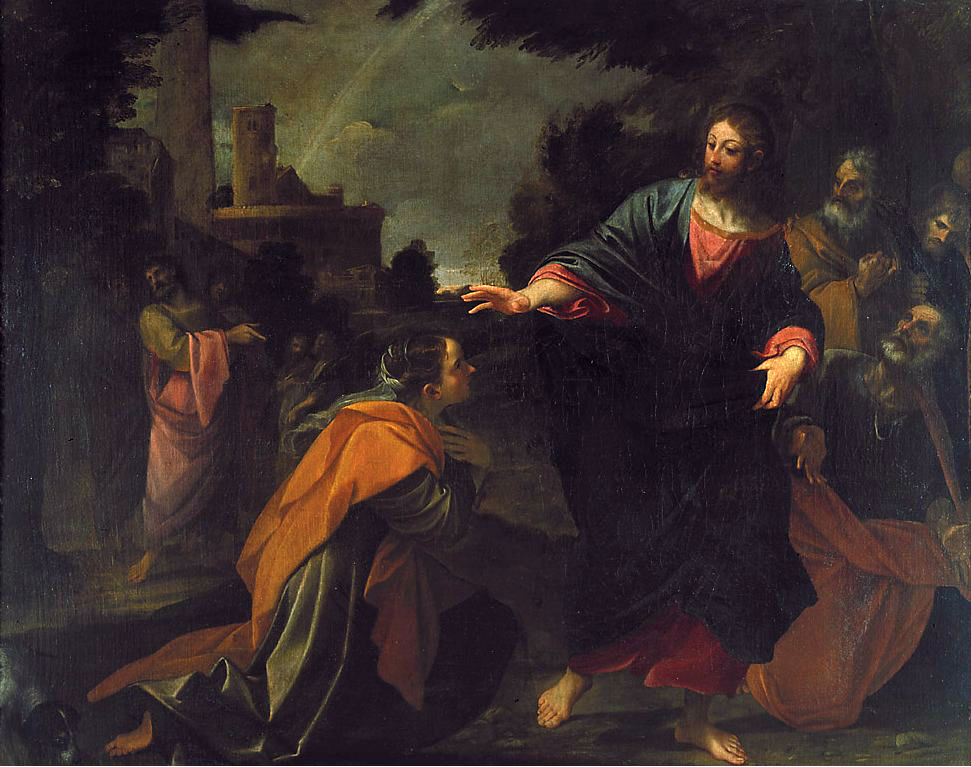
The story of Christ’s encounter with the Canaanite woman found in Matthew 15 is unsettling.
Ludovico Carracci leans into that tension by showing Jesus and the woman locked in a moment of raw human need and unexpected grace. The kneeling figure draws your eye immediately, her posture making the case for her daughter before she even speaks, while Jesus’ gesture suggests both challenge and invitation. Around them, Carracci fills the scene with onlookers whose mixed reactions mirror the discomfort in the Gospel itself — some curious, some resistant, some unsure what to make of this boundary‑breaking exchange. As a member of the influential Carracci family, Ludovico helped push Italian painting toward greater emotional realism, and you can feel that impulse here in the way he lets the drama play out through bodies, faces, and the charged space between them.
Five-Minute Homily
Isaiah 56 speaks with force into our moment. We live in a time when communities argue over who belongs, who is welcome, and how trust can be rebuilt after deep fractures. The prophet’s words cut through that noise. They remind us that God’s people have stood in this kind of uncertainty before — when institutions collapsed, when identity felt fragile, and when the future was anything but clear. Isaiah answers that anxiety with a call to justice, mercy, and wide‑open welcome.
To hear that call, we need to know where we are in Isaiah’s long prophetic story. The book unfolds across three eras. First Isaiah (1-39) speaks from eighth‑century Judah under the pressure of Assyria. Second Isaiah (40-55) speaks hope to exiles in Babylon. Third Isaiah (56-66) — where today’s reading begins — addresses those who have returned home and now face the hard work of rebuilding a broken society. Isaiah 56 stands at the threshold of that struggle. The exiles are back, but nothing is simple. The temple lies in ruins. Social divisions run deep. Debates about purity and belonging threaten to define the future. Into that fragile moment, the prophet announces that God’s salvation is already moving — and calls the people to embody it through justice, faithfulness, and a welcome that refuses to shut anyone out.
Samuel Giere of Wartburg Seminary sharpens this point: Isaiah 56 is a deliberate reset. It reopens the covenant and stretches it beyond every boundary the community had used to decide who counts. The foreigner and the eunuch — people long excluded by law, custom, and religious practice — are not just invited in. They are promised joy in God’s presence and given “a name better than sons and daughters.” The prophet is saying something bold: God’s renewed covenant is not a gated community. It is a gathering place. God’s blessing spills outward, reaching those who were once pushed aside. “My house shall be called a house of prayer for all peoples” (verse 7). That line is not a slogan. It is a mission. It tells Israel — and it tells us — that God’s future cannot be built by drawing tighter circles. It is built by practicing justice, keeping faith, and welcoming those who have been told they don’t belong.
This is where the Gospel comes alive. In Matthew 15, Jesus confronts boundary‑keeping of a different kind — purity rules that define who is clean, who is worthy, who is inside. He teaches that what defiles is not what goes into the mouth but what comes out of the heart. Then he meets a Canaanite woman whose persistence breaks open the disciples’ assumptions. Jesus steps across the boundary they thought was fixed. He embodies Isaiah’s vision: God gathers the outcasts — and then gathers “others besides those already gathered” (Isaiah 56:8).
So what does that mean for us? It means the church’s calling is not to guard the door but to widen it. Isaiah and Jesus both insist that God’s mercy is always moving outward. In a moment when our public life feels fractured and fearful, these texts invite us to trust that God is already gathering, already restoring, already breaking down the barriers we build. Our task is to live in that movement—to become communities where God’s wide mercy is not just preached but practiced, where strangers find joy, and where those once pushed aside discover that they are already at the center of God’s heart.
Soli Deo Gloria!
I am indebted to Samuel Giere for his interpretation of the Isaiah passage this week. He is an Associate Professor of Homiletics and Biblical Interpretation at Warburg Seminary in Dubuque Iowa. His article was from 2014 and was accessed from the Working Preacher website, sponsored by Luther Seminary in St. Paul, Minnesota.
Musical Reflection
Folliott S. Pierpoint wrote “For the Beauty of the Earth” in 1864 while walking near his home in Bath, England, struck by the spring landscape and wanting to create a simple hymn of gratitude for creation and the gifts of daily life. His original text was meant for Communion, which is why the refrain was “Christ, our God, to thee we raise,” though later hymnals broadened it for general use. More than a century later, John Rutter (1945– ) took Pierpoint’s words and shaped them into one of his most beloved choral pieces, full of the warm, flowing lines choirs love him for. Rutter grew up in London, studied at Clare College, Cambridge, and quickly became known for music that feels both polished and immediately singable. His setting of “For the Beauty of the Earth” remains a favorite because it captures Pierpoint’s simple joy while sounding unmistakably like Rutter — bright, grateful, and beautifully crafted. I hope you enjoy the version I posted here.
Lyrics
Verse 1
For the beauty of the earth
For the beauty of the skies
For the love which from our birth
Over and around us lies
Over and around us lies
Chorus
Lord of all, to thee we raise
This our joyful hymn of praise
Verse 2
For the beauty of the hour
Of the day and of the night
Hill and vale and tree and flower
Sun and moon and stars of light
Sun and moon and stars of light
Chorus
Lord of all, to thee we raise
This our joyful hymn of praise
Verse 3
For the joy of human love
Brother, sister, parent, child
Friends on earth and friends above
For all gentle thoughts and mild
For all gentle thoughts and mild
Chorus
Lord of all, to thee we raise
This our joyful hymn of praise
The Heartstrings Cello Ensemble is a small, collaborative group of cellists known for performances that blend warmth, clarity, and an easy sense of connection with audiences. Their sound leans into the natural lyricism of the cello, creating arrangements that feel both intimate and richly textured. The ensemble often mixes familiar classical repertoire with fresh, accessible selections that highlight the expressive range of the instrument. What sets them apart is the way their players listen to one another, shaping a unified sound that feels heartfelt, inviting, and true to their name.
Visit Their Website Here!
ELCA Commemorations
Note: The ELCA commemorates a wide range of Christians throughout the year as a way of remembering that God has worked through ordinary people in every age. These commemorations — drawn from Scripture, the early church, the Reformation, and more recent history — invite us to see faith lived out in many different vocations and cultures. They aren’t about elevating “heroes,” but about widening our sense of the communion of saints and letting their witness encourage our own. In marking these days, the church pauses to give thanks, to learn, and to be reminded that the Holy Spirit continues to shape faithful lives in every generation.
You will find the full listing of them in the front of the ELW. We have several commemorations this week, as noted.
Commemorations: Week of 10 August
Monday 10 August
Lawrence, deacon, martyr (d. 258)
Tuesday 11 August
Clare, Abbess of San Damiano (d. 1253)
Thursday 13 August
Florence Nightingale (d. 1910), Clara Maass (d. 1901); renewers of society
Friday 14 August
Maximilian Kolbe (d. 1941), Kaj Munk (d. 1944); martyrs
Saturday 15 August
MARY, MOTHER OF OUR LORD

Digital Ministry
We’re living in a moment when the tools of ministry have expanded far beyond the walls of any building. Digital platforms now allow Scripture, teaching, and community to reach people wherever they are. What once required physical presence can now be shared through video, messaging, and collaborative online study. This new landscape invites congregations to imagine ministry with a wider reach and a deeper sense of connection!
Explore Living Lutheran
Living Lutheran is the flagship magazine of the Evangelical Lutheran Church in America, offering stories, reflections, and reporting that explore how faith is lived out in daily life. It highlights the people, ministries, and global connections of the ELCA while engaging readers with thoughtful articles on theology, discipleship, justice, and contemporary issues. Designed to inform and inspire, the magazine serves as a gathering place for the diverse voices and experiences that shape Lutheran life today.
Visit the Living Lutheran Magazine Website
If you are seeking a church home or want to participate in our weekly on-line worship, subscribe to our YouTube Channel. All are welcome!
Background on the ELCA
The Evangelical Lutheran Church in America (ELCA) is a national church body made up of nearly 8,900 congregations across the United States and the Caribbean. It holds together a shared theology, mission, and public witness rooted in Lutheran tradition and shaped by a commitment to grace, justice, and service in the world. The ELCA is organized into 65 Synods, each serving as a regional expression of the church. Synods provide pastoral care and oversight for congregations and rostered ministers, support call processes, guide mission and ministry in their region, and connect local congregations to the wider work of the ELCA. In short, Synods are the bridge between local congregations and the national church—helping communities thrive, collaborate, and live out the gospel in their particular context.
Black River Falls ELC is a member of the Northwest Synod of Wisconsin.
