Navigate the Blog
- Pentecost 15 Readings
- Image of the Week
- Five-Minute Homily
- Musical Reflection
- Who Are We Commemorating This Week?
- Digital Ministry and Beyond
Two Worlds started in February 2023 as a simple extension of an Intro to Bible Study class and a desire to dig deeper into the Revised Common Lectionary. Today it’s a small digital ministry space that shares the RCL readings, a brief homily, and supporting images, music, and ELCA commemorations. The blog is authored by Paul Rykken in consultation with Pastor Jen Hatleli of Evangelical Lutheran Church in Black River Falls, Wisconsin.
Note: The blog lands more naturally on a larger screen.
Reflect on This . . .
“Luther revolutionized the understanding of the laity and clergy and introduced the concept of vocation and the understanding of “everyday worship”, where one serves God through one’s daily tasks and work, for the good of the community. He did this by highlighting that everyone is called to serve God with their lives and work.”
Rev. Dr. Anne Burghardt
Lutheran World Federation
Note: I drew this quote from an address delivered by Dr. Burghardt in South Africa, August 2026. The full text is linked at the end of the blog.
Pentecost 15 Readings
Common Themes and Connections
The common thread running through these Pentecost 15 readings is a sober but hopeful reckoning with sin—not as a topic for shame or avoidance, but as a reality that calls for truthful speech, renewed desire, and communal repair. Ezekiel names sin plainly as the path that leads to death, yet God’s desire is always that people turn and live, which makes honest warning an act of love rather than judgment. Psalm 119 internalizes this struggle, portraying sin as the pull of “selfish gain” and misplaced desire, countered by a heart taught and shaped by God’s way. Paul and Matthew both press this into daily life: Romans insists that love is the antidote to sin’s distortions and urges believers to “wake up” from the numbing habits that keep them from God, while Matthew frames sin within community relationships, where confrontation, forgiveness, and reconciliation become the means by which Christ remains present among his people.
Ezekiel 33: 7-11
Psalm 119: 33-40
Romans 13: 8-14
Matthew 18: 15-20
Readings are Linked
Image of the Week
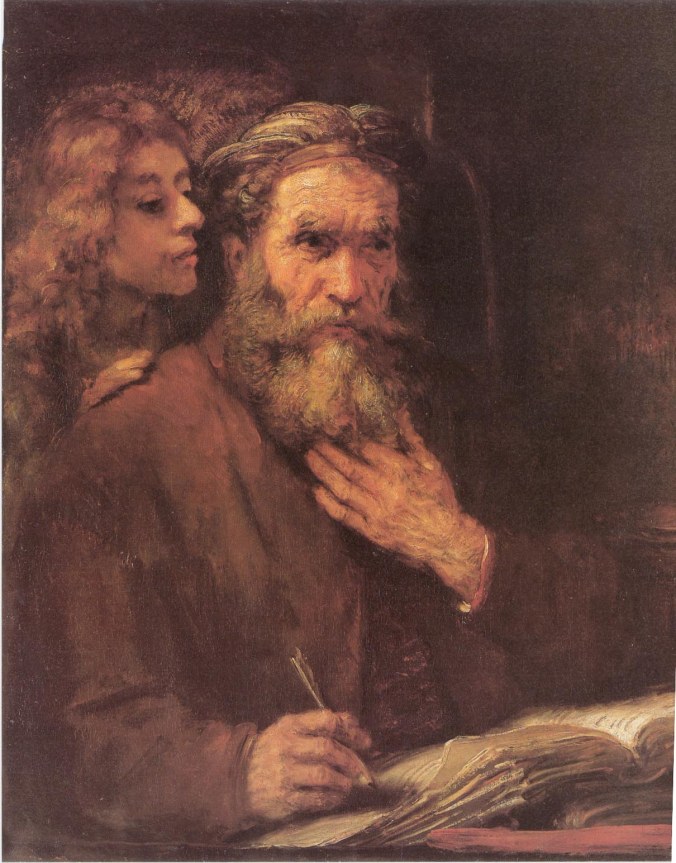
Rembrandt’s Saint Matthew Inspired by an Angel feels almost like you’ve walked in on a quiet moment: Matthew is hunched over his writing, and an angel leans in close, as if sharing a last‑minute tip or gentle nudge. The whole scene has that late‑Rembrandt vibe—earthy colors, loose brushwork, and a focus on mood rather than fancy details. By 1661, Rembrandt had weathered plenty of personal and financial trouble, and you can sense that introspective, human-centered approach in the way he paints Matthew as a thoughtful, slightly weary man doing his best to capture something divine. Today the painting hangs in the Louvre, still radiating that mix of mystery and tenderness that Rembrandt was so good at.
Five-Minute Homily
Pentecost 15: “When Truth Meets Compassion”

“There’s never any shortage of sin in the world.” My father, Thor “Unk” Rykken, used to say that with a grin that suggested he’d seen plenty of evidence. He certainly wasn’t wrong. Sin is always nearby, and we usually spot it in someone else long before we recognize it in ourselves. This week’s readings don’t let us dodge the topic — they show us how God confronts sin and how we’re called to do the same.
Ezekiel knew what it meant to name sin out loud. God asked him to warn Israel during the Babylonian Captivity, a job most of us would avoid — how would you react to someone shouting at us on the church steps about repentance? Yet Ezekiel 33:11 reveals the heart behind the hard words: God takes no pleasure in anyone’s downfall but longs for us to turn and live. Luther loved that verse because it exposes the grace beneath the judgment — God doesn’t want us stuck in misery or wandering in the dark. Even when sin is real and its consequences unavoidable, God’s desire is always life. Paul’s message in Romans 13 shifts the focus from warning to transformation. For people shaped by 613 commandments (can you imagine?), the idea that love fulfills the entire law must have felt like switching from a thousand‑page manual to a sticky note. The command to “love your neighbor as yourself” wasn’t new, but Jesus embodied it so completely that Paul could say love dismantles sin’s power. Sin shrinks life; love expands it. Sin isolates; love wakes us up and pulls us into community.

Finally, Matthew’s Gospel brings sin into the daily life of the church, where conflict is inevitable and usually uncomfortable. Jesus doesn’t treat conflict as a scandal to hide but as a place where honesty and dignity must meet. His three‑step process is practical and surprisingly calm: speak privately, then with witnesses, then with the community. And if reconciliation still fails, treat the person “as a gentile and a tax collector” — which, given Jesus’ dinner companions, may mean holding them with both truth and stubborn compassion. Relationships in Christ carry eternal weight, and how we handle sin between us shapes the health of the whole body.
As a lifelong teacher and coach, I’ve learned the difference between reacting and responding. Reacting is quick, emotional, and usually fueled by the sense that we’ve been wronged — something sin loves to amplify. Responding takes a breath, steps back, and chooses firm compassion, the kind of “tough love” that still protects dignity. That’s the spirit of Jesus’ teaching: deal with sin honestly but do it in a way that keeps the door open to grace. In a world overflowing with conflict, that approach feels not only wise but urgently needed.
Soli Deo Gloria
Musical Reflection

When I heard of Dolly Parton’s death this week, my first thought was, “She carried Jesus into the world.” I don’t know all the details of her denominational background, but she spoke openly about her faith in Jesus Christ in a refreshing way and grew up in a deeply religious Tennessee family shaped by gospel music, Scripture, and the witness of her grandfather, Rev. Jake Owens. She often said she grew up knowing Jesus loved her and believing that through God all things were possible — an outlook that shaped both her music and the way she treated people. Her song, Light of a Clear Blue Morning, was written during a tumultuous period in her life in the 1970s. It resonates so deeply with Christians because it captures that unmistakable movement from darkness into hope — the very arc of the Gospel story — think resurrection.
Lyrics
It’s been a long dark night
And I’ve been a-waitin’ for the mornin’
It’s been a long hard fight
But I see a brand new day a-dawning
I’ve been looking for the sunshine
You know I ain’t seen it in so long
But everything’s gonna work out just fine
And everything’s gonna be all right
That’s been all wrong
‘Cause I can see the light of a clear blue morning
I can see the light of a brand new day
I can see the light of a clear blue morning
Oh, and everything’s gonna be all right
It’s gonna be okay
It’s been a long, long time (ooh, ooh, ooh)
Since I’ve known the taste of freedom
Those clinging vines (ooh, ooh, ooh)
That had me bound, well I don’t need ’em, oh
I’ve been like a captured eagle
You know, an eagle’s born to fly
Now that I have won my freedom
Like an eagle, I am eager for the sky
But I can see the light of a clear blue morning
I can see the light of brand new day
I can see the light of a clear blue morning
Oh, and everything’s gonna be all right
It’s gonna be okay
I can see the light of a clear blue morning
I can see the light of a brand new day
I can see the light of a clear blue morning
Oh, and everything’s gonna be all right
Everything’s gonna be all right
Everything’s gonna be all right
It’s gonna be okay
But I can see the light of a clear blue morning
I can see the light of a brand new day
I can see the light of a clear blue morning
Oh, and everything’s gonna be all right
Everything’s gonna be all right
Everything’s gonna be all right
It’s gonna be okay
And I can see the light of a clear blue morning
I can see the light of a brand new day
I can see the light of a clear blue morning
Everything’s gonna be all right
Everything’s gonna be all right
Everything’s gonna be all right
It’s gonna be okay
There are several versions of this song out there — this one is a favorite of mine. It features Dolly with a star-studded cast: Lainey Wilson, Miley Cyrus, Queen Latifah and Reba McEntire, along with David Foster on piano and Christ Church Choir on background vocals. When the song hits the 2:30 mark, you may want to dance!
Enjoy!
Who Are We Commemorating This Week?
Note: The ELCA commemorates a wide range of Christians throughout the year as a way of remembering that God has worked through ordinary people in every age. These commemorations — drawn from Scripture, the early church, the Reformation, and more recent history — invite us to see faith lived out in many different vocations and cultures. They aren’t about elevating “heroes,” but about widening our sense of the communion of saints and letting their witness encourage our own. In marking these days, the church pauses to give thanks, to learn, and to be reminded that the Holy Spirit continues to shape faithful lives in every generation.
You will find the full listing of them in the front of the ELW.
Commemorations: Week of 31 August
Wednesday 2 September
Nikolai Frederick Severin Grundvig, bishop, renewer of the church (d. 1872)
Follow this Link for Further Information
Grundtvig was a Danish pastor and writer who believed regular people deserved a chance to learn, grow, and shape their communities—not just those who went to universities. His ideas led to the creation of folk high schools, places where adults could live, study, sing, debate, and explore history and culture without the pressure of grades or exams. At their heart, these schools were about waking people up to their own gifts and helping them take part in the life of a healthy democracy.

Digital Ministry and Beyond
We’re living in a moment when the tools of ministry have expanded far beyond the walls of any building. Digital platforms now allow Scripture, teaching, and community to reach people wherever they are. What once required physical presence can now be shared through video, messaging, and collaborative online study. This new landscape invites congregations to imagine ministry with a wider reach and a deeper sense of connection. At the same time, we need to find the balance with ongoing in-person efforts!
Lutheran World Federation
The Lutheran World Federation (LWF) is a global communion of Lutheran churches formed in 1947 to strengthen cooperation in theology, mission, and humanitarian work across more than 99 countries. The ELCA has been a full and active member since its founding in 1988, inheriting earlier U.S. Lutheran participation in the LWF through predecessor church bodies. Through this relationship, ELCA congregations are connected to worldwide ministries of relief, advocacy, and ecumenical partnership carried out in the name of a shared Lutheran witness.
This document I shared below is a 2026 talk from Rev. Dr. Anne Burghardt, the General Secretary of the Lutheran World Federation, shared with Lutheran leaders from across Africa. She’s basically naming the tough stuff churches are facing—political division, rising authoritarianism, and pressure on communities—and urging leaders to lean into servant leadership rather than power‑driven models. Throughout the address, she keeps tying local challenges back to the wider global Lutheran family, reminding everyone that they’re part of a communion working together for justice, dignity, and faithful leadership.
READ THE FULL ADDRESS HERE
In-Person Opportunities
As we turn the page into September, we’re refreshing our adult education opportunities at ELC as we continue creating spaces where members can explore Scripture and connect faith to daily life. Our digital ministry—including Two Worlds, the weekly lectionary blog — remains part of that effort. Beginning in September, Sundays from 11:00–11:45 a.m. will be dedicated to Faithful Conversations, a renewed rhythm of study shaped by three strands: Lutheran Theology, History, and Spiritual Disciplines. We’ll begin with a four‑week book study of Real Faith for Real Life (27 September–18 October), followed by a one‑day Reformation session on Martin Luther (25 October), a four‑week exploration of the lectionary (1–29 November), and a five‑week study of the Augsburg Confession (10 January–7 February 2027).

If you are interested in ordering the book for our first go-round, follow the link below. We will also have several copies available. We will revisit a study the book from three years ago — it remains remarkably relevant.
ORDER YOUR COPY HERE!
