Where Are We in the Lectionary Calendar?
Next Sunday we celebrate The Holy Trinity. Beyond that, we have entered the Season of Pentecost, or Ordinary Time, which stretches across the entire second half of the Lectionary year until Advent begins Year B. This long green season focuses on growth, mission, and the Spirit‑shaped life of the church.
Matthew is highlighted in Year A, so nearly all the Gospel readings between now and the end of November come from the first of the Gospels. As an introduction to Matthew, take time to watch the video here — this is part one and I will post part two next week. If you are not familiar with The Bible Project, Mackie and Collins do an excellent job!

The Bible Project is a nonprofit, crowdfunded organization that creates free videos, podcasts, articles, and classes to help people experience the Bible as a unified story that leads to Jesus. It uses visual storytelling and deep biblical scholarship to explain literary design, key themes, and the historical context of Scripture in an accessible way. Founded by Tim Mackie and Jon Collins in 2014, it has since produced hundreds of resources in more than 50 languages to help people become lifelong students of the Bible.
BibleProject Website
Thanks for your visit!
Two Worlds is a digital ministry space where I share the weekly Revised Common Lectionary readings and a brief homily with supporting images and music. As a nod to our history, I also include the ELCA’s commemorations for the week. Most images come from Wikimedia Commons, and I utilize Copilot for some aspects of the research and writing.
The project grows out of ongoing conversation with Pastor Jen Hatleli of ELC in Black River Falls — a dialogue first sparked by a 2023 Bible Study that set this whole thing in motion.
This Week’s Readings (Linked) and Themes
The Holy Trinity
Genesis 1:1 – 2:4a
Psalm 8
2 Corinthians 13: 11-13
Matthew 28: 16-20
The Trinity readings trace a single arc: God creates, crowns humanity with dignity, and then sends the Church into the world wrapped in divine presence. Genesis 1 reveals the relational God whose Word and Spirit bring creation to life, while Psalm 8 marvels that this majestic Creator entrusts such glory to human beings. 2 Corinthians 13 turns that wonder into a blessing, naming the grace of Christ, the love of God, and the fellowship of the Spirit as the Church’s shared life. And in Matthew 28, Jesus commissions his followers to baptize into the name—singular—of Father, Son, and Holy Spirit, completing the picture of a God who creates, redeems, and accompanies his people.
Luther Commenting on the Trinity
“Therefore, we should not dispute about how it can be that God the Father, the Son, and the Holy Spirit are One God, for it is by its very nature beyond all reason, but it should be enough for us that God speaks thus about Himself and reveals Himself thus in His Word. This is a strengthening message, and it should make our hearts joyful towards God. For we see that all three Persons, the whole Godhead, turns Himself to us in order that we poor wretched people should be helped against sin, death, and the devil, that we may be brought to justification, the Kingdom of God, and eternal life.”
(From Luther’s sermon on John 3)
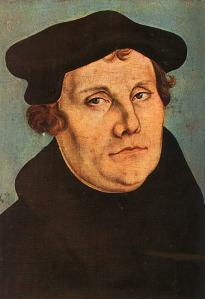
(1483-1546)
Three-Minute Homily: “Living Inside the Mystery”
“God of heaven and earth, before the foundation of the universe and the beginning of time you are the triune God: Author of creation, eternal Word of salvation, life-giving Spirit of wisdom. Guide us to all truth by your Spirit, that we may proclaim all that Christ has revealed and rejoice in the glory he shares with us. Glory and praise to you, Father, Son, and Holy Spirit, now and forever. Amen.” (ELW, p. 37)
Holy Trinity Sunday drops us right into the deep end. One God. Three persons. A mystery we name every week but never quite pin down. The prayer offered above, rooted in the old Anglican Collects and carried into our ELW, reminds us that when we speak of the Trinity, we’re stepping into a centuries‑long conversation. Working with these texts this week took me back to my Concordia College religion classes in the mid‑70s, where early church debates swirled far above my teenage understanding. One of the fiercest was Arianism — the claim that Jesus was created by God and not fully one with God. For those of us raised in Lutheran pews, the unity of Father, Son, and Holy Spirit can feel like background music. But it wasn’t. It was contested, defended, and eventually confessed as the heart of Christian faith.
That’s why the creeds matter. In the ELCA, we adhere to the three ecumenical creeds. The Apostles’ Creed gives us the basic frame. The Nicene Creed, hammered out in 325, sharpens it: the Son is “of one being with the Father,” the Spirit “the giver of life.” And the Athanasian Creed — our most detailed and demanding — insists that the Three are not blended, not divided, but one God in perfect unity. I’m grateful we don’t recite that one every Sunday, but its very intensity shows how central the Trinity is to Christian identity. Still, doctrine alone can’t carry the whole weight. Martin Marty puts it simply: the Trinity teaches us about relationship.** God is not solitary. God is communion — Creator, Redeemer, Advocate — love shared and overflowing. And when we invoke the Trinity, we’re drawn into that divine life so we can live it out with one another. And this isn’t just ancient history. Our own Lutheran World Federation continues dialogues with Roman Catholic and Orthodox churches — conversations that have already borne fruit, like the Joint Declaration on the Doctrine of Justification. These dialogues still take up Trinitarian questions: the Holy Spirit, the nature of the Church. In other words, the Trinity still shapes the Church’s life today.
So on this Holy Trinity Sunday, we don’t try to solve the mystery. We let it shape us. We let the creeds, the prayer, and the long witness of the Church remind us that God’s very being is relationship — endless joy and love shared among Father, Son, and Holy Spirit, and poured out for the life of the world. One God. Three persons. And a love big enough to hold us all.
Soli Deo Gloria!
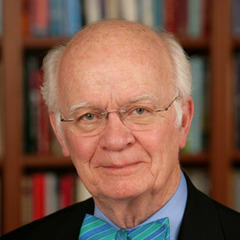
**My reference to Martin Marty (1928-2025) comes from his terrific book, Lutheran Questions, Lutheran Answers (Augsburg Fortress, 2007). Marty, pictured here, was a remarkable theologian and writer. His son, Peter Marty, is the editor The Christian Century.
Image of the Week: Medieval Depiction of the Trinity
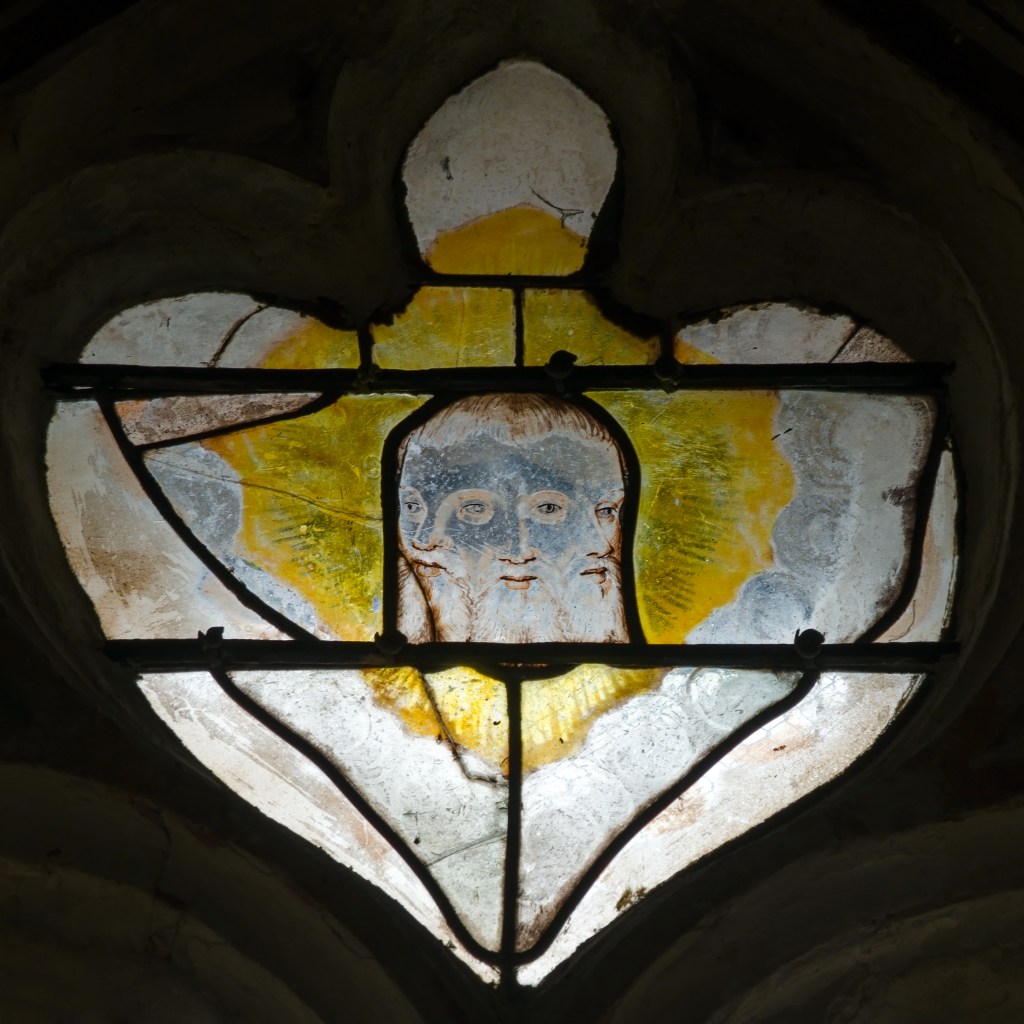
This window from the church in Courgenard — a small village in the Sarthe region of northwestern France — shows a classic medieval way of picturing the Trinity known as the “Throne of Grace.” Beginning in the 1100s, Western artists used this image of God the Father holding the crucified Christ with the Holy Spirit as a dove to help ordinary worshipers visualize the mystery of God’s self‑giving love. It grew out of a period when the Church was working hard to express the unity of the Trinity while still honoring the distinct roles of Father, Son, and Spirit. The fact that this window survives in a rural parish reminds us how even small communities were shaped by the major theological currents of the Middle Ages.
Musical Meditation: The Battle Hymn of the Republic
In the lead-up to July 4th, I plan to feature music drawn, in part, from the National Songs section of Evangelical Lutheran Worship (Hymns 887–893), or other songs that have that flavor.
As we approach the 250th anniversary of the Declaration of Independence, this feels like a fitting season to pause, listen, and reflect on our nation’s story—its beauty, its complexity, and the ongoing work of shaping a more just and generous common life. These hymns give us a way to hold together gratitude for our homeland with a wider, prayerful awareness of the world God loves.
The Battle Hymn of the Republic was born in the early days of the Civil War, when Julia Ward Howe heard Union soldiers belting out the rough‑and‑ready marching tune John Brown’s Body. She loved the energy but thought the lyrics could use an upgrade, so later that night she woke up with lines “singing” in her head and wrote a new text that wrapped the Union cause in bold, biblical language. When her version appeared in The Atlantic Monthly in 1862, it instantly reframed the war as a moral crusade, pairing a revival‑style melody with a sense of divine purpose. That mix of faith, fire, and patriotism helped the song take on a life of its own — echoing through rallies, churches, and even state funerals for generations. I hope you will appreciate this beautiful piano interpretation by Sangah Noona.
Sangah Noona is a South Korean–born pianist (born 1987) whose blend of classical training and wide‑ranging musical taste has made her a standout presence on YouTube. She built her early career in Seoul as a session musician and hotel pianist before moving to the United States, where her livestreams and genre‑spanning performances drew a large, loyal following. Known for her expressive touch and easy rapport with listeners, she moves comfortably from Chopin to jazz standards to rock requests without losing her signature warmth.
Visit Noona’s Website Here
ELCA Commemorations This Week
Note: The ELCA commemorates a wide range of Christians throughout the year as a way of remembering that God has worked through ordinary people in every age. These commemorations—drawn from Scripture, the early church, the Reformation, and more recent history—invite us to see faith lived out in many different vocations and cultures. They aren’t about elevating “heroes,” but about widening our sense of the communion of saints and letting their witness encourage our own. In marking these days, the church pauses to give thanks, to learn, and to be reminded that the Holy Spirit continues to shape faithful lives in every generation. You will find the full listing of them in the front of the ELW.
Wednesday 27 May
John Calvin, renewer of the church (d. 1564)
Friday 29 May
Jiri Tranovsky, hymnwriter (d. 1637)
Sunday 31 May
Visit of Mary to Elizabeth
Explore each by following the link!
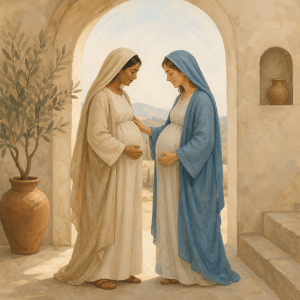
(A.I. Generated Image, 2026)
Going Beyond: Digital Ministry and Beyond
From Henri Nouwen
“Celebrating means the affirmation of the present, which becomes fully possible only by remembering the past and expecting more to come in the future. But celebrating in this sense very seldom takes place. Nothing is as difficult as really accepting one’s own life. More often than not the present is denied, the past becomes a source of complaints, and the future is looked upon as a reason for despair or apathy. When Jesus came to redeem mankind, he came to free us from the boundaries of time. Through him it became clear not only that God is with us wherever our presence is in time or space, but also that our past does not have to be denied but can be remembered and forgiven, and that we are still waiting for him to come back and reveal to us what remains unseen.“
Visit the Henri Nouwen Society Website
Our in-person Lectionary Discussion Group at ELC will be taking a pause from Memorial Day through Labor Day.
We will use this time to formulate adult education experiences for the fall of 2026 and beyond. Look for further adult education announcements throughout the summer.
(Charles Schulz)
