Navigate Two Worlds Here
- RCL Calendar and Sunday’s Readings
- Four-Minute Homily: “The Courage to Discern”
- Image: “Jews Mourning the Babylonian Exile”
- Musical Reflection: “Before You, Lord, We Bow”
- ELCA Commemorations This Week
- Going Beyond: In Person and Digital Resources
Welcome and Thanks for your Visit!
Two Worlds is a digital ministry space featuring the weekly Revised Common Lectionary readings and a brief homily, supported by images, music, and the ELCA’s weekly commemorations. Visuals come primarily from Wikimedia Commons, and I utilize Copilot (Microsoft A.I. assistant) for both research and editing. The blog reflects ongoing dialogue with Pastor Jen Hatleli of ELC in Black River Falls and was first prompted by a 2023 Bible Study that set this work in motion.
From Tish Harrison Warren
(Anglican priest and author)

“The world-renowned cellist Pablo Casals was asked why he continued to practice his instrument four or five hours a day at eighty-three years old. ‘Because I think I am making progress,’ he replied. To devote oneself fully to any craft requires the effort of a lifetime. As long as there is breath in you, my husband reminds me when I’m most discouraged, God is not finished with you — his work continues in and through you.”
This quote is from Warren’s 2026 book, What Grows in Weary Lands: On Christian Resilience. It’s a marvelous book and I highly recommend it!
RCL Calendar and Sunday’s Readings

Luther and the Psalms
“Luther loved the Psalms, first lecturing on them in 1513–1516. His immersion in the Psalms certainly impacted the events of 1517. After the Ninety-Five Theses, Luther returned to the Psalms again and again. He started a practice of reading the Psalms through the day at seven designated times. This enabled him to read through the Psalter in two weeks. He kept disciplined at that practice throughout most of his life. He read the Psalms hundreds of times.“
Stephen J. Nichols
Tabletalk Magazine
(September 2024)
Common Themes This Week
The readings for 5 Pentecost lean hard into the theme of true allegiance — what it looks like to stand with God when competing voices promise easier paths. Jeremiah exposes the tension between comforting falsehoods and the costly truth, while Psalm 89 anchors the community in God’s steadfast love and faithfulness as the only reliable ground. Paul pushes this further by insisting that real freedom comes not from doing whatever we want but from offering ourselves to God in a way that reshapes our desires and our actions. Jesus then brings it home by teaching that receiving his messengers — and offering even the smallest act of mercy — reveals a life aligned with God’s kingdom, where faithfulness is measured in both loyalty and hospitality.
Pentecost 5 (Year A)
First Reading:
Jeremiah 28: 5-9
Psalm 89: 1-4, 15-18
Second Reading (Epistle)
Romans 6: 12-23
Gospel:
Matthew 10: 40-42
Readings are Linked
Four-Minute Homily: “The Courage to Discern”
When the Lectionary drops us into the prophets, I often feel like I’m back in college, pounding on the glass while my basketball teammates carried on conversations I couldn’t follow. “Let me in!” was our running joke, and honestly, I still feel that way when I hit certain Old Testament passages. This week’s reading from Jeremiah — his clash with the false prophet Hananiah — had me tapping the glass again.
First, some background. The prophetic books are dense with history and mystery. Prophets weren’t fortune‑tellers; they were God’s messengers, calling out idolatry, summoning people to repentance, and insisting on justice. Their writings stretch across three centuries (roughly 760 – 460 BCE), framed by Israel’s exile and eventual restoration. Jeremiah stands among the four Major Prophets (Isaiah, Ezekiel, and Daniel are the other three), while twelve others form the Minor Prophets (Hosea, Joel, Amos, Obadiah, Jonah, Micah, Nahum, Habakkuk, Zephaniah, Haggai, Zechariah, and Malach). Together they form a chorus of warning, lament, and hope.
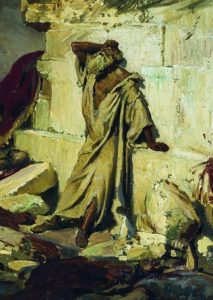
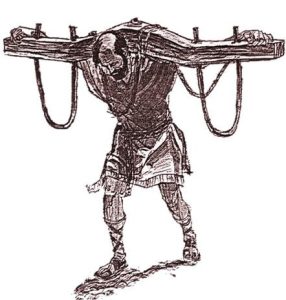
Jeremiah himself lived through seismic upheaval: the fall of Assyria, the rise of Babylon, and the brutal deportations known as the Babylonian Captivity. Nebuchadrezzar destroyed Solomon’s temple in Jerusalem (586 BCE), the heart of Israel’s spiritual life. Jeremiah, called by God before birth, interpreted these events as the consequence of Israel’s unfaithfulness. His message isolated him, yet he stayed faithful to the call. That’s the backdrop for this week’s tense exchange. In Jeremiah 28, the year is 593 BCE. King Zedekiah sits on a shaky throne. Hananiah steps forward with a message everyone wants to hear: the exile will end in two years, Babylon’s power will crumble, and all will be well. Jeremiah responds with what sounds like dry, prophetic sarcasm — “Amen… may the Lord do so” — but he doesn’t buy it. Then comes the dramatic moment: Hananiah grabs the wooden yoke Jeremiah is wearing, breaks it, and declares that God will shatter Babylon the same way. Jeremiah walks away, but God sends him back with a hard truth: Hananiah has spoken rebellion, not revelation — his words were comforting, but false. Within months, Hananiah is dead.
So what do we do with this strange, ancient confrontation? What does it say to us now? First, Jeremiah’s message still resonates. He calls us to keep God first, to reject the idols we craft — status, certainty, political identity, even religious performance. He calls us to repentance. He calls us to love our neighbors, pursue justice, and refuse the easy path of self‑deception. Jesus himself echoes Jeremiah when he overturns the moneychangers’ tables, quoting Jeremiah 7:11. Second, the story warns us about false prophets — those who tell people exactly what they want to hear. Hananiah offered comfort without truth, reassurance without repentance. We swim in a digital world thick with misinformation, half‑truths, and voices claiming moral or spiritual authority. Some even blend religious language with political ambition, a modern form of idolatry. Discernment isn’t optional; it’s a spiritual discipline. And finally, Jeremiah reminds us that the prophets were always pointing forward. They glimpsed the coming Messiah long before Bethlehem. That thread runs straight into this week’s Gospel, where Jesus speaks across time: “Whoever welcomes you welcomes me, and whoever welcomes me welcomes the one who sent me.” The same God who breathed through Jeremiah breathes through Christ — and still breathes through us 2,600 years later.
Soli Deo Gloria.
Image: “Jews Mourning the Babylonian Exile“
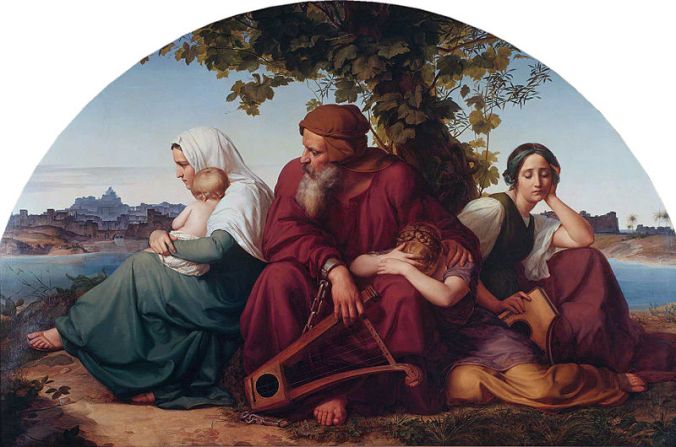
Eduard Bendemann’s Jews Mourning the Babylonian Exile (1832) captures a sad moment in history — a group of Judean exiles slumped along the banks of the Euphrates, their harps hanging unused — an unmistakable nod to Psalm 137’s “How can we sing the Lord’s song in a foreign land.” Bendemann was in his early twenties when he painted it, a German artist of Jewish heritage working in the Romantic era, drawn to big emotional themes and stories of a people pushed to the edge. You can see that sensibility here: the muted colors, the stillness, the way every figure seems caught between despair and stubborn hope. The painting helped launch his career, and it also reflects a 19th‑century fascination with the Hebrew Scriptures as a mirror for national identity, suffering, and resilience. It’s a deeply human scene — ancient grief rendered by a young artist who understood something about longing and loss.
Musical Reflection: “Before You, Lord, We Bow“
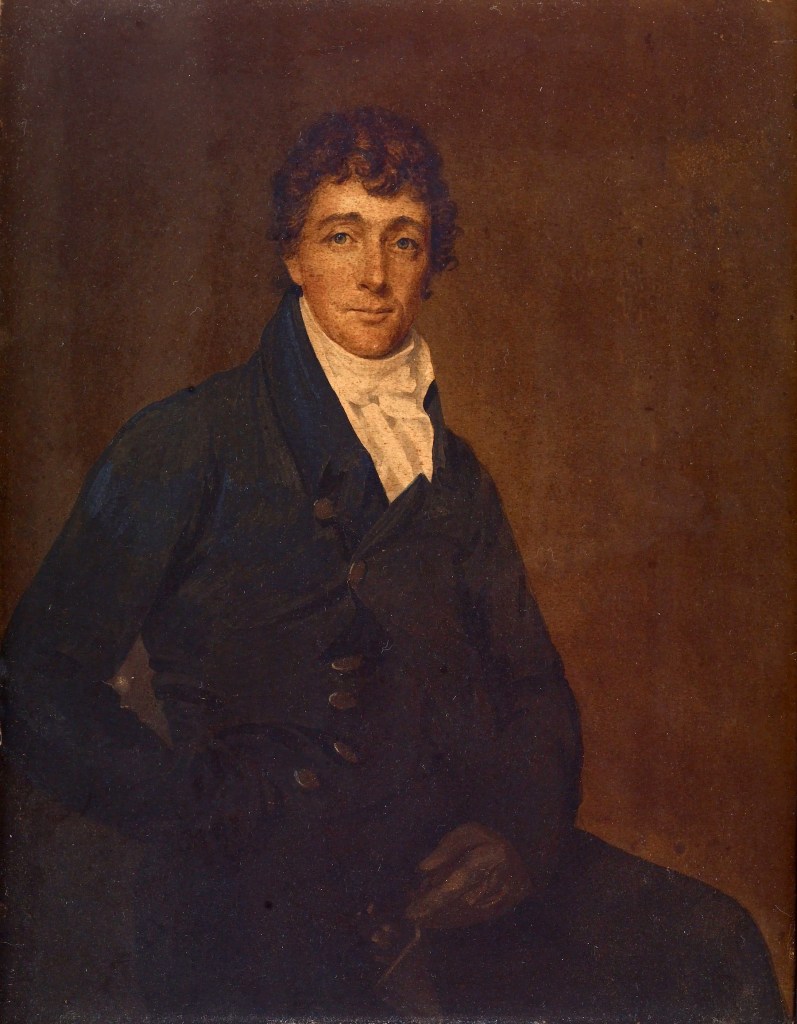
by Joseph Wood
The backstory of hymns is often fascinating and offers context that enlivens our hearing or singing. Francis Scott Key’s legacy is a complicated one. A devout Christian best known for The Star‑Spangled Banner, he also wrote hymns, including Before You, Lord, We Bow, composed in 1812 amid a young nation’s turmoil. The hymn reveals a different side of Key — less patriotic triumph, more humility and repentance — yet, like many of his generation, his life held deep contradictions: he enslaved people and defended slavery in court even as he spoke of moral responsibility and national accountability before God.
As we approach the 250th anniversary of our nation’s birth and hear this hymn from the ELW’s “National Songs” section (893), it helps to remember that Key wasn’t offering a victory song but a prayer. Its sturdy DARWALL tune carries a simple truth: a nation stands healthiest when it bows before God, not when it exalts itself. (Note: DARWALL’S 148th refers to a jubilant hymn tune written in 1770 by the English composer John Darwall. He originally composed it for the metrical setting of Psalm 148). In our fractured public moment of 2026, the hymn invites us to hold our love of country with open hands, seeking God’s guidance, correction, and renewal for the sake of our neighbors and the common good.
Lyrics
1. Before You, Lord, we bow,
Our God who reigns above
And rules the world below,
Boundless in pow’r and love.
Our thanks we bring
In joy and praise,
Our hearts we raise
To You, our King!
**2. The nation You have blest
May well Your love declare,
From foes and fears at rest,
Protected by Your care.
For this bright day,
For this fair land–
Gifts of Your hand–
Our thanks we pay.
3. May ev’ry mountain height,
Each vale and forest green,
Shine in Your Word’s pure light,
And its rich fruits be seen!
May ev’ry tongue
Be tuned to praise
And join to raise
A grateful song.
4. Earth, hear your Maker’s voice;
Your great Redeemer own;
Believe, obey, rejoice,
And worship Him alone.
Cast down your pride,
Your sin deplore,
And bow before
The Crucified.
5. And when in pow’r He comes,
Oh, may our native land
From all its rending tombs
Send forth a glorious band,
A countless throng,
With joy to sing
To heav’n’s high King
Salvation’s song!
** Verse 2 is not included in the ELW version of the hymn.
Posted simply by “Ben” on YouTube, I cannot identify this exceptional organist. I searched for various versions of this hymn and this one stood out to me, in part, because of the variations offered within the performance.
Enjoy singing along, although you may want to warn others in your midst, if necessary!
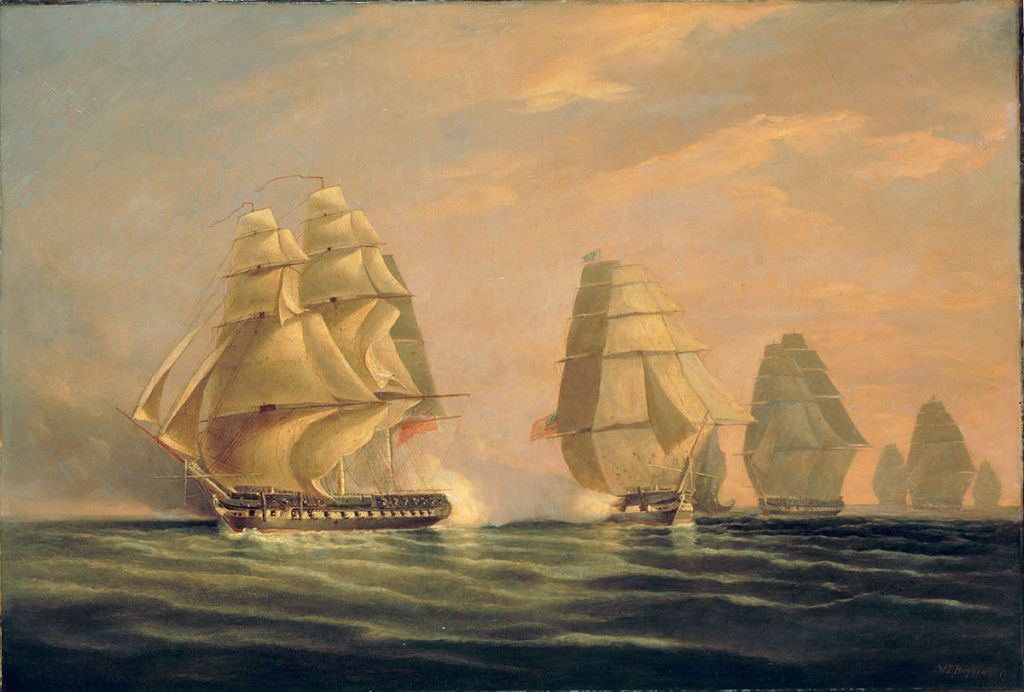
The first naval battle of the War of 1812 (23 June) as depicted by the artist William James Huggins. The HMS Belvidera encountered the USS President and USS United States, along with the sloops Hornet and Argos. The engagement occurred off the northeast coach near New York.
ELCA Commemorations This Week
Note: The ELCA commemorates a wide range of Christians throughout the year as a way of remembering that God has worked through ordinary people in every age. These commemorations — drawn from Scripture, the early church, the Reformation, and more recent history — invite us to see faith lived out in many different vocations and cultures. They aren’t about elevating “heroes,” but about widening our sense of the communion of saints and letting their witness encourage our own. In marking these days, the church pauses to give thanks, to learn, and to be reminded that the Holy Spirit continues to shape faithful lives in every generation.
You will find the full listing of them in the front of the ELW. Explore any via the links provided.

Wednesday 24 June
JOHN THE BAPTIST
Thursday 25 June
Presentation of the Augsburg Confession (1530)
Philipp Melanchthon,renewer of the church (d. 1560)
Saturday 27 June
Cyril, Bishop of Alexandria (d. 444)
Sunday 28 June
Irenaeus, Bishop of Lyons (d. 202)
Going Beyond: In Person and Digital Resources
Explore Living Lutheran
Living Lutheran is the flagship magazine of the Evangelical Lutheran Church in America, offering stories, reflections, and reporting that explore how faith is lived out in daily life. It highlights the people, ministries, and global connections of the ELCA while engaging readers with thoughtful articles on theology, discipleship, justice, and contemporary issues. Designed to inform and inspire, the magazine serves as a gathering place for the diverse voices and experiences that shape Lutheran life today.
Visit the Living Lutheran Magazine Website
If you are seeking a church home or want to participate in our weekly on-line worship, subscribe to our YouTube Channel. All are welcome!
Global Refuge and World Refugee Day
Global Refuge — formerly Lutheran Immigration and Refugee Service — carries forward an 85‑year legacy of welcome that resonates powerfully on World Refugee Day, honoring those forced to fell conflict or persecution (observed each year on 20 June). Since 1939, the organization has walked alongside more than 800,000 newcomers, offering resources, guidance, and a soft place to land as they rebuild their lives in the United States. Their work unfolds against the backdrop of a world in which at least 41.6 million people are refugees and more than 117 million are forcibly displaced worldwide, a reminder of the immense human need that persists (hard to wrap my brain around those numbers). The mission of Global Refuge stands as a testament to compassion in action — helping new neighbors reimagine what’s possible and ensuring that welcome remains a lived, daily commitment.
Visit the Global Refuge Website
