Navigate Two Worlds
- Pentecost 8 Readings
- Five-Minute Homily
- Image of the Week
- Musical Reflection
- ELCA Commemorations
- Going Beyond
Welcome and Thanks for your Visit!
Two Worlds is a digital ministry space featuring the weekly Revised Common Lectionary readings and a brief homily, supported by images, music, and the ELCA’s weekly commemorations. The blog is part of the adult education program at ELC in Black River Falls, Wisconsin.
Note: Image and lay-out tends to land better on a bigger screen.
The excerpt to the right is from Warren’s book, What Grows in Weary Lands: On Christian Resilience (2026). It is an excellent book, and timely!
From Tish Harrison Warren
(Anglican priest and author)

“I’ve come to think that this phrase cheerful seriousness is what it looks like to be a resilient people. This is who the church is meant to be. We are a serious people. We do not pretend that the darkness is any less dark than it truly is. We do not presume that with enough money, technology, fame, or power, we would avoid trouble, death persecution, or pain. We do not act as if the problems in the world or our own lives are easy to solve. We take our relationships with our neighbors and with God seriously. And yet, as Jesus told his disciples to be, we remain, intentionally and authentically, ‘of good cheer.’ The reason Jesus gave his followers for remaining cheerful was not a promise that if they did their duty, all things would go their way or that they would not grow weary. Instead, he promises that ‘in the world you will have tribulation,’ yet we can rest in knowing that he has ‘overcome the world.’ The hope that Jesus has overcome the world is what orients our perseverance. It is what fuels our resilience.”
Pentecost 8 Readings
What is the Revised Common Lectionary?
The Revised Common Lectionary grew out of late‑20th‑century ecumenical work, especially the Consultation on Common Texts, which wanted churches to share a common, three‑year rhythm of Scripture shaped by the seasons of the church year. Each Sunday’s readings are meant to speak to one another: the Old Testament reading sets the theme, the psalm responds to that reading, the epistle widens the theological frame, and the Gospel anchors the day. The RCL also offers alternative first readings — usually a choice between a semi‑continuous Old Testament track that moves through major narratives and a thematic track that ties more directly to the Gospel. In the ELW, you see this in the paired options for the first reading and psalm, giving congregations the flexibility to follow the unfolding Old Testament story or lean into the Sunday’s central theme. You will note I am including an alternative reading this week.
Pentecost 8 (Year A)
First Reading:
Isaiah 44: 6-8
Alternate First Reading:
Genesis 28: 10-19a
Psalm 86: 11-17
Second Reading (Epistle)
Romans 8: 12-25
Gospel:
Matthew 13: 24-30, 36-43
Readings are Linked
Common Themes This Week
Across these readings, God’s people are reminded that the Lord alone is God, the one who speaks truth and remains faithful even when circumstances appear uncertain or unfinished. Whether through Jacob’s dream at Bethel or Isaiah’s proclamation, God reveals a presence that is both near and sustaining, guiding the faithful in the midst of vulnerability. Paul deepens this theme by describing life in the Spirit as a movement from fear to hope-filled endurance, trusting that creation itself is being renewed. Jesus’ parable of the wheat and weeds reinforces that God’s kingdom grows quietly and persistently, calling believers to patience, confidence, and steadfast trust in God’s final justice.
Five-Minute Homily

Spanish philosopher Ortega y Gasset once wrote, “Tell me the landscape in which you live, and I will tell you who you are.” I suspect many reading this feel that truth in the upper Great Lakes region where we live, where the scenery can stop you mid‑stride. This week’s story of Jacob’s dream brought that quote back to me — and with it the power of sacred spaces in our lives. One of mine came far from here: a late‑1970s hike over the Continental Divide on a cool Colorado morning. Out of nowhere, my father — ever the romantic — recited Psalm 121. The moment stunned me. The air, the mountains, the cadence of the psalm — it all felt charged. I honestly sensed God’s presence. Landscapes shape us. Sacred spaces shape us. They become part of our spiritual autobiography.
I’ve been thinking about this especially after reading Heidi Haverkamp’s reflection on the Genesis 28 text in the July edition of The Christian Century (page 26). She reminds us that we have relationships with places — just as we do with people. Certain landscapes, certain buildings, certain corners of the world carry a weight for us not because they are universally holier, but because they are woven into our story. They are where we encountered God, or hope, or grief, or calling. They are where something in us shifted. Jacob marks his encounter with God by naming the place Beth‑El — the house of God. Later in life, after wrestling with the mysterious figure who renames him Israel, he doesn’t mark that ground at all. Not every encounter becomes a monument. But some do. Some need to.
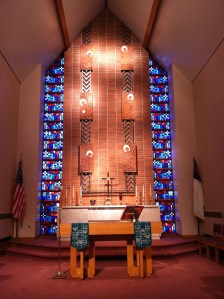
And that brings me to our own worship space at ELC in Black River Falls. When you look up at the carved structure above the altar, it’s easy to see why so many have called it Jacob’s Ladder — a visual echo of that Genesis story. The whole front piece draws the eye upward. Its tiered panels, haloed figures, and words like “ADORATION” and “PRAY” create a sense of movement from earth toward heaven, a kind of worship rising toward God. Whether the artist intended Jacob’s Ladder, the heavenly liturgy, or something else entirely, the effect is the same: the space feels sacred. Not because wood, brick, or stained glass are holier than other materials, but because of what has happened here. Baptisms. Funerals. Communion. Singing. Silence. Prayer. Community. As with so many places of worship, this place has shaped thousands of people.
Haverkamp reminds us that sacred places can become idols if we cling too tightly. But she also says they can be portals to the Spirit — “gates of heaven and houses of the holy.” Not because God is confined here, but because we are. We’re embodied creatures. We live in landscapes. Like our spiritual ancestors, we need places that help us remember who we are and whose we are.
So this week, as we read Jacob’s story again, I invite you to consider the landscapes that have shaped your faith. The places — wild or ordinary, ancient or recent — where you have sensed God’s presence. And I invite you to give thanks for this place, too. Not as the only gate of heaven, but as one of the gates through which God has chosen to meet us. May we honor these places without owning them. May we cherish them without clinging. And may we continue to discover, in the landscapes of our lives, the God who still speaks, still blesses, and still calls us by name.
Soli Deo Gloria.

I am indebted to Heidi Haverkamp for her insights into the Genesis text this week! She helped me reflect on this text. She is an Episcopal priest, spiritual director, and author whose work focuses on helping people notice the sacred in everyday life. A graduate of Seabury-Western Theological Seminary, she has served parishes in Illinois and Indiana and writes regularly for publications such as The Christian Century, Forward Movement, and Living Lutheran. She is also the author of Everyday Connections, a series of devotional books shaped around the Revised Common Lectionary.
Image of the Week

Murillo’s Dream of Jacob becomes even more interesting when you remember who painted it. Bartolomé Esteban Murillo (1617–1682) spent most of his life in Seville, creating warm, devotional images that felt closer to everyday experience than the high drama of other Baroque painters. You see that instinct here: Jacob isn’t posed like a hero, just a tired traveler asleep under a tree, while the ladder rises behind him in a soft glow and angels move with an easy, almost casual grace. Murillo’s gentle light and calm landscape fit the spiritual mood of 17th‑century Spanish art, which often aimed to make holiness feel intimate and accessible. The whole scene suggests that God’s presence doesn’t always arrive with spectacle — sometimes it slips quietly into the edges of an ordinary moment, right where a weary man lays his head.
Musical Reflection

(1949-2014)
Brilliant composer Stephen Paulus wrote Pilgrim’s Hymn in 1995 as part of his larger work The Three Hermits, but the anthem quickly stepped out on its own. It’s one of those pieces that feels both simple and profound — a short prayer wrapped in Paulus’ warm, unmistakable harmonic language. The text leans straight into the mystery of God’s nearness: God hears before we speak, knows before we ask, and meets us in the quiet places where words fall short.
That line — “Even before we call on Your name… You hear our prayer” — lands right in the center of this week’s readings. Isaiah reminds us that God alone is God; Jacob wakes to discover holiness right under his head; the psalmist asks to be taught God’s way; Paul talks about hope that carries us through the groaning; and Jesus’ parable nudges us toward patience while God does the slow work of sorting wheat from weeds. Paulus’ text feels like it could have been lifted straight from this set of scriptures. It’s a gentle way of saying what the lectionary keeps repeating: God is already present, already listening, already working in the places we barely understand.
I hope you enjoy this excellent version from the Minnesota Choral Artists!
Lyrics
Even before we call on Your name
To ask You, O God
When we seek for the words to glorify You
You hear our prayer
Unceasing love, O unceasing love
Surpassing all we know
Glory to the Father
And to the Son
And to the Holy Spirit
Even with the darkness sealing us in
We breathe Your name
And through all the days that follow so fast
We trust in You
Endless Your grace, O endless Your grace
Beyond all mortal dream
Both now and forever
And unto ages and ages
Amen
The Minnesota Choral Artists, led by Matthew Culloton, bring a warm, polished sound and a knack for smart, engaging programming. Under Matthew’s direction — and yes, he’s the brother of Michael Culloton, who conducts the Concordia Choir — the ensemble sings with clarity, heart, and real musical intention. Their performances balance craft and connection, offering audiences choral music that feels both finely shaped and deeply human.
Visit their website for more information!
ELCA Commemorations
Note: The ELCA commemorates a wide range of Christians throughout the year as a way of remembering that God has worked through ordinary people in every age. These commemorations — drawn from Scripture, the early church, the Reformation, and more recent history — invite us to see faith lived out in many different vocations and cultures. They aren’t about elevating “heroes,” but about widening our sense of the communion of saints and letting their witness encourage our own. In marking these days, the church pauses to give thanks, to learn, and to be reminded that the Holy Spirit continues to shape faithful lives in every generation.
You will find the full listing of them in the front of the ELW. Explore any via the links provided.

Monday 6 July: Bartolome de Las Casas, missionary to the Indies (d. 1566)
Bartolomé de Las Casas (1484–1566) was a Spanish Dominican friar who became one of the earliest and most forceful Christian advocates for the rights and dignity of Indigenous peoples in the Americas. Originally a participant in the colonial system, he experienced a profound conversion of conscience that led him to renounce his encomienda, enter the Dominican Order, and devote his life to exposing the brutality of Spanish conquest. Through writings such as A Short Account of the Destruction of the Indies and persistent petitions to the Spanish crown, he argued that Indigenous peoples were fully human, capable of reason and faith, and entitled to justice — positions that challenged both political power and prevailing theological assumptions. The ELCA commemorates him because his witness embodies a Lutheran commitment to neighbor‑love, justice, and repentance, and because his voice continues to call the church toward solidarity with oppressed peoples and honest reckoning with the legacy of colonization.
The accompanying painting is “Fray Bartolomé de las Casas” (1875) by the Mexican artist Félix Parra, and it hangs in the Museo Nacional de Arte in Mexico City. Parra created it during a period when Mexican intellectuals were re‑examining the legacy of Spanish colonization, and the work reflects that historical moment. Las Casas is shown as a solemn, compassionate defender of Indigenous peoples, a visual interpretation of his lifelong struggle against the violence of the conquest. Parra’s style blends academic realism with moral drama: the friar stands at the center, often depicted shielding or advocating for Indigenous victims, making the painting both a tribute and a critique of the complex nature of colonial history.
Going Beyond
Explore Living Lutheran
Living Lutheran is the flagship magazine of the Evangelical Lutheran Church in America, offering stories, reflections, and reporting that explore how faith is lived out in daily life. It highlights the people, ministries, and global connections of the ELCA while engaging readers with thoughtful articles on theology, discipleship, justice, and contemporary issues. Designed to inform and inspire, the magazine serves as a gathering place for the diverse voices and experiences that shape Lutheran life today.
Visit the Living Lutheran Magazine Website
If you are seeking a church home or want to participate in our weekly on-line worship, subscribe to our YouTube Channel. All are welcome!
The Henri Nouwen Society

The Henri Nouwen Society exists to carry forward the spiritual vision of Henri J.M. Nouwen, inviting people into a deeper awareness of themselves as God’s Beloved. Through daily meditations, podcasts, online retreats, and accessible resources, the Society helps new generations engage Nouwen’s themes of vulnerability, compassion, and contemplative living. Its work continues to nurture communities seeking a more grounded, grace‑filled spiritual life.
